Last Friday night, global markets suddenly experienced a "night of plummeting": the Nasdaq fell nearly 2%, gold crashed from high levels, and Hong Kong stock futures followed with a sharp decline. People attributed this to Oracle's negative tech news and a technical adjustment due to "over-inflation".
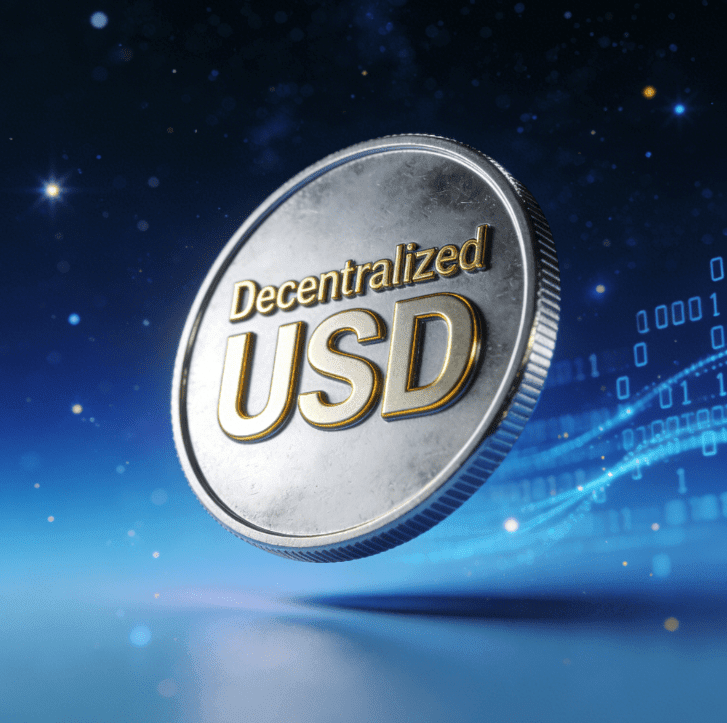
However, beneath this surface turbulence, a deeper and more enduring monetary variable is playing a key role—Decentralized USD. This new concept, translated as "decentralized dollar", is reconnecting traditional financial markets with the crypto world in ways that most people have yet to notice, and it could fundamentally change the logic of future volatility.
A neglected resonance source
Traditional analysis often overlooks the fact that the currently massive USD stablecoin market has become a new resonance source connecting traditional financial markets and the crypto world.
Represented by USDC and USDT, the “on-chain dollar credentials” have more than $150 billion in assets backing them, most of which are short-term U.S. Treasuries. Research from the Bank for International Settlements indicates that only $3.5 billion in stablecoin fund flows can significantly affect the yield on 3-month U.S. Treasuries within 10 days. This means that a previously marginal crypto market can now shake the cornerstone of global asset pricing—the U.S. Treasury market.
When news from Oracle raises concerns about tech stocks, this concern first spreads to the U.S. stock market and then rapidly extends to the U.S. Treasury market, while the volatility of U.S. Treasuries then transmits instantly to the entire crypto ecosystem through the massive reserves of stablecoins.
The real “decentralized dollar” experiment is facing a test
A more pure Decentralized USD experiment, such as USDe, which does not rely on U.S. Treasury reserves and maintains its peg through algorithms and over-collateralization, is facing another layer of examination.
The stability of this type of currency highly relies on the funding rates and liquidity of the derivatives market. When global risk assets experience a sell-off, market volatility sharply increases, which may put pressure on their complex hedging mechanisms. Every severe shock in the global market serves as a “stress test” for these Decentralized USD protocols—testing whether they can genuinely maintain independence and stability when issues arise in the traditional financial system.
Policy-driven monetary experiments
Looking deeper, the recent regulatory framework promoted by the U.S. is trying to reshape the future form of Decentralized USD. Regulatory measures like the (GENIUS Act) clearly send the signal that future compliant stablecoins will be required to strictly limit reserve assets to cash and U.S. Treasuries, and they must not pay interest to holders.
This is essentially a strategic design: by converting global demand for “on-chain dollars” into sustained purchasing power for U.S. Treasuries, the dominance of the dollar is extended into the blockchain realm. And prohibiting interest payments is intended to protect the traditional banking system from shocks.
The competition of two paths
The current development of Decentralized USD is showing two clear paths:
One path is the “compliant stablecoin” route, following the model of USDC, becoming an on-chain distribution channel for U.S. Treasuries, fully integrated into the existing financial regulatory system.
Another path is the “crypto-native dollar,” as explored by projects like USDe, attempting to establish an independent currency system that does not rely on traditional banks and U.S. Treasuries.
The market turmoil this weekend highlights the different challenges facing these two paths: the former increasingly resonates with the traditional financial system, while the latter faces stability tests in extreme market conditions.
Insight: Reinterpreting market correlation
For investors, this evolution brings important insights:
Asset correlation reconstruction: The correlation between cryptocurrencies and traditional assets has never been so tight. Understanding U.S. Treasury yields, Federal Reserve policies, and geopolitical games has become a necessary condition for analyzing the crypto market.
The evolution of the concept of safety: What is a “safe asset”? In times of turmoil in traditional finance, truly decentralized and censorship-resistant Decentralized USD may offer new hedging options.
Focus on long-term narratives: Behind the short-term fluctuations of the market lies the long-term trend of the evolution of currency forms. Decentralized USD, as a key interface connecting two worlds, will profoundly impact the financial landscape of the next decade.
The turmoil this weekend is not merely a technical adjustment or a reaction to a single negative factor. It reveals a profound reconstruction that the global financial market is undergoing: a new monetary era driven by Decentralized USD is approaching, and all of us, whether we realize it or not, are already part of it.
@USDD - Decentralized USD #USDD以稳见信