
Have you ever been annoyed by those so-called community managers who only shout 'To Da Moon'? In the noisy marketplace of Web3, too many projects simplify 'community operation' into cheap PR noise: posting a few memes, holding a few giveaways, shouting a few slogans, and then claiming to have community consensus.
YGG chose a completely different path from the very beginning.
In its design, 'community' is not just a tool for retaining users, but one of the most important production factors of the protocol. The Ambassador Program is not about finding a few people to help post announcements, but about building a human network similar to multinational corporations' 'global embassies':
Systematically upgrade core players from pure consumer roles to ecological evangelists + operational partners.
This is not just traffic operation, but a social experiment with clear incentive mechanisms and governance structures:
Verifying whether the core moat of DAO is code or the globally distributed human nodes.
I. Industry Pain Points: Global Ambitions vs Local Implementation
What GameFi wants to do is 'a global economic system shared by players', but in reality, there are three obvious fractures:
Language and cultural differences: Filipino players, Venezuelan gold miners, Chinese speculators, have completely different understandings of the same game.
Payment and infrastructure differences: The chains, wallets, and fiat currency entrances in different regions are completely different.
Communication mode differences: Discord, Telegram, Twitter, Douyin, the main battlegrounds in each region are different.
The white paper pointed out early on:
If DAO wants to become the largest virtual world economy, it cannot rely on 'main portal + a white paper' to govern the world, but must depend on:
Functional Team
Community Manager
Localized Ambassador
To solve the 'last mile' problem of protocol implementation.
YGG's ambassador program is essentially a 'human Layer 2' protocol:
Through token incentives, organize players familiar with local culture to solve compliance, education, and communication issues that on-chain code cannot address.
II. Mechanism Design: The closed loop from contribution to reward
The ambassador program is not just a 'welcome to volunteer', but a complete 'contribution—proof—settlement' system.
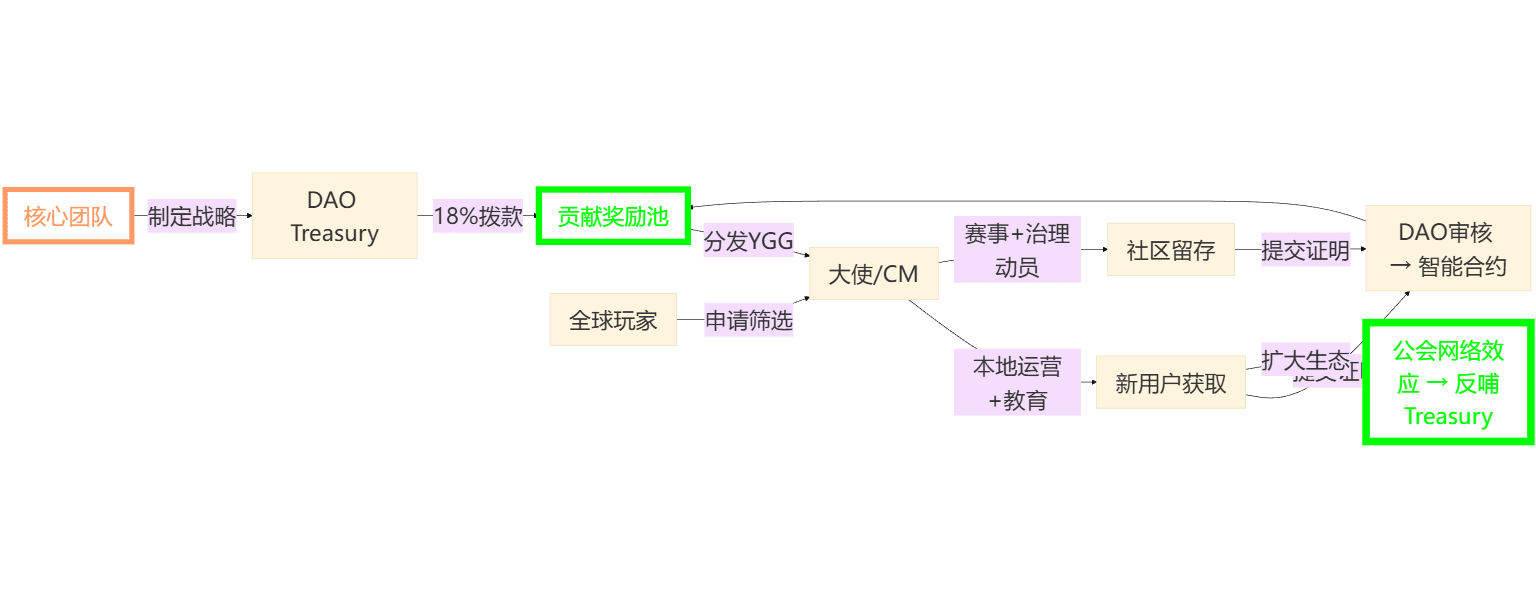
It can be seen that this is a standard DAO-level 'business pipeline':
Core Team formulates strategies, DAO Treasury allocates funds
Global players apply/select to become ambassadors or community managers
Ambassadors are responsible for localized operations, educating newcomers, organizing activities
Submit results in the form of 'proof of work' to DAO
After DAO review, YGG tokens are issued from the 'contribution reward pool' through smart contracts
New users joining, guild scale expanding, in turn enhancing DAO's financial capacity
This design is no longer 'the project party pays salaries', but:
Proof of contribution on-chain
Incentive rules written into token distribution
Settlement completed through smart contracts
Labor relationships have been protocolized.
III. Budget Structure: 80 million tokens are not a cost, but a human capital investment
Many people focus on 'how much the team occupies, how much the investors occupy' when looking at token distribution, but overlook YGG's layout in 'human capital'.
According to the early disclosed allocation plan:
80,000,000 YGG tokens (approximately 18% of the total)
Specifically used for DAO Management—clearly marked as:
"Rewards for contribution of work"65,000,000 YGG tokens (approximately 14%)
As the Growth budget, for:
New game promotion, event rewards, airdrop guidance, and other growth expenditures
These two parts combined form the 'compensation pool' of the ambassador system:
DAO Management: can be seen as 'base salary, long-term incentives'
Growth: can be seen as 'performance bonuses, growth commissions'
Compared to traditional businesses, this is an on-chain OPEX (operational expenditure) model, where salaries are not paid through banks but through DAO issuing tokens.
For token holders, this 80 million is not consumed administrative expenses, but a long-term investment in network effects and growth curves.
IV. Differences from 'Volunteer Model': This is a professional global team
Unlike many projects relying on 'volunteers', 'moderators', 'temporary CMs', YGG's ambassador system itself has:
Clear role definitions: Ambassador / Community Manager / Game Master
Verifiable on-chain incentives: contribution linked to rewards
Clear boundaries of responsibility: education, content, activities, governance mobilization
The white paper lists multiple core contributors:
Mia Bao from China
Elle and Kookoo from the Philippines
Researchers/content creators from Canada and other places
These people themselves are KOLs, researchers, content producers in their respective regions:
Someone is responsible for writing localized NFT / DeFi research newsletters
Some are high-frequency content creators, streamers, educators
What YGG is doing is very much like a 'community acquisition':
There is no need to recruit everyone as employees, but to connect them along with the community trust behind them to the protocol through the ambassador program.
Tokens are the acquisition price, and roles are a form of long-term authorization.
V. Governance and Feedback: Ambassadors are the 'nerve endings' of the DAO
From a governance structure perspective, ambassadors are not just 'task executors', but bidirectional neural nodes:
Downward:
Translate DAO's decisions into languages and activities that local players can understand (such as local language tutorials, AMAs, esports competitions, in-person meetups).Upward:
Organize players' feedback, pain points, new game demands, SubDAO proposals, and economic design issues, and relay them back to the core team and governance forum.
YGG gave ambassadors titles like 'Game Masters', essentially doing one thing:
Expand the governance radius of the DAO.
The core team can be very small, but through the ambassador 'human network', governance radius can cover:
Multilingual countries
Different income groups
Different gaming cultural layers
This is a low-cost, high-resilience organizational method.
VI. What does it mean for token holders? Understanding 'Ambassador Program = Long-term Moat'
From the perspective of token holders, the value of the ambassador program lies in:
It adds a layer of 'human network' support behind each YGG token
It breaks down the operational, educational, and promotional costs that originally needed to be borne by companies and distributes them to 'local partners' globally
It migrates growth, branding, user education—traditional Web2 areas—into a verifiable Web3 incentive system
When you see:
A small language country you have never heard of hosting a YGG competition
A marginal market suddenly emerging with a batch of highly active players
A region without traditional financial infrastructure appearing complex gameplay like Yarn, Scholar, etc.
It is very likely that there is an ambassador behind whom you do not know.
And his/her incentives come from the portion of YGG tokens that you hold.
You can be just a token holder 'served' by this network,
or choose to enter this system and become part of the network:
If you have an advantage in local language
Or you excel in content, education, organizing activities
Or perhaps you already have a strong voice in a certain game
Then, the ambassador program offers a path to 'ecological partners'—
Using your time, skills, and influence to exchange for higher weight in the YGG economy.
In this sense, the ambassador program is not only building a community, but also constructing a set of human infrastructure that can be driven and governed by tokens.
I am a sword seeker on a boat, an analyst who looks at essence and does not chase noise.
