
In the world of trading, success is not limited to what you trade, but extends crucially to when you make the decision.
The idea may be correct, the analysis sound, and the risk management disciplined… yet the deal ends in a loss simply because the timing was wrong.
⸻
First: Why is timing a crucial element?
The market does not move in a straight line, but in waves.
Entering late means buying at the top or selling at the bottom, while entering early means enduring fluctuations that your psyche or capital may not be able to tolerate.
The golden rule:
The market may give you the same idea more than once, but it rarely gives you the same timing twice.
⸻
Second: The difference between the accuracy of the analysis and the accuracy of the timing
Many traders say:
“My analysis was correct, but the deal hit the stop loss!”
This is an indirect admission that analysis alone is not enough.
The correctness of the direction does not mean the correctness of the entry point.
A common example:
• The trend is upward ✔
• Entry was at a strong resistance level ✖
• Result: A natural correction that gets you out of the trade before the price completes its upward climb.
⸻
Third: Timing and Capital Management
The more accurate the entry time:
• Small stop-loss
• The risk-reward ratio has increased
• Reduce psychological stress during the transaction
Good timing not only increases profits, but also protects the account from depletion.
⸻
Fourth: Timing and Momentum
Entering into a deal without momentum is like pushing a parked car down a gentle slope:
• Requires more energy
• It may regress at any moment
The correct timing is often:
• After a clear break
• Or after retesting
• Or with confirmation of momentum (volume – strong candle – acceleration)
⸻
Fifth: Common timing errors
1. Fear of missing out (FOMO)
Late entry after a strong move.
2. Market revenge
Entering quickly after a loss without waiting for a clear opportunity.
3. Trading during times of low liquidity
Where the movements are deceptive and the vibration is high.
⸻
Sixth: Timing and discipline
A good deal is not measured by its quantity, but by the quality of its timing.
Waiting is a true trading skill, not a weakness.
sometimes:
• The best deal is the one you didn't enter
• The most valuable decision is patience.
⸻
a summary
Trading is not a race of speed, it's a race of timing.
And whoever masters timing:
• Reduces losses
• Improves results
• And it stays in the market longer
The right idea at the wrong time = a loss
The right timing for a good idea = an opportunity
⸻
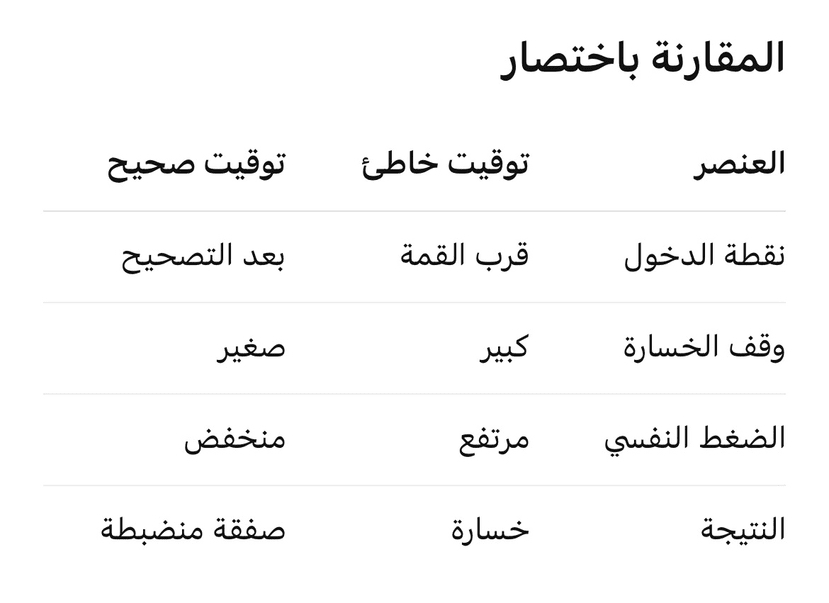
Practical example: How timing makes a difference in trading (gold example)
Let's assume the following scenario on the XAUUSD (Gold) pair – 15-minute timeframe:
First scenario: Correct analysis – wrong timing ❌
General trend: Upward ✔
The price approached a strong previous peak.
The trader enters a buy order motivated by fear of missing out (FOMO).
What's going on?
The price is declining by 80-120 points (normal correction).
Hit the stop-loss
Then… gold continued its upward trend as expected.
Result
The direction was correct, but the timing was wrong.
Second scenario: Correct analysis – Correct timing ✅
Same upward trend ✔
The trader is waiting for a correction.
The price returns to:
Previous support
or moving average
Or an important Fibonacci level
An engulfing candle or a clear momentum signal appears
Login:
Purchase from the support area
Stop loss small below support
Aim for a profit that is two or three times greater than a loss.
Result:
Less risk
Earn faster
Less psychological stress
practical lesson
The market doesn't just punish you for wrong analysis,
In fact, it punishes you even more for being hasty.
Late arrival = paying the price for your haste
Entering at the right time = rewarding your patience
🚀 Timing is king: Your secret key to profitability in the financial markets
Did you know that the difference between a successful trader and a loser lies not only in knowing the direction of the market, but also in mastering the "value of timing"? In the world of trading, timing is not just an hour or a minute, but the wisdom that makes you ahead of everyone else.
Why is timing worth money?
Timing in trading is the art of making decisions at the perfect moment that gives you the highest probability of profit and the lowest probability of loss.
Entry into a trade: Optimal price and excellent timing mean buying at the end of a correction period or the moment a true breakout is confirmed. When you enter at the right time, you secure the best price, giving you a wider safety margin and reducing the distance to your stop-loss point – the essence of risk management.
Exiting the trade: Protecting profits. Unrealized profits are just numbers on a screen! Timing here means knowing exactly when to hit the "sell" button. Exiting before a reversal ensures you retain maximum profits. Staying in the trade after it's too late is a sure recipe for turning profits into losses.
Understanding market cycles, a skilled trader with good timing knows when to buy quietly during an accumulation phase when pessimism prevails, when to ride the upward momentum wave, and, most importantly, when to sell assets during a distribution phase before the price collapses. They don't chase prices; they capitalize on the cycles.
Reacting to news with timing is crucial when dealing with earnings reports or major economic data. It's not about trading immediately after the news (which is often characterized by extreme volatility), but rather waiting a few moments after the market has absorbed the news to confidently determine the new direction.
Ultimately, good timing prevents you from falling into the trap of false gains and protects you from making emotional decisions based on fear or greed. Timing is discipline, and discipline is sustainable profit.
#TradingTips#CryptoTiming#BinanceSquare#RiskManagement#TechnicalAnalysis#Cryptocurrencies#TradingStrategies #Bitcoin
#Trading
#CryptoTrading
#BinanceSquare
#TechnicalAnalysis
#RiskManagement
#TradingPsychology