
On November 18, 2025, Kite's test network recorded a very typical 'weight reversal' at block height 18,345,092:
A small meteorological data node that only staked 5,000 KITE tokens saw its daily reward exceed that of a passive validating node holding 2 million tokens for the first time.
This is not a vulnerability, but rather the result of PoAI (Proof of AI) + Data Shapley fully functioning for the first time.
While traditional PoS still rewards the simple holding behavior of 'the more money you have, the higher your earnings', Kite begins to measure the size of 'intelligent contributions' with algorithms—
Consensus shifts from 'capital-based' to 'contribution-based', directly altering the interest structure among nodes, developers, and AI agents.
1. Kite aims to correct the 'allocation distortion' of PoS, not to deny PoS.
Kite has not abandoned PoS but has layered PoAI on top of PoS:
PoS layer:
Responsible for Sybil protection and economic security; the more staked, the higher the cost of being slashed, making attacks harder.PoAI layer:
Responsible for value distribution, changing 'block rewards + x402 returns' from a single staking weight to staking × intelligent contribution factor.
In the traditional PoS system, several structural issues that Kite focuses on are very obvious:
Large nodes occupy most of the staking rights for a long time, leading the network towards oligopoly;
Small nodes that truly provide quality data, models, and services lack economic returns and are discouraged early on.
Faced with the AI regulations on 'data sources and responsibility attribution', PoS can hardly provide any verifiable proof of contribution.
Kite's goal with PoAI is very straightforward:
Continue to use PoS for security, but no longer allow 'lazy capital that only puts in money without effort' to occupy network dividends for a long time.
2. Data Shapley: Kite uses game theory to price 'intelligent contributions'
The core of PoAI is not a new slogan, but Kite introducing the Shapley value into consensus economic distribution:
The Shapley value comes from cooperative game theory and is used to measure a participant's 'marginal contribution' to overall value;
Kite has implemented this idea into Data Shapley:
– If a certain AI agent or data node is removed, how much will the overall efficiency of the network decline?
– This difference is the contribution weight that the node should receive.
In Kite's PoAI model, the actual reward weight of each node can roughly be abstracted as:
Reward weight ≈ staking amount × contribution multiplier (calculated by Data Shapley)
Thus:
Nodes that only stake without providing services can only receive the baseline part of 'pure staking rewards';
Nodes that provide high-value reasoning, data, and models will receive a larger share due to a higher contribution multiplier;
Small nodes without capital advantages can also 'surpass' large nodes on the rewards leaderboard as long as they contribute unique and irreplaceable data.
Kite uses PoAI to force validators back from being 'rent-seekers' to 'real service providers'.
3. How does Kite implement this entire process on-chain?
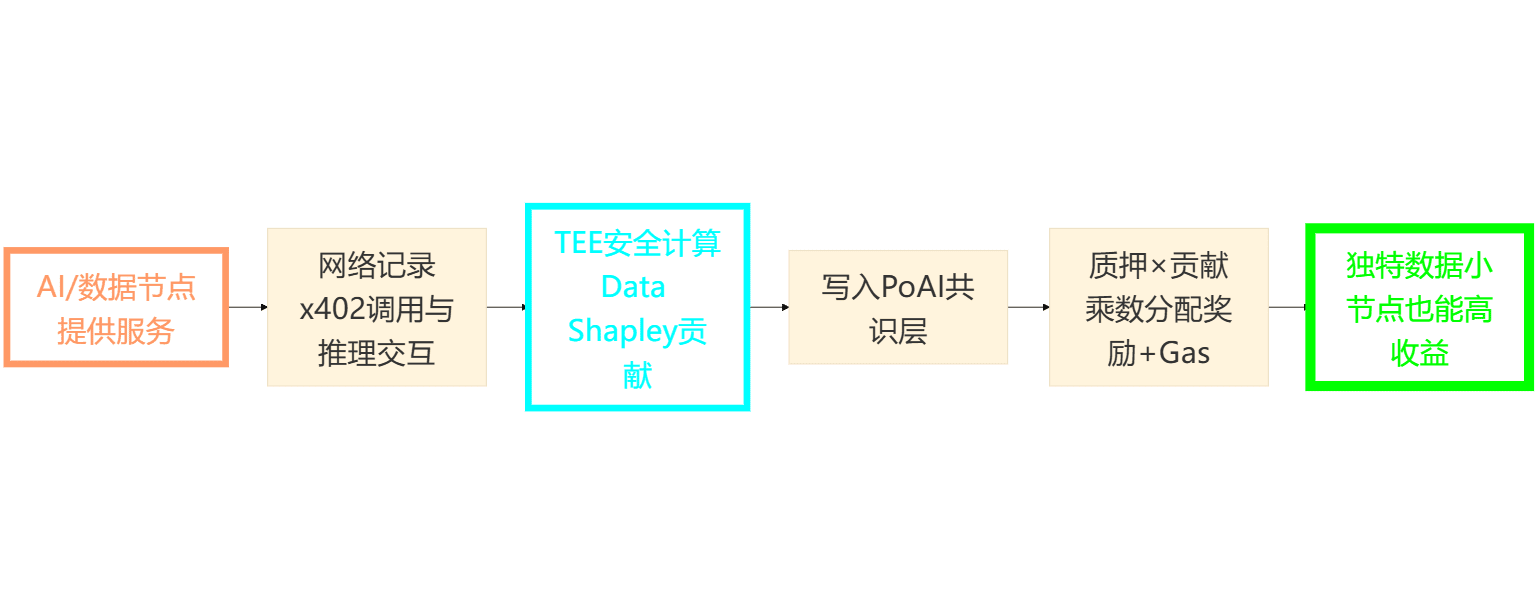
Kite has not made PoAI a bypass logic that 'only runs during block production', but has deeply embedded PoAI into every call of the x402 protocol:
Every time an x402 request occurs,
Kite records: which agent initiated, which data sources were called, which models were used, and how much computational power was consumed.In a trusted execution environment (TEE) off-chain,
Kite performs Data Shapley calculations for this round of interaction, estimating the marginal contributions of different nodes.The calculation results are written back to the consensus layer in the form of contribution weights,
affecting the distribution ratio of PoAI rewards for this round/period.Ultimately, the block rewards + fees generated from x402,
are automatically settled among nodes according to the formula 'staking × contribution multiplier'.
4. Testnet data: when rewards truly flow to 'builders'
In the Kite testnet v2 phase, several phenomena after introducing Data Shapley weights are very representative:
Decline in revenue concentration:
After introducing PoAI for three weeks, the reward distribution concentration in the Kite test network has significantly decreased,
with more revenue flowing to nodes that truly provide services rather than just passive large nodes accumulating stakes.Improvement in developer retention rate:
Active developers find that 'writing a good high-value agent and connecting good data sources',
brings returns that can exceed simply increasing their stake, so they choose to stay and continue building.Token prices and 'intelligent activity volume' begin to correlate:
As the number of x402 calls and effective reasoning increases,
the value of KITE begins to reflect the network's 'intelligent GDP' (effective computational volume + effective data flow) more,
rather than just simply following macro market fluctuations.
For institutional investors focusing on ESG, fairness, and transparency, this model of 'earning rewards by contribution' is more easily incorporated into long-term allocation frameworks:
Kite has natively encoded the rule of 'whoever really does the work has the right to earn rewards' in the consensus layer.
5. The significance of PoAI to the agent economy: Kite has turned 'intelligence' into a billable asset.
If we consider PoW as pricing for electricity and PoS as pricing for capital,
then what Kite is doing with PoAI is attempting to price 'intelligent contributions':
AI agents, data nodes, and model providers are no longer just 'tools', but economic entities with independent rights to revenue;
Every inference, every piece of data, and every collaborative call will form a billable record in Kite's ledger;
The entire network operates like an automatically functioning economy, executing 'distribution by contribution' through code.
For participants on CreatorPad focusing on Kite, the more important aspect is cognitive upgrading:
Is it investing in a 'high TPS public chain' or a new economic system that incorporates data value into the consensus layer?
Are you looking at short-term price fluctuations or the continuous growth of 'real intelligent activity volume' on the network?
In Kite's PoAI design, fairness is no longer just a slogan, nor a moral judgment made arbitrarily,
but a mathematical conclusion locked on the chain by the Data Shapley algorithm and consensus rules.
Risks and warnings
Mechanisms like PoAI, Data Shapley, etc., are still in the continuous refinement and iteration stage; testnet data cannot be equated with long-term performance on the mainnet;
Any token-related content is for illustrative purposes regarding economic model design and does not constitute investment advice or profit guarantees;
Before participating in the Kite ecosystem, individuals still need to complete their own due diligence (DYOR) to understand technical risks, consensus risks, and market risks.
I am a sword seeker on a boat, an analyst who only looks at essence and does not chase noise. @KITE AI $KITE #KITE


