
The excitement lies in the transformative potential of applying blockchain technology to traditional and financial asset classes, completely reshaping financial markets.
* Increase liquidity and global reach:
* Converting traditionally illiquid assets (such as real estate, private equity, and luxury goods) into digital tokens that are fractionalizable and tradable 24/7. This opens up new secondary markets and significantly increases liquidity.
* Democratic access: Fractional ownership allows individual investors to buy small shares of expensive assets that were previously exclusive to institutions, opening investment opportunities to a wider audience.
* Operational efficiency and cost reduction:
* Blockchain infrastructure and its smart contracts allow for near-instant settlement of transactions (as opposed to traditional settlement which may take days T+2).
* Many processes that require intermediaries and manual procedures (such as property transfers, distribution of returns, and bond bonuses) are being automated, reducing operational costs and risks.
* Transparency and security:
* Recording ownership and transactions on the blockchain provides a transparent and immutable record, enhancing trust and reducing fraud.
* Market capitalization growth:
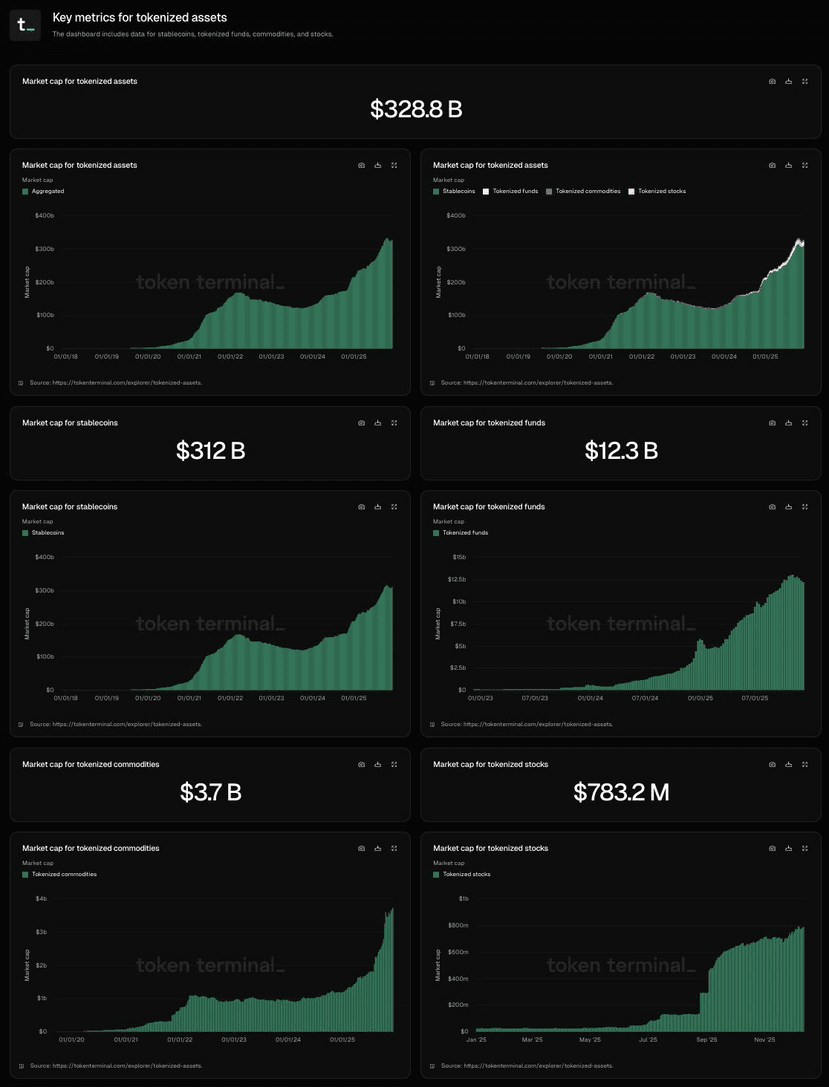
* The figures in the chart indicate that the market value of tokenized assets has surged dramatically to nearly $329 billion, highlighting strong institutional and investment interest, especially in the stablecoin sector, which is foundational to digital financial infrastructure.
* There is enormous growth potential in sectors such as tokenized funds ($12.3 billion), tokenized commodities ($3.7 billion), and tokenized stocks ($783.2 million), where the market size is expected to reach trillions of dollars by 2030.
In short, "tokenized assets" are not just a technological innovation, but a revolution in the way assets are owned, managed, and traded globally, promising a more efficient and inclusive financial future.
