In 2025, the public blockchain sector of the cryptocurrency market experienced significant differentiation. BRC fluctuated with resilience in ecological narratives, ETH relied on Layer 2 dividends for support, and SOL was stabilized by institutional funding. However, TON, backed by the Telegram ecosystem, faced a downward trend, becoming the 'dead weight' of the public blockchain sector for the year. It plummeted from $2.8 at the beginning of the year to a low of $1.59 by year-end, a decline of over 80% from its historical high of $8.25, with a market value shrinking by more than 70%. The total value locked (TVL) in the ecosystem dropped sharply from $770 million to $170 million. This collapse was by no means accidental; it was a quadruple resonance of systemic pressure in the market, structural flaws in the token, a disconnection in ecological value, and negative regulatory repercussions. The so-called advantage of 1 billion user traffic completely failed in the face of fundamental deficiencies.
1. Market Linkage + Concentrated Chips, Selling Pressure Like a Mountain Difficult to Support
The interconnectivity of the crypto market will be fully demonstrated in 2025, while the structural flaws of TON's chips exacerbate its troubles during downturns. The total market value of cryptocurrencies saw multiple rounds of adjustments throughout the year, especially on the day in December when TON fell to 1.59 dollars, the total market value also fell by 2.19%. The risk-averse sentiment triggered by the core assets like Bitcoin adjusting directly affected TON, which lacks independent value anchor points. Even more fatal is its distorted chip distribution: 68% of the supply is concentrated in the hands of whales, while nearly 99.9% of retail investors' holdings account for only 3.2% of the circulation, making the market easily swayed by large transactions.
Starting from November 2025, the monthly release of 37 million TON tokens will become a continuously released 'selling pressure bomb', coupled with the TON strategic company board members selling related stocks worth 560,000 dollars continuously from late November to early December, further intensifying market panic. Even if the project party stakes 82% of the TON reserves to stabilize the market, it is still difficult to withstand the dual selling pressure brought by whale sell-offs and unlocks, ultimately forming a vicious cycle of 'market decline—whales fleeing—retail investors trampling'.
2. The Dilemma of 1 Billion Traffic: From Viral Spread to Activity Exhaustion
Backed by Telegram's 1 billion monthly active users and an average daily usage time of 41 minutes, the traffic advantage was supposed to be TON's most core narrative support, but the reality in 2025 is a complete disconnection between traffic and value. In the early days, through viral spread of mini-games like Catizen and Notcoin, TON once achieved a peak of 2.5 million daily active addresses, but this reliance on the 'Tap To Earn' model for growth lacks sustainability—as airdrop incentives recede, the proportion of real users continues to decline, with a retention rate dropping to the industry's lowest point. By the end of the year, daily active addresses had sharply decreased to 137,000, a drop of over 94%.
The so-called 'traffic conversion' is more of a false prosperity supported by traffic manipulation and '毛党', with less than 1% of the 900 million Telegram users being aware of TON, and less than 0.1% actually using ecological applications. Even if TON becomes Telegram's exclusive blockchain partner, requiring all small applications to migrate to its ecosystem, and launching a compliant custody wallet in Uzbekistan to connect with 27 million local users, it has failed to activate real demand—after the new wallet was launched, it brought in less than 100,000 new users, most of whom were for testing purposes, failing to form a scale effect. After the traffic dividend was exhausted, the activity of the ecosystem sharply shrank, with daily trading volume falling from a peak of 2.3 billion dollars to 320 million dollars, a drop of 86%.
3. Ecological Hollowing: Apart from mini-games, there is nothing else.
The root cause of the failure of traffic conversion is the severe hollowing out and imbalance of development in the TON ecosystem. Compared to ETH's diverse layout in DeFi and Layer2, and SOL's breakthroughs in NFTs and institutional applications, TON's ecological narrative has always been limited to Telegram's mini-games, with a single track that is severely homogenous. In the DeFi sector, apart from a few leading protocols like STON.fi, there is a lack of competitive projects, with only 13 projects having a TVL of over ten million dollars, and these are highly concentrated in the liquidity staking track, making the overall ecosystem's risk resistance very weak.
The technical barriers further limit the vitality of the ecosystem, as TON's unique programming language and architectural design are not friendly enough to developers, resulting in a 45% year-on-year decrease in new developers in 2025, with innovative momentum continuously depleting. Although at the end of the year, STON.fi launched a DAO governance mechanism in an attempt to activate the ecosystem through community participation, the proposals corresponding to the 5.6 million users were mostly focused on experience optimization, lacking breakthrough ecological upgrade plans, failing to change the imbalanced pattern of 'resources concentrated in a few leading applications, and small and medium projects lacking support'. This 'one-legged walking' ecological structure, naturally cannot support the previous valuation bubble after the traffic dividend recedes.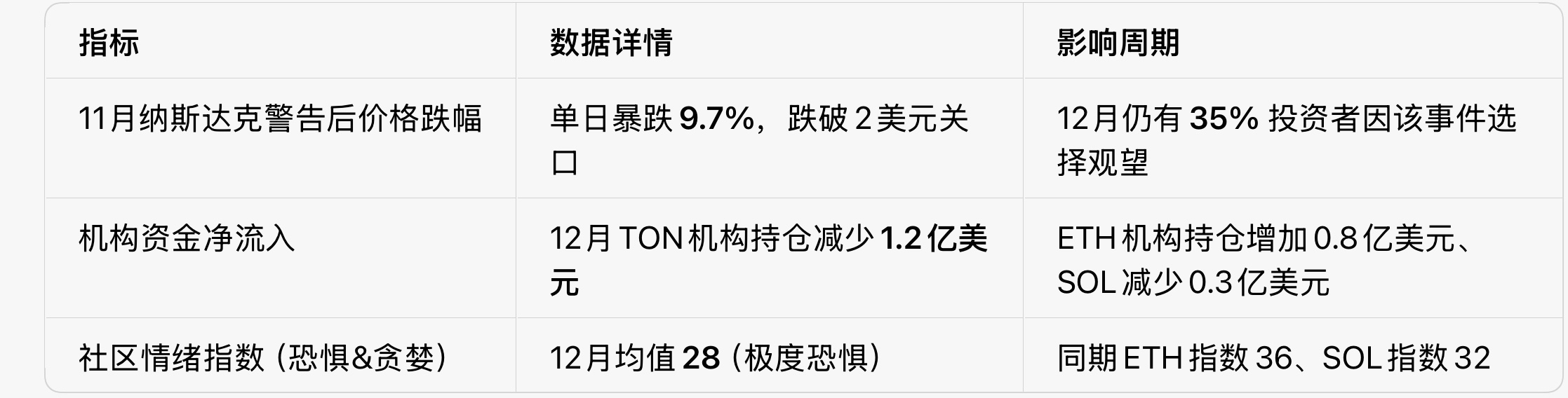
4. Regulatory Negativity + Governance Controversy, Confidence Collapse Hard to Recover
The trust crisis of TON in 2025 persisted from the beginning of the year to the end, with regulatory negativity and governance controversies continuously eroding market confidence. In November, Nasdaq condemned the 558 million dollar private placement transaction of TON Strategy Co., pointing out that it used nearly half of the funds to acquire TON without shareholder approval, violating equity issuance rules, directly triggering a single-day drop of over 5% in TON, breaking the key support level of 2.16 dollars. Although the exchange did not propose delisting, this incident raised doubts among institutional investors about its compliance, leading to a net outflow of over 120 million dollars in institutional funds throughout the year, becoming an important driver of the price decline.
The controversies at the governance level have further exacerbated market concerns. Major changes in the management of the TON strategic company occurred after compliance turmoil, and the lack of transparency in the new team's strategic adjustments, combined with board members selling shares at high positions, has left investors lacking confidence in the project's long-term development. The market panic triggered by the arrest of Telegram founder Durov has not completely dissipated, leading to a chain reaction of 'negative news—panic selling—price plummeting' multiple times throughout the year, and even though top venture capital firms like Sequoia Capital previously provided a financing endorsement of 400 million dollars, it has not reversed the market's pessimistic expectations.
Conclusion: The endgame of traffic narrative ultimately returns to value itself.
TON's 2025 is a typical case of 'playing a good hand poorly'. It has proven throughout the year: without a healthy token structure, without diverse ecological support, and without a stable compliance foundation, even the largest traffic is just a mirage. Telegram's 1 billion users, top venture capital backing, and the narrative halo of exclusive cooperation ultimately became 'paper benefits' that could not be realized in the face of hard injuries, such as concentrated chips, hollowed-out ecosystems, and regulatory controversies.
For the crypto market, TON's collapse is a wake-up call: traffic does not equal value, and narrative cannot replace fundamentals. The core competitiveness of public chains ultimately needs to return to technological innovation, ecological prosperity, and compliance stability. Stories about traffic that are detached from these foundations, no matter how beautiful they sound, can only be fleeting. TON in 2025 has already become a 'drag' in the public chain race. If it wants to reverse the decline in 2026, relying solely on Telegram's traffic empowerment is far from enough. Only by achieving substantial breakthroughs in optimizing token structure, diversifying the ecosystem, and compliant governance can it truly activate the potential value of 1 billion traffic. Otherwise, it will only walk further down the road of 'dragging down'.#TON $TON