
In the past six months, the price movement of Ethereum may have left you feeling confused, but the real story lies hidden in little-known institutional filing documents. While the retail market is still entangled in short-term fluctuations, a group of institutional whales known as 'Digital Asset Treasuries' (DATs) are quietly consuming ETH at a historic rate.
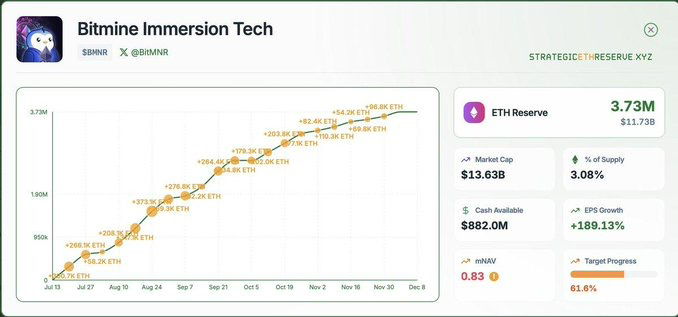
1. Data does not lie: This is a silent transfer.
Let's look at the core data:
The total accumulation has surpassed 5.1 million ETH, and the holding curve has been steadily steeply rising over the past six months.
Among them, BitMine Immersion Technologies (BMNR) stands out, holding approximately 3.9 million ETH, making it one of the largest enterprise-level ETH holders globally.
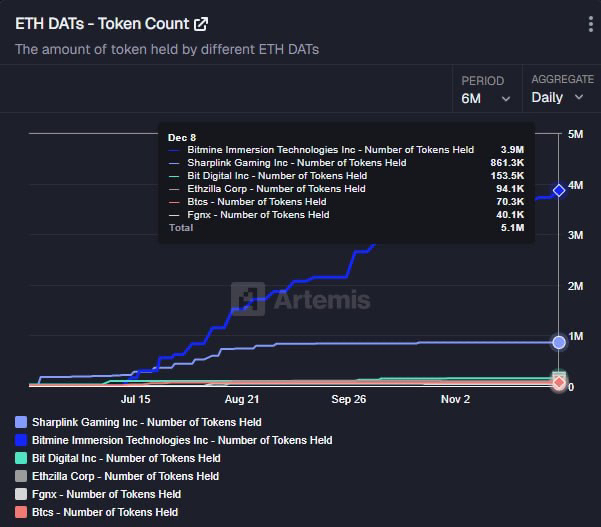 Other well-known institutions like Sharplink Gaming and Bit Digital are also continuously increasing their holdings.
This is not an action of scattered soldiers but an organized asset transfer from 'weak hands' to long-term corporate treasuries. More critically, this accumulation has never ceased, even during periods of retail sentiment hesitation, demonstrating a firm determination completely decoupled from market sentiment.
2. Institutions vote with real money: the stark ratio of 359:4
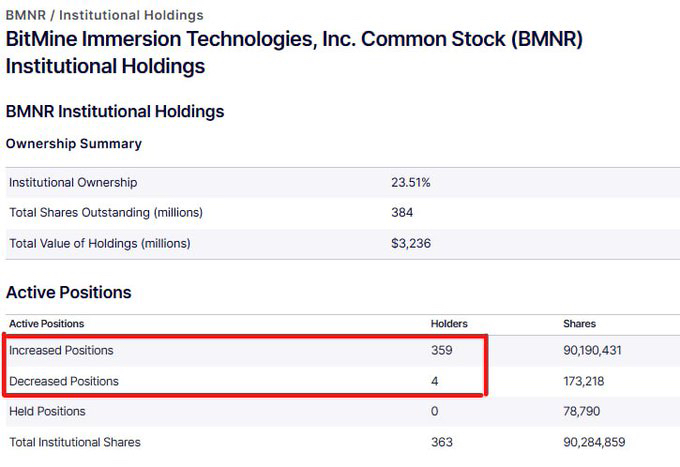
True confidence is reflected at the equity level. The Nasdaq Q3 filing reveals a startling fact:
359 institutions increased their holdings in BMNR stocks, while only 4 reduced theirs.
Net inflow exceeds 90 million shares, and institutional ownership has surpassed 23%.
The 359:4 increase ratio is extremely rare in institutional behavior. This clearly indicates that large capital is not speculating on concepts but is strategically positioning itself for long-term exposure to the ETH ecosystem. BMNR has become the 'proxy asset' for many traditional institutions to compliantly gain exposure to ETH.
3. Who is entering? The list says it all.
The list of purchasers can be called the 'Hall of Fame' in the global financial field:
Morgan Stanley, Susquehanna, ARK Invest, Fidelity, JPMorgan, Sumitomo Mitsui Trust, BlackRock, Jane Street, Citadel...
The commonality among these names is that they typically only systematically deploy positions when they clearly see long-term value trends. Their entry is not a short-term signal but a footnote of a generational trend.
4. Institutional logic: The aim is far beyond just price.
Why now? Why ETH? Institutions see a multidimensional chessboard.
Revenue logic: The yield from ETH staking is extremely attractive in a traditional low-interest-rate environment, especially as the Federal Reserve begins its rate-cutting cycle, this advantage will be further amplified.
Ecological logic: Ethereum's dominant position in tokenization, stablecoins, DeFi, and Layer 2 infrastructure makes it a bet on the underlying protocols of future financial infrastructure.
Product catalyst: The staking ETH ETF prepared by BlackRock (related to its massive 13 trillion asset management scale) will provide institutions with a new and convenient revenue-generating tool. This is not just a product, but a signal.
Supply logic: The continuous decline in ETH supply on exchanges corroborates the institutions' strategy of 'only entering and not exiting', indicating that the circulating chips are being systematically locked.
5. Market misalignment: Your confusion is their opportunity.
A key divergence must be pointed out:
Market situation: ETH price fluctuating within a range, retail sentiment divided, discussions centered around short-term uncertainty.
Institutional side: The data shows positions climbing month by month, with inflows continuing and being one-sided.
This disconnection of cognition and behavior often occurs on the eve of major market repricing. Institutional filing documents typically lead market price discovery. The current one-sided accumulation trend suggests they are positioning themselves in advance for various themes that may mature in 2025-2026 (such as yield-bearing assets and tokenized financial infrastructure).
Core viewpoint:
This is not an ordinary increase in holdings. This is a strategic reserve of long-term value and productive assets of ETH, led by the world's top financial institutions and carried by core enterprises.
Accumulation of 5.1M ETH, nearly 4M ETH concentration in a single enterprise, a 359:4 institutional voting ratio, and that dazzling list of participants—these factors appearing simultaneously paint an unmistakable picture: large whales are feeding in deep waters, while the surface waves have not yet truly surged.
For observers, the revelation may be that in the crypto market, sometimes the loudest voices do not come from the community's clamor, but from the silently and steadily growing numbers in the filing documents. When giants align their layouts in the same direction, what is worth pondering may not be 'why hasn't the price moved yet', but 'what will the market look like when their layouts are complete'.
The landscape is being reshaped, and the chips are changing hands. The historical accumulation speed often foreshadows historical trend changes. Which side of the story are you on?
