

@Injective A few times in crypto’s short history, I’ve watched something unfold that feels like a quiet shift in how a project thinks about value not the flashy “to the moon” rhetoric, but real economic re-thinking. That’s the space Injective 3.0 occupies right now. It’s not a marketing slogan; it’s a deliberate change in how Injective handles the supply of its native token, INJ, hoping to move from inflationary pressures toward a more deflationary path. 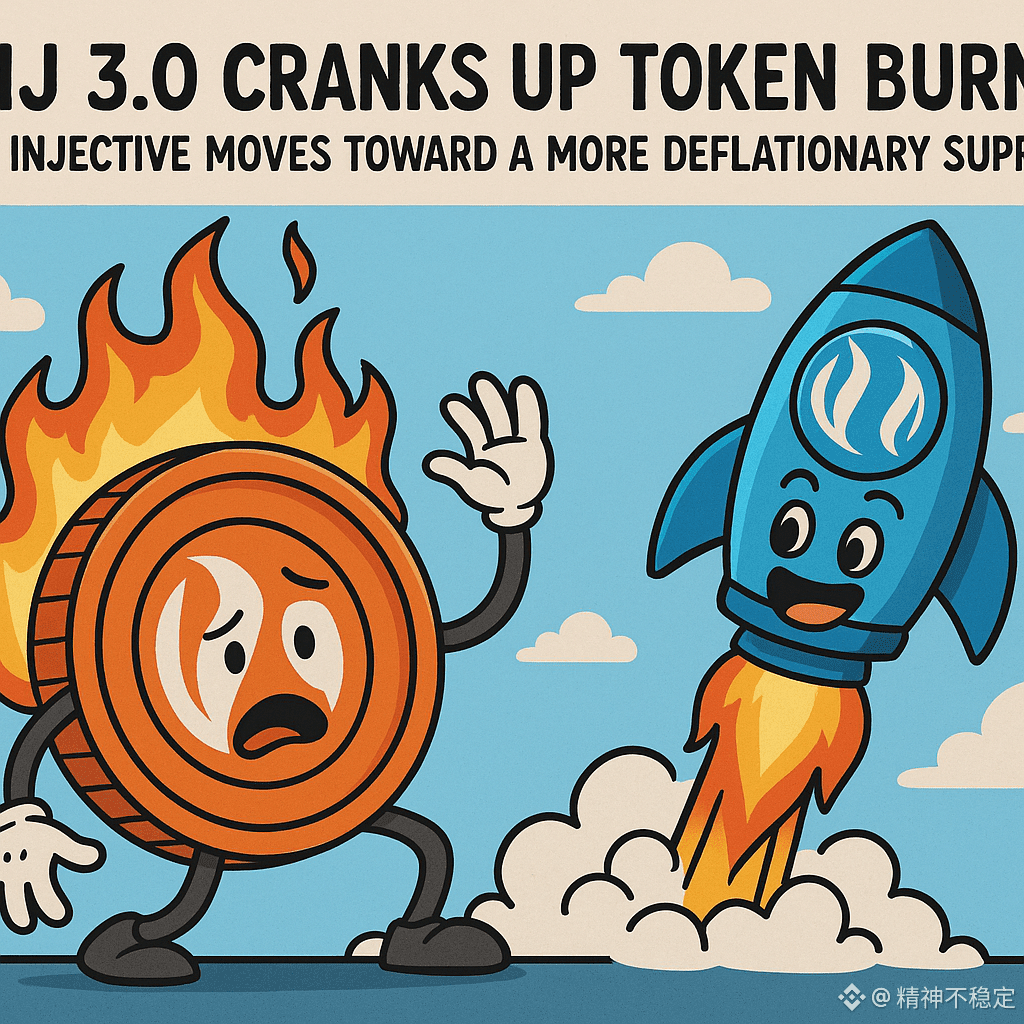
If you’ve spent even a little time in crypto communities, you know how loaded words like deflationary can be. They get tossed around like magic spells that automatically summon price rises. But the truth beneath Injective’s latest update is more methodical and, to me, worth exploring on its own terms — not as hype, but as a design choice.
The story begins with the simple fact that most cryptocurrencies inflate over time. New tokens are generated — through mining, staking rewards, governance incentives — and that growing supply can dilute holders if demand doesn’t keep pace. Traditional economics tells us scarcity can strengthen value; that’s the idea behind Bitcoin’s fixed supply. INJ 3.0 doesn’t freeze supply outright, but it sets up mechanisms to pull the supply trajectory tighter and more restrained than before.
Behind this isn’t some vague slogan. The Injective community passed a governance proposal, known as IIP-392, to tweak multiple tokenomics parameters. These changes tighten the inflation bands and make the protocol’s internal supply adjustment more responsive to real usage and staking behavior. In practical terms, that means smaller inflation bounds on newly minted tokens and stronger triggers for burns when ecosystem activity grows.
One part of this transition that’s already capturing attention is the burn mechanism. This isn’t a one-off event; it’s a structured process where INJ tokens are regularly removed from circulation based on revenue and community participation. Weekly burn auctions, for example, pool fees from across the Injective ecosystem and then permanently destroy the winning bids. That’s a deliberate act of reducing supply aligned with actual economic activity on the network — not just a vanity burn transaction.
But the evolution doesn’t stop there. Injective has layered in a community buyback and burn system that invites participation from token holders. Here, anyone can commit INJ during a scheduled event. That committed INJ is exchanged for a share of ecosystem revenue — and the tokens surrendered are burned. The process is public, on-chain, and transparent. It asks token holders to engage actively rather than passively watch from the sidelines.
Stepping back, what becomes clear is that Injective is trying to move beyond the simplistic “burn tokens, push price up” model that crypto narratives often default to. Instead, this is closer to programmable scarcity — it ties supply dynamics to real network participation: staking, protocol revenue, validator engagement. As more INJ gets staked, the system becomes more deflationary. That’s not just an economic lever; it’s a philosophical one: you’re rewarded for securing and participating in the network first, and scarcity follows.
Why is this trending now? Part of it is timing. The broader crypto market has been in a relatively quieter phase, so upgrades that impact fundamentals — like tokenomics — stand out. But there’s also a deeper trend here: a maturity in how protocols think about supply. No longer is the default to continuously issue tokens with the hope that growth absorbers them. There’s a school of thought now that sustainable ecosystems need measured scarcity to attract both builders and long-term holders. Injective is testing that idea in real time.
I’ve talked with devs, analysts, and holders who see this as a real experiment in economic design — not perfect, not guaranteed to succeed, but thoughtful in intent. The tweaks to inflation bounds and the dynamic mechanism that adjusts based on staking ratios feel engineered, not slapped together. The funny thing is how easy it is to miss the nuance when everybody is focused on price charts instead of incentive structures.
At the same time, it’s not all rosy. No deflationary mechanism works in a vacuum. The market’s reaction, broader sentiment, regulatory context, and the utility adoption of Injective itself all matter. I saw some commentary in technical circles suggesting that simply reducing supply isn’t enough if network usage doesn’t grow correspondingly. That’s a fair point: demand has to match scarcity for the economic model to have meaningful impact.
Personally, what intrigues me most about INJ 3.0 isn’t the promise of scarcity but the intentionality behind it. Injective isn’t waving a supply cap; it’s building a feedback loop between network engagement and supply dynamics. That feels like the kind of structural thinking that, over years, can yield something substantive rather than speculative.
In the end, the shift toward a more deflationary supply in Injective isn’t a single moment — it’s a narrative arc.What’s interesting here is the bigger struggle: balancing rewards, community activity, and long-run sustainability. That matters to holders, but it also matters to anyone trying to understand where token models are heading. The price will move as it does, but the real value might be the lessons this experiment reveals about the next wave of token economics.
@Injective #injective #Injective $INJ
