
By Syed Mubashir Crypto
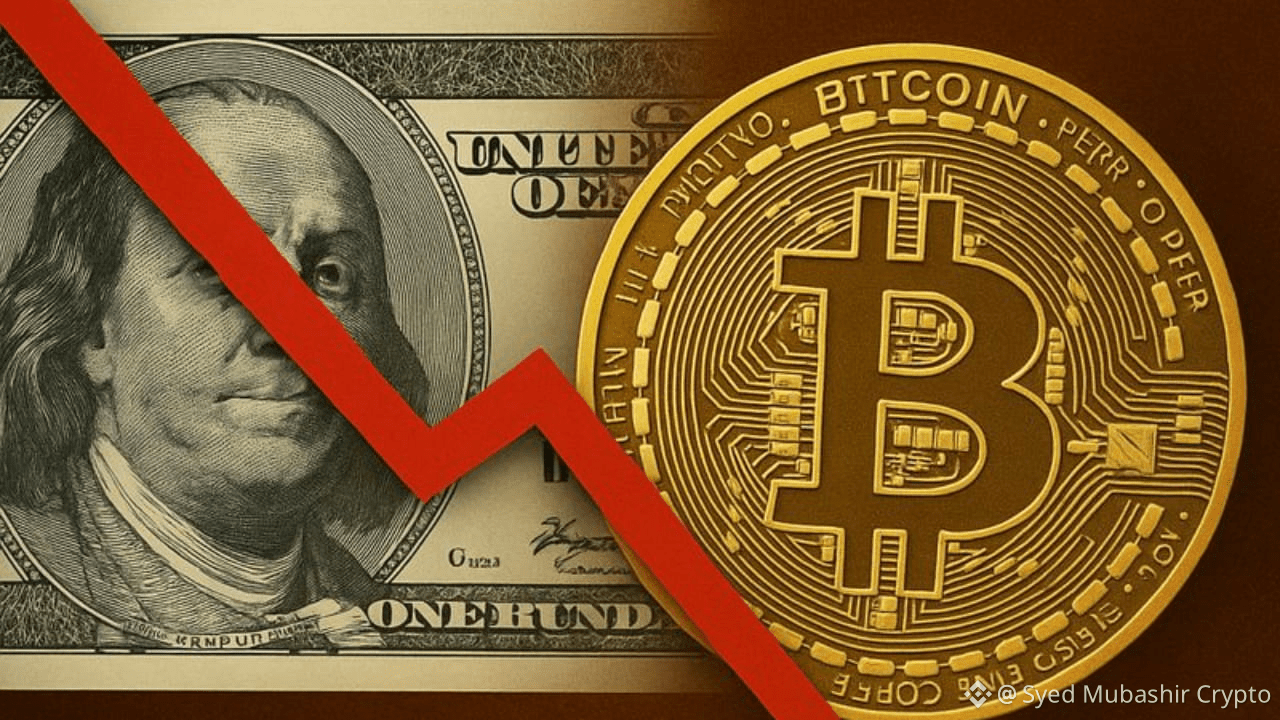
🚨 The U.S. dollar is sliding—and this isn’t random noise.
Currency moves like this never happen by accident. When a reserve currency weakens, it’s a signal that pressure is building beneath the surface. In this case, the pressure is obvious: over $34 trillion in U.S. debt.
At that scale, the usual solutions don’t work. Raising taxes won’t solve it. Cutting spending won’t solve it. Even rapid economic growth won’t solve it fast enough. History shows that when governments reach this point, they rely on the oldest strategy in the book: currency devaluation.
A weaker dollar makes massive debt easier to manage. It reduces the real value of what’s owed and avoids the political shock of default. But the cost doesn’t vanish—it’s simply shifted. From the government to the public.
Cash holders lose purchasing power. Fixed-income earners fall behind. Savings that “sit safely” quietly erode.
If this continues as a slow, controlled decline, the pattern is predictable. Hard assets rise. Risk assets reprice higher. Anything denominated in dollars moves upward. Savers struggle. Borrowers benefit.
This isn’t a theory or a conspiracy. It’s basic math. Governments buried under debt consistently choose inflation over default.
This is exactly the environment where Bitcoin performs best. BTC is priced in dollars. When the dollar weakens, $BTC price rises—not because Bitcoin changes, but because the measuring unit does.
While debates rage online, capital is already repositioning.
Staying in cash for too long may feel safe, but history shows it’s often the most expensive choice.
Some will ignore this. Others will remember it later.
That’s the difference between watching cycles—and understanding them.
spot btc:

feature btc:
Your move.#USJobsDat #CPIWatch #WriteToEarnUpgrade