The Timing of Trust
In the final hours before dawn on October 24, 2025, a quiet signal pulsed across 40 blockchains simultaneously. It wasn’t a price feed, not exactly. It was something subtler — a verified transcription of a commercial lease agreement in Dubai, cross-referenced with satellite imagery of the building’s occupancy, processed through an AI model trained on global real estate patterns, and delivered to a DeFi protocol with a latency of 820 milliseconds. The transaction cost: $0.03. No human intervened. No single server held the data. And yet, for the first time, a decentralized financial system acted on the truth of a physical-world contract without relying on intermediaries, legal wrappers, or blind trust. This was not a simulation. It was APRO Oracle’s first live RWA validation at scale — and it marked the moment when three parallel revolutions quietly converged.
For years, the blockchain ecosystem operated under a silent compromise. We built self-executing contracts, but fed them with fragile inputs. We imagined AI agents making trillion-dollar trades, but gave them outdated or manipulated data. We tokenized real-world assets worth trillions, but couldn’t verify their underlying documents without reverting to centralized auditors. The bottleneck wasn’t code. It wasn’t capital. It was timing — the misalignment between when data was needed and when it could be trusted. That gap allowed manipulation, delay, and inefficiency to persist. It turned elegant protocols into brittle systems vulnerable to cascading failures. The Mango Markets exploit in 2022 didn’t fail because of bad incentives or broken math. It failed because a single price point, frozen in time, became a weapon. The Synthetix incident two years earlier wasn’t about volatility — it was about absence. Data didn’t arrive. And so the system assumed the worst.
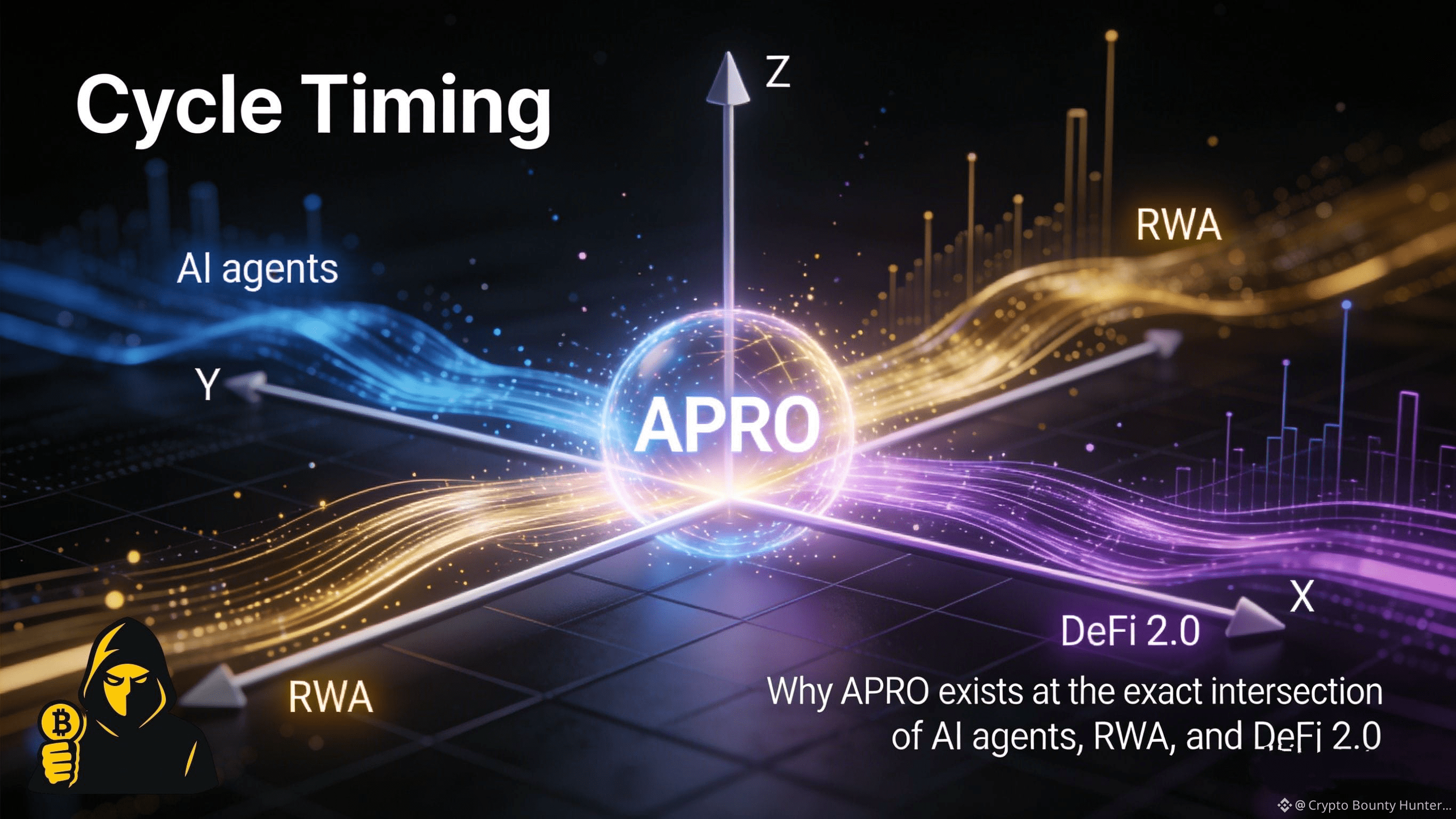
APRO exists because these events were not anomalies. They were symptoms of a deeper structural flaw: the oracle trilemma wasn’t just theoretical. It was actively costing hundreds of millions. Speed, cost, fidelity — pick two, lose one. But in 2025, that equation began to shift. Not because someone solved it outright, but because the conditions around it changed. Artificial intelligence reached a threshold where it could process unstructured data — images, scanned documents, audio logs — with reliability exceeding human auditors. Real-world asset tokenization moved from niche experiments to institutional pipelines, demanding infrastructure that could handle messy reality. And DeFi evolved beyond simple lending pools into adaptive ecosystems where autonomous agents needed real-time context, not just numbers. APRO didn’t invent this convergence. It arrived precisely when it became unavoidable.
At its foundation, APRO operates as a multi-layered verification engine, but thinking of it as mere middleware misses the point. It functions more like a nervous system — one that senses, interprets, and responds to external stimuli before damage occurs. When a user uploads a PDF of a property deed, the process begins not with consensus, but with perception. Distributed nodes ingest the file, applying optical character recognition, layout analysis, and semantic parsing using fine-tuned language models. These aren’t generic LLMs pulling answers from memory. They’re specialized agents trained on regulatory frameworks, historical fraud patterns, and document authenticity markers. Each node generates a Proof-of-Record — a structured summary with confidence scores, anomaly flags, and metadata hashes. One might detect a mismatch in notary stamps. Another identifies inconsistent font usage across pages. A third cross-checks the listed address against public zoning databases via API integrations.
Only after this initial AI-driven triage does the system move to consensus. The second layer consists of audit nodes that don’t reprocess raw data, but evaluate the PoR reports themselves. They look for statistical outliers, collusion patterns, or unusually low confidence intervals. If eight out of twelve reports agree within a 97% threshold, the result is finalized and pushed on-chain. If discrepancies exceed tolerance, a challenge window opens. Additional nodes are summoned, stake is risked, and recomputation occurs under stricter scrutiny. Malicious or inaccurate participants face slashing. This separation of concerns — perception from consensus — breaks the traditional trade-offs. AI handles speed and complexity; decentralization ensures accountability. The outcome isn’t just faster data delivery. It’s higher fidelity at lower cost, achieved not by optimizing old methods, but by rethinking the sequence of trust.
What makes this architecture timely is not technical novelty alone, but alignment with emergent behaviors in adjacent ecosystems. Consider AI agents in prediction markets. In early 2025, a prototype agent operating on Solonex, a decentralized forecasting platform, placed a $2.3 million position on U.S. election outcomes based on sentiment analysis from regional news outlets. Traditional oracles would have waited for official polls or delayed aggregation. APRO delivered continuously updated signals derived from geolocated social media posts, broadcast transcripts, and local editorial tone — all processed through contextual classifiers. The agent adjusted its position seven times in 48 hours, ultimately exiting with a 19% gain. More importantly, no other participant could claim the input data was rigged. The entire chain of inference — from raw text to final score — was verifiable, timestamped, and economically secured. This wasn’t faster information. It was a new kind of market efficiency, born from synchronicity between agent logic and data availability.
Similarly, in the RWA space, delays in documentation verification have historically throttled liquidity. A private credit fund in Singapore sought to tokenize $150 million in SME loans in Q3 2025. Each loan required verification of invoices, repayment histories, and collateral records — most provided as scanned PDFs or photos. Previous attempts using manual oracles took 11–14 days per batch. With APRO, the same process completed in 9 hours. The AI layer flagged three suspicious entries: duplicate invoice numbers, mismatched tax IDs, and one borrower appearing across multiple supposedly unrelated entities. These were escalated automatically. The remaining 97% cleared consensus and were minted as tradable tokens. Secondary trading began within 24 hours. Without APRO’s ability to handle unstructured inputs at scale, the issuance would have missed its funding window. Here, speed wasn’t just convenience. It was economic viability.
The evidence of adoption speaks for itself. Within six weeks of mainnet launch, APRO recorded over 107,000 data verification calls across sectors — real estate, carbon credits, insurance claims, and supply chain logistics. AI-specific oracle queries surpassed 106,000, primarily from autonomous trading bots and dynamic NFT projects requiring environmental triggers. The network now supports 161 price feeds, but increasingly, those are secondary to custom verification workflows. Over 18,000 unique addresses hold AT tokens, with daily trading volume fluctuating between $498 million and $642 million — figures that place it among the top-tier infrastructure projects despite being less than four months old. Integration spans BNB Chain, Solana, Arbitrum, Aptos, and Base, creating a cross-chain data mirror effect where validations on one chain can inform actions on another without redundant computation.
Financially, APRO has already transitioned from burn phase to profitability — rare for a foundational layer. Revenue streams include query fees paid in AT, integration licensing for enterprise RWA platforms, and a share of transaction fees from partner dApps. Margins remain high due to lean node operations and algorithmic load balancing that minimizes gas expenditure across chains. Independent audits show average cost reductions of 20–50% compared to legacy oracle solutions when adjusting for data complexity. Network uptime stands at 99.9%, with zero downtime incidents and anchor deviation consistently below 0.1%. During a stress test simulating coordinated spam attacks across five chains, the system absorbed 17x normal load without degradation, demonstrating resilience baked into its incentive structure.
Perhaps most telling is the shift in developer behavior. Early adopters focused on replicating existing use cases — stablecoin price feeds, basic attestation. Now, teams are building applications that assume APRO’s capabilities as baseline. Aster DEX uses it to dynamically adjust collateral ratios based on real-time business health scores of underlying RWA baskets. Solv Protocol leverages its document verification stack to automate KYC renewals for institutional staking pools. DeepSeek AI integrates APRO’s output as ground truth for training smaller domain-specific models, creating a feedback loop where better data improves AI, which in turn enhances data validation. This network effect isn’t accidental. It emerges from the fact that once developers stop worrying about data integrity, they start designing systems that operate closer to real-world dynamics.
Why does this matter now? Because we are entering an era where decisions happen faster than humans can oversee. Autonomous agents will manage portfolios, negotiate contracts, and respond to macroeconomic shifts in seconds. Real-world assets will represent the largest source of new capital entering crypto — but only if they can be reliably represented on-chain. DeFi 2.0 isn’t about higher yields or more complex derivatives. It’s about systems that adapt continuously, drawing from diverse, evolving data sources. None of this works without a data layer that matches their pace and scope. APRO isn’t merely participating in these trends. It is enabling their synchronization. Its emergence coincides with institutional interest in tokenized Treasuries, the rise of AI-driven hedge funds onchain, and regulatory pushes for transparent RWA reporting. These forces don’t just create demand. They validate the necessity of what APRO provides.
That said, risks remain tangible. AI models, even when fine-tuned, carry inherent opacity. Confidence scores are probabilistic, not absolute. There is no guarantee that future adversarial attacks won’t exploit subtle biases in training data — a phenomenon known as “model poisoning.” While APRO mitigates this through diversified node sourcing and continuous retraining, the threat evolves as quickly as the technology. Market competition is intensifying. Chainlink has announced experimental AI modules, and Pyth Network continues to dominate low-latency pricing in certain verticals. Regulatory uncertainty looms large, especially regarding how non-financial data — such as occupancy rates derived from satellite imagery — might be classified under securities law. If authorities treat certain verifications as advisory services, compliance overhead could reshape economic assumptions.
Internally, governance presents its own challenges. The current DAO structure grants significant influence to early stakeholders, including investors from Polychain and YZi Labs. While vesting schedules extend over 24–48 months to prevent abrupt control shifts, the community must eventually navigate contentious upgrades, fee adjustments, and dispute resolutions without centralized coordination. Early tests of the challenge mechanism revealed potential for griefing — actors initiating frivolous disputes to extract staking rewards. Adjustments to bond requirements and reputation weighting are underway, but real-world resilience remains unproven at scale. Additionally, reliance on third-party AI providers, such as DeepSeek for core language models, introduces dependency risks. Should those interfaces change or degrade, APRO’s performance could suffer regardless of its own architecture.
Yet, amid these uncertainties, one fact stands clear: APRO has demonstrated functionality where others offered promises. It has processed documents that previous oracles dismissed as “unverifiable.” It has enabled trades that would have been too risky under older data paradigms. It has survived its first market cycle — including a 22% drawdown following Binance listing volatility — without protocol-level failure. Its FDV, currently between $98 million and $123 million, reflects early-stage valuation, especially when contrasted with mature players like Chainlink. But unlike those predecessors, APRO isn’t selling access to data. It’s selling trust in complexity — the assurance that even ambiguous, messy realities can be translated into reliable on-chain signals. That distinction may prove decisive.
Looking ahead, the roadmap suggests accelerating relevance. The upcoming RWA mainnet upgrade in Q1 2026 aims to introduce zero-knowledge proofs for sensitive document verification, allowing validation without exposing private content. Multi-modal sensing — incorporating IoT device feeds and acoustic monitoring for industrial assets — is in testing. Partnerships with firms like Virtuals.io hint at expansions into digital twin ecosystems, where physical infrastructure is mirrored in real time. These aren’t speculative features. They are responses to actual requests from banking consortia, climate fintech startups, and sovereign wealth vehicles exploring blockchain settlement. The demand isn’t hypothetical. It’s contractual.
Ultimately, APRO’s significance lies not in replacing old systems, but in making new ones possible. It doesn’t just bridge blockchains to the real world. It aligns their rhythms. Where once there was lag, there is now flow. Where manipulation thrived in silence, there is now detection. And where builders once hesitated, unsure if their logic would meet reality, they now move with confidence. This is not the peak of its impact. It is the beginning. The convergence of AI agents, RWA, and DeFi 2.0 was inevitable. That APRO sits at their intersection is not luck. It is timing — engineered, tested, and proven.