

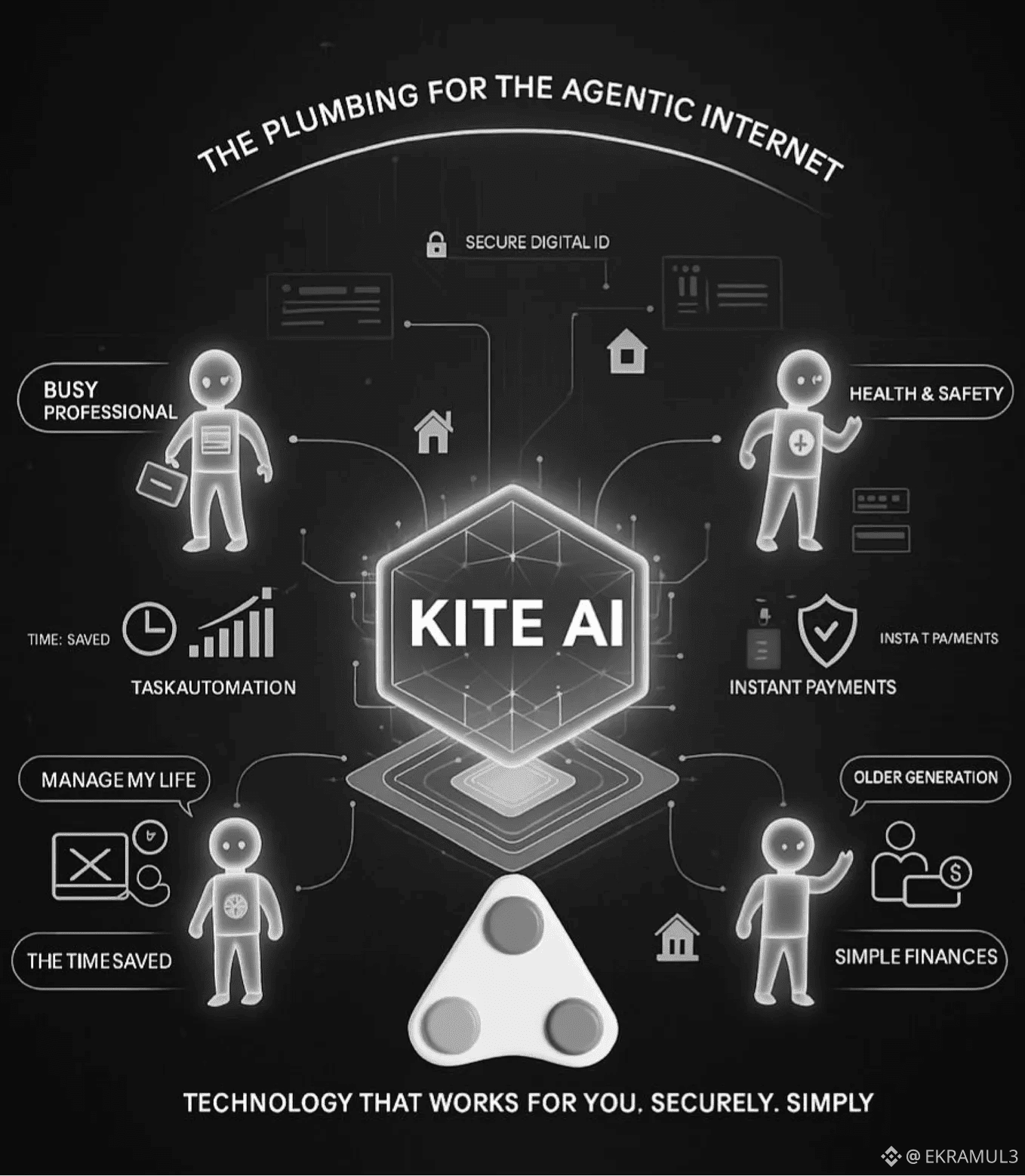
 Most discussions around AI payments still imagine a human somewhere in the loop. An agent “requests” approval, waits for a signature, or triggers a wallet flow that ultimately belongs to a person. Kite rejects that model entirely. It starts from a more honest assumption: in the next phase of the internet, AI agents will not ask for payments. They will resolve economic actions themselves, inside predefined constraints, at machine speed.
Kite is not trying to bolt AI onto existing blockchain logic. It is redesigning the financial stack so that autonomous agents can complete an entire economic cycle on-chain intent, validation, execution, settlement without human bottlenecks. That distinction is subtle, but it changes everything.
From Human Approval to Machine Resolution
Traditional blockchains treat payments as explicit events. A user initiates a transaction. A wallet signs. A network confirms. This flow assumes intent must always come from a human. But autonomous AI systems do not work this way. They operate in continuous loops. They evaluate conditions, resolve outcomes, and act in real time.
Kite reframes payments not as “transactions” but as resolutions of intent. An AI agent does not request permission every time it needs to spend. Instead, it operates inside a permissioned economic envelope. When conditions are met, value moves automatically. No prompts. No pop-ups. No waiting.
This is the core philosophical shift behind Kite’s design. Payments are no longer interrupts. They are conclusions.
Why Autonomous Payments Break Existing Chains
Most existing Layer 1s struggle with agent-driven activity for one simple reason: they were built for sporadic, human-paced interactions. AI agents behave very differently. They generate high-frequency actions, micro-settlements, and continuous coordination flows.
In such an environment, latency becomes logic. Fee unpredictability becomes risk. Identity ambiguity becomes a security failure.
Kite addresses this by building an EVM-compatible Layer 1 optimized for resolution speed and predictability, not just throughput. Fast finality is not a performance feature here; it is a functional requirement. If an agent cannot rely on deterministic execution, it cannot safely operate autonomously.
Identity as an Execution Boundary, Not a Wallet
The most important innovation in Kite is not speed. It is how identity is treated.
Instead of collapsing everything into a single address, Kite introduces a three-layer identity model that mirrors how autonomous systems actually behave:
User identity defines ultimate ownership and intent
Agent identity defines autonomous actors with delegated authority
Session identity defines temporary execution contexts with scoped permissions
This structure turns identity into a control surface, not just an authentication mechanism. An agent does not hold unlimited power. It holds defined authority, bounded by time, budget, and behavioral constraints.
If a session expires, spending stops.
If an agent is revoked, autonomy ends.
If a rule is violated, execution fails.
Autonomy exists but only inside enforceable boundaries.
Payments Become Policy Outcomes
On Kite, a payment is not something an agent decides to do. It is something that happens because policy allows it.
This is where programmable governance moves from abstraction to execution. Instead of humans voting and manually enforcing outcomes, governance on Kite is embedded directly into how agents resolve actions.
Spending limits, counterparties, execution windows, fee caps these are enforced at the protocol level. Even a malfunctioning or misaligned AI cannot exceed its authority. The chain itself becomes the final arbiter.
In effect, Kite turns governance into machine-enforceable economic law.
Machine-to-Machine Value Flows
Once payments are resolved autonomously, a new type of economy becomes possible.
Agents no longer interact only with users. They interact with other agents. They pay for compute. They purchase data. They negotiate services. They stream value in exchange for execution.
These are not speculative use cases. They are the natural consequence of AI systems operating at scale. And they are impossible to support with manual approval models.
Kite enables machine-to-machine payments that are auditable, permissioned, and trust-minimized. Every flow is tied to an identity. Every action is provable. Every settlement is final.
This is not DeFi as humans know it. It is economic infrastructure for software.
Why EVM Compatibility Still Matters
Despite its forward-looking design, Kite deliberately remains EVM-compatible. This is not a compromise; it is a strategy.
EVM compatibility allows existing developer tooling, smart contract logic, and mental models to carry forward. Builders do not need to relearn how to write contracts. They need to rethink what those contracts represent.
On Kite, smart contracts are less about user-triggered execution and more about policy definition. Developers define rules. Agents resolve actions. The chain enforces outcomes.
This combination familiar tooling with radically different execution semantics is what makes Kite dangerous in the best sense of the word.
The Role of the KITE Token
The KITE token is not positioned as a speculative asset first. Its rollout reflects the network’s long-term intent.
At first, KITE jumpstarts everything. Developers, validators, even the earliest users everyone gets a reason to dive in, try things out, launch agents, and really push the system’s limits. Usage comes first, and liquidity chases after.
Later on, KITE steps up. It becomes the network’s economic engine. People stake it to keep things secure. It sets the rules for how the protocol works. And as agents make things happen, KITE soaks up the value they create.
As agent activity scales, the token’s relevance grows organically. It is not an add-on. It is the settlement asset of an autonomous economy.
Why Kite Feels Different
What makes Kite stand out is not marketing or narrative timing. It is conceptual clarity.
Most projects talk about AI “integration.” Kite talks about AI sovereignty. It assumes agents will operate continuously, independently, and economically. It does not try to slow them down or keep humans artificially in the loop.
Instead, it asks a harder question:
How do we let machines act freely without losing control?
Kite’s answer is not surveillance or centralization. It is structure. Identity layers. Permissioned autonomy. Policy-driven execution. Deterministic settlement.
That is why Kite does not feel like an experiment. It feels like infrastructure that will quietly become indispensable.
The Bigger Picture
The future internet will not be built only by people clicking buttons. It will be built by agents negotiating, coordinating, and resolving actions faster than humans can observe.
In that world, the most valuable blockchains will not be the loudest or the most flexible. They will be the ones that resolve intent reliably.
Kite is building for that future.
Not a chain where AI asks to pay
but a chain where AI finishes the job and moves on.



