
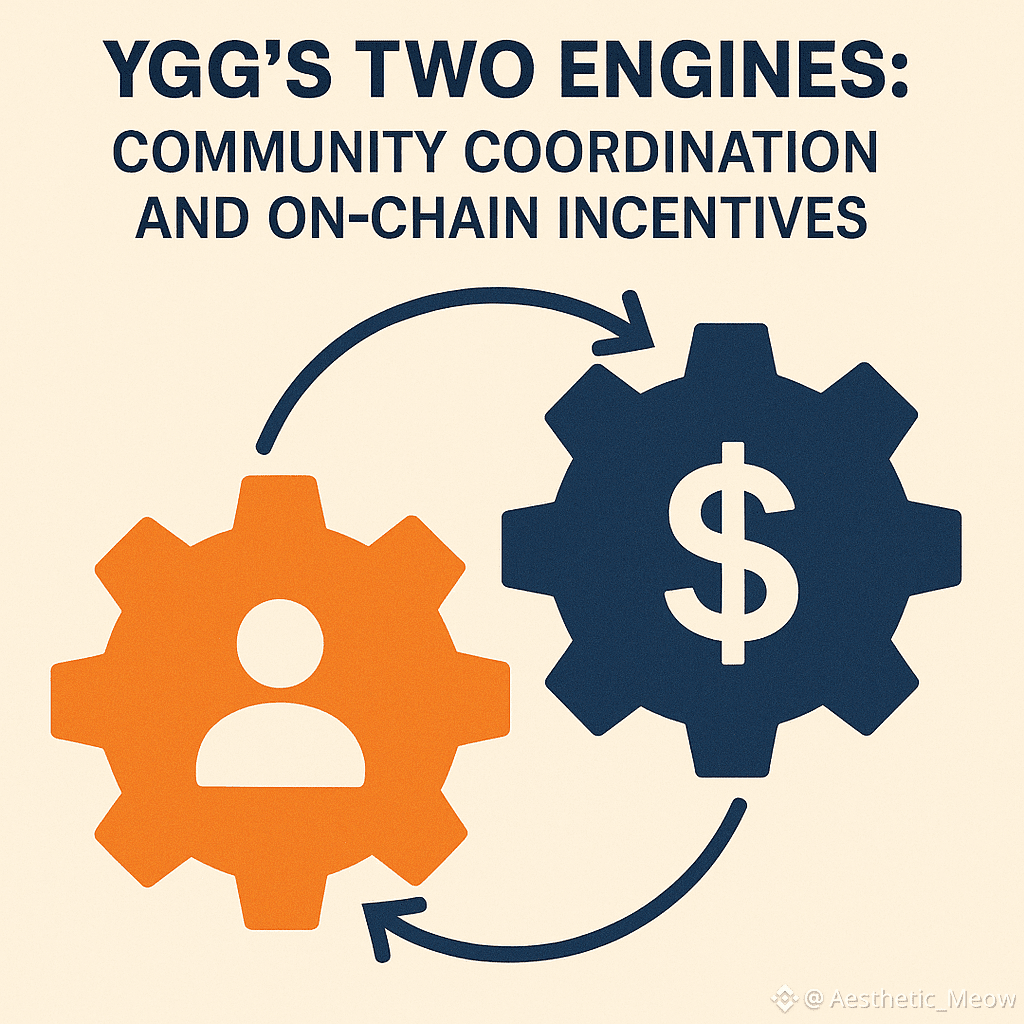
Most systems in Web3 focus on one engine while downplaying the other. They either become entirely social – lots of community energy, little structure – or purely mechanical – clear incentives, weak human connection. YGG’s more significant idea is that a guild needs both, and in a specific order. Community coordination is the first engine; it’s what makes participation cohesive. On-chain incentives are the second engine; they help that cohesion last through time, scale, and market ups and downs.
If you see YGG as just "a token plus a community," you miss the real operation. The operation is how it tries to turn scattered human effort into reliable results without treating people like parts, and how it tries to link those results to distribution without claiming distribution is guaranteed.
The first engine – community coordination – is invisible until it fails. When it works, it seems natural, almost obvious. People know what to do. New members get integrated. Good practices spread. Roles form. Knowledge is passed on. Disagreements are settled before they cause real problems. That smoothness isn't by chance. It's built. In guild economies, coordination is the production setup. A wallet can hold assets, but it can't teach someone how to use them effectively. A smart contract can give out rewards, but it can't prevent exhaustion, maintain trust, or transfer skills. That work belongs to the human side.
This is why calling YGG a "guild" is important. It suggests training, standards, guidance, and shared discipline – things older economies needed long before blockchains existed. A guild doesn't just gather people. It makes it easier for newcomers and increases the chance they will become skilled. In fast-changing digital spaces, skill isn't a personal trait; it's a system. It's what happens when learning is organized and practice is designed.
But coordination alone has a downside: it depends heavily on motivation, and motivation goes in cycles. People show up when things look promising and disappear when things look tough. A guild can be strong culturally and still struggle if it can't turn effort into results people see and trust. That's where the second engine comes in: on-chain incentives – not to replace community, but to provide stability.
Incentives, at their best, aren't bribes. They are a form of accounting. They are a way of stating, with clear rules, what the system values. They provide continuity when moods shift. They make participation visible. They offer a common way to talk about contribution and reward. But incentives have a negative side: if they are seen as the main driving force, they become exploitative. People learn to game the system, not to build. They focus on the number, not the goal. The community becomes a temporary crowd that leaves when the rewards decrease.
YGG’s bigger challenge – its actual design problem – is how to prevent incentives from becoming a replacement for coordination. This is why results-based distribution is such a key idea in how we've discussed YGG. The goal isn't to promise constant, easy returns. The goal is to keep distribution tied to reality: to make the reward story depend on what the organization is actually creating and maintaining. When distribution is linked to performance, the system becomes more honest. When it's not, the system becomes weaker because it starts paying for showing up rather than rewarding actual results.
Vault logic sits right between these two engines. A vault is mechanical, yes. But it also shapes culture. It quietly shows participants the time frame the system expects, the type of commitment it values, and the kind of relationship it wants between people and results. If vault participation requires patience, it filters out purely opportunistic behavior. If vault logic is clear, it builds trust. If vault logic is unclear, it creates suspicion. The mechanism is never just code; it's a social message presented as a contract.
Now consider SubDAOs, and you see the same two-engine idea on a larger scale. SubDAOs are a way to coordinate – local teams close to the actual situation – and also a boundary for incentives – smaller groups that can be responsible for results. They allow YGG to grow without claiming that one central decision-making process can understand every situation equally well. They also make responsibility clearer: decisions are made closer to the people who directly experience the effects.
This is where YGG’s approach becomes quietly established. Organizations last by managing two kinds of scarcity: the scarcity of resources and the scarcity of attention. Coordination is how an organization uses attention wisely – putting the right people on the right problems with shared standards. Incentives are how an organization uses resources wisely – distributing value in a way that keeps the system going and remains honest about what's working. If either engine fails, the organization weakens. If both engines support each other, the organization can last through different periods.
The most important point here is that these engines are not equal in their role. Coordination is the first engine because it creates ability. Incentives are the second engine because they protect ability. When incentives come first, ability often never develops. When coordination comes first, incentives can become a reflection of real productivity rather than a temporary fuel.
So the real question YGG keeps asking – whether openly or indirectly – is a mature one: can a guild become a lasting organization in digital economies by seeing people as the source of ability and on-chain mechanisms as the source of accountability? Can it build a culture that learns and changes, while also building incentives that reflect results rather than create them?
If the answer is yes, then YGG’s two engines don't just power one guild. They offer a plan for what many on-chain communities will eventually need to become: not just groups of owners, but organizations that can coordinate human effort and distribute value with enough discipline to last after the excitement fades.
@Yield Guild Games #YGGPlay $YGG
