
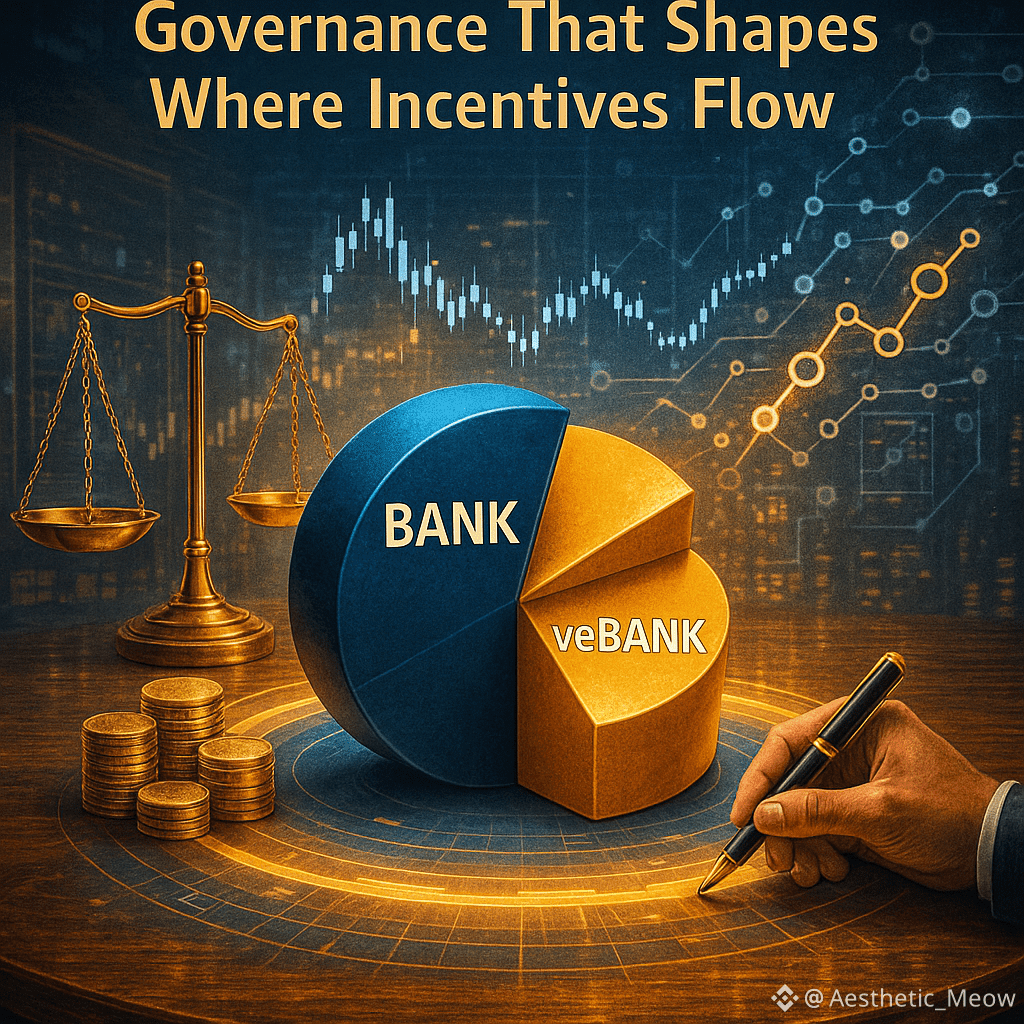
Discussions about governance, in DeFi frequently resemble a ceremony. Proposals, voting, forums, discussions. Significant certainly but the element that truly impacts results is seldom the voting action. It’s the outcome that the vote directs.
Within an asset-management framework such as Lorenzo, governance involves more, than code upgrades. It includes steering capital allocation determining which products merit backing, which approaches ought to expand and how incentives should be distributed when resources are scarce. Incentives are never impartial. They act like a force of attraction drawing liquidity focus and progress toward what they incentivize.
That’s the reason why BANK and veBANK represent more than a token and a vote." They aim to create a governance framework of directing economic movement as an allocator would functioning more like a portfolio committee rather, than a comment thread.
BANK as the Coordination Layer
BANK functions as the core coordination tool. Its role is not to substitute strategy execution or guarantee returns. Instead its responsibility is to establish a system, for collective decision-making throughout the protocol’s range of products vaults, OTFs and any forthcoming innovations.
Practically speaking BANK serves as the tool that states: "If you desire influence, over how this system develops you’re not merely transient. You’re making a pledge." Commitment is crucial since temporary players and lasting caretakers seek outcomes. One pursues what is popular now; the other aims to create something that endures beyond the moment.
veBANK: Turning Time Into Influence
veBANK transforms governance into more, than signals. Vote-escrow mechanisms turn a concept into an economic one: time ought to matter.
When an individual locks BANK to obtain veBANK they exchange liquidity for control. They express, "I’m ready to accept flexibility so the protocol can maintain greater stability." This trade-off is intentional. It selects for participants who anticipate remaining involved enough to value secondary impacts such, as sustainability, incentive optimization and product consistency.
This shifts the nature of governance. When your power depends on the length of your lock you cease to act like a visitor. You begin to think like a proprietor.
Incentives as Product Design, Not Marketing
Here is the inconvenient reality: incentives have the power to generate liquidity yet they can also warp the truth. When incentives are poorly targeted they fail to produce value—instead they provoke lived actions. Capital comes in farms. Then exits. The graph appears robust until it suddenly isn’t.
Lorenzo’s perspective suggests an intentional strategy: incentives ought to act as supportive structures, for products. They should assist promising vaults in achieving scale enable strategic products to gain enough liquidity to be practical and guide the ecosystem in identifying which strategies merit greater expansion.
In that regard incentives are integrated into product design than being allocated to a marketing budget. Governance determines the allocation of that budget.
What veBANK Owners Are Actually Doing
Considering Lorenzo as a layer for asset management, veBANK holders essentially act as selectors of the strategy collection. They decide which strategies receive support.
This involves choices such, as: Which vaults ought to be prioritized with incentives? Which products should be promoted for liquidity? Which strategic paths merit sustained backing?
Although the system automates the execution of strategies people continue to design the menu.. The menu is important. Since products represent commitments. They encourage users to assume risk in a form. When governance determines which products get the backing it indirectly influences the type of risk the ecosystem promotes.
Therefore the true function of veBANK goes beyond voting. It involves allocation governance governance that operates similarly to capital planning.
The Emotional Difference Between “Voting” and “Owning”
A slight emotional change occurs when transitioning from voting to vote-escrow power.
Informal voting seems like engagement. Vote-escrow conveys a sense of duty.
When your power becomes linked to time avoiding the repercussions of what you back becomes difficult. If incentives are misaligned and the ecosystem deteriorates those with the influence are also the ones most vulnerable to lasting harm damage to reputation, liquidity and trust, in the product.
That’s the sophistication of ve-systems. They don’t presume people are flawless. They presume people react to incentives and aim to synchronize incentives with responsibility.
Why This Matters for an On-Chain Asset-Management Layer
Lorenzo is doing more, than creating vaults. It is developing a system where strategies can be bundled and expanded. Within this structure governance becomes a part of the products design.
If an on-chain system is to function like asset management it requires more, than execution logic. There must be a method of prioritization an approach to determine which strategies warrant scaling which require tuning and which should be deprioritized as market conditions shift.
BANK and veBANK serve as that mechanism.
Not flawless. Not mystical. Yet directionally significant: a framework where those influencing incentive distribution're the ones dedicating time and resources to the protocol’s long-term success.
And that’s the deeper takeaway: the point of governance here isn’t to create more votes. It’s to create better consequences so incentives don’t just move fast, they move wisely.
@Lorenzo Protocol #LorenzoProtocol $BANK

