

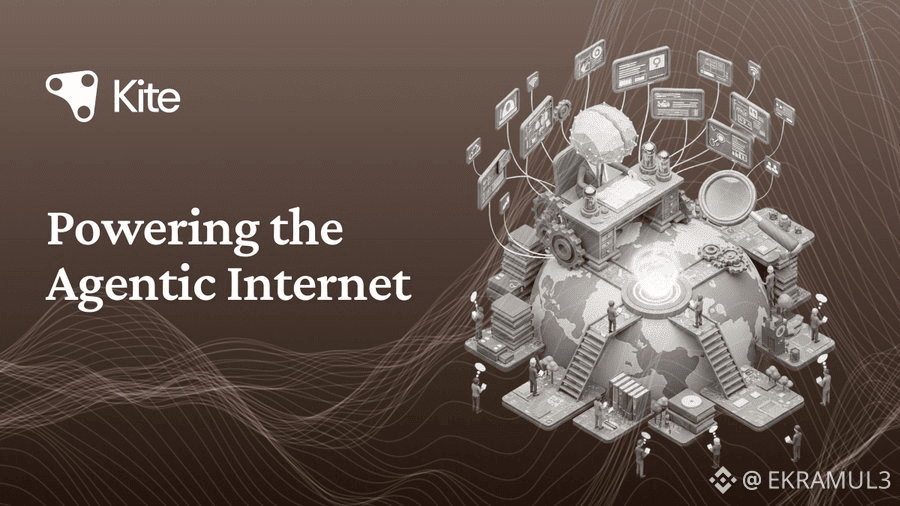
 Kite is not trying to teach blockchains how to move faster.
It is teaching automation how to behave.
Most conversations around AI payments start with speed and end with efficiency. Kite starts somewhere more uncomfortable: authority. Who is allowed to move value? Under what scope? For how long? And what happens when intelligence is no longer human-paced?
Kite’s answer is not more automation.
It is bounded automation.
From Permissionless to Rule-Bound
Traditional blockchains assume one thing: whoever controls the key controls the money. That model works for humans. It collapses when intelligence becomes delegated.
Kite replaces the idea of “permissionless spending” with something more precise: rule-resolved settlement.
AI agents on Kite don’t ask a human to approve every action. They also don’t roam freely. They operate inside predefined economic corridors enforced by the chain itself.
The result is subtle but powerful. Payments don’t wait for approval. They also don’t escape control.
Identity as Economic Geometry
Kite’s three-layer identity system is not just about security. It’s about economic shape.
Users define intent and ownership
Agents execute logic and decisions
Sessions define temporary authority
This structure turns value movement into a scoped operation rather than a blanket permission. An agent can be allowed to settle invoices, rebalance positions, or pay for compute without ever touching the rest of the wallet.
That distinction is what separates automation from abdication.
Why Settlement Matters More Than Execution
Most chains obsess over execution speed. Kite obsesses over settlement correctness.
In an agentic economy, execution is cheap. Settlement is expensive. Every autonomous action creates risk financial, regulatory, operational. Kite treats settlement as the moment where rules, identity, and intent converge.
That’s why agents on Kite don’t “send payments.”
They resolve obligations.
A task completes. A condition is met. A rule passes. Value settles.
Machine-Speed, Institution-Grade
Kite is EVM-compatible, but it doesn’t behave like a generic EVM chain. Its design assumes:
high-frequency micro-settlements
predictable fee environments
continuous agent activity
auditable action trails
This is infrastructure for systems that never log out.
The focus isn’t DeFi composability for traders. It’s operational reliability for autonomous systems that must run for months without human supervision.
Governance That Shapes Behavior, Not Just Votes
Kite treats governance as a behavioral layer, not just a political one.
Rules don’t live in PDFs or forums. They live in session scopes, spending limits, counterpart lists, and execution constraints. Governance decisions directly shape how agents are allowed to behave.
That makes governance executable and automation accountable.
Why the Token Isn’t Rushed
KITE’s phased utility is intentional. You don’t decentralize control before systems learn to behave.
Early phases focus on participation and ecosystem formation. Later phases introduce staking, fee capture, and governance weight once agent activity becomes meaningful enough to govern.
It’s not cautious. It’s structural.
The Bigger Shift
Kite isn’t betting that AI agents will exist. That’s already settled.
It’s betting on something more specific:
that economic systems will stop trusting intelligence blindly and start constraining it deliberately.
The future agent economy won’t be powered by raw autonomy.
It will be powered by autonomy that understands limits.
Kite is building the settlement layer for that world
where AI agents don’t ask for permission,
but they never operate outside the rules either.
That balance is rare.
And that’s why Kite feels less like a product
and more like infrastructure that arrives before people realize they need it.

