
@Injective :In every financial era, there comes a moment when the old systems no longer collapse loudly but instead fade under their own weight. Complexity grows faster than trust. Access becomes permissioned. Innovation slows as layers of intermediaries harden into walls. Crypto was born as a response to this stagnation, yet even within decentralized finance, new bottlenecks emerged—congestion, fragmentation, and architectures that could not scale without compromise. It is within this quiet tension that Injective takes shape, not as a reactionary platform, but as a rethinking of how financial systems should be built from the ground up.
Injective does not begin with the assumption that finance must imitate existing institutions on-chain. Instead, it questions the structure itself. Traditional finance is layered with brokers, clearing houses, settlement delays, and opaque order books. Many early DeFi protocols simply recreated these patterns using smart contracts, achieving transparency but not true structural evolution. Injective’s architecture departs from this by placing speed, composability, and user sovereignty at the core rather than treating them as afterthoughts.
At the heart of Injective is a purpose-built layer-one blockchain designed specifically for financial applications. Unlike generalized chains that attempt to serve every use case equally, Injective optimizes for markets: spot trading, derivatives, prediction markets, structured products, and entirely new financial primitives that have no off-chain equivalent. This specialization is not limiting—it is liberating. By focusing on finance as infrastructure rather than as apps stacked on top of infrastructure, Injective creates space for complexity without sacrificing performance.
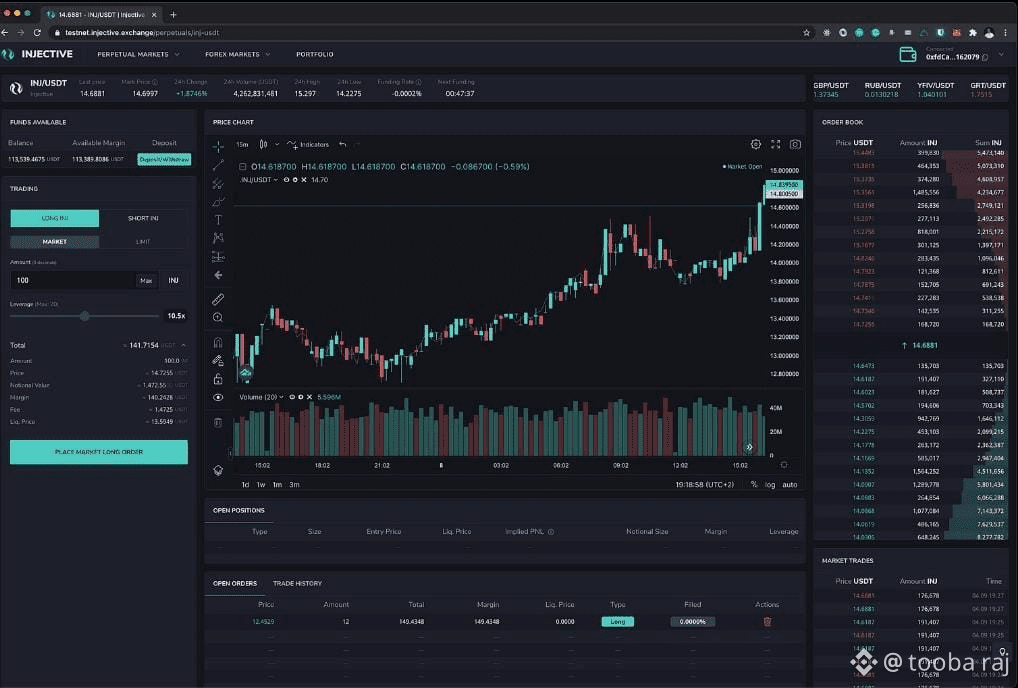
One of the most defining aspects of Injective’s architecture is its fully on-chain order book. For years, order books were considered impractical on-chain due to latency and cost, pushing many decentralized exchanges toward automated market makers. While AMMs unlocked early liquidity, they introduced inefficiencies, impermanent loss, and limited price discovery. Injective’s design brings back the precision of order books while preserving decentralization, enabling professional-grade trading without custodial risk. This is not nostalgia for old finance mechanics—it is their transformation into open, verifiable systems.
Speed plays a subtle but crucial role here. Financial markets are sensitive to time. Milliseconds define fairness, arbitrage, and risk. Injective’s high-throughput consensus allows trades, liquidations, and settlements to occur fast enough to support complex strategies that were previously confined to centralized venues. Yet this speed is not achieved by sacrificing decentralization. Validators remain distributed, governance remains on-chain, and participation remains open.
Interoperability is another structural pillar rather than a marketing feature. Injective is deeply integrated with the Cosmos ecosystem through IBC, allowing assets and data to move across chains without bridges that introduce custodial risk. This matters because modern finance is inherently cross-border and multi-asset. A financial architecture that cannot communicate beyond itself becomes an island. Injective instead functions as a hub where liquidity, information, and execution can converge across ecosystems.
What emerges from this architecture is not just a faster exchange or a more efficient protocol, but a different mental model of finance. Markets on Injective are not controlled by gatekeepers or shaped by opaque incentives. They are defined by code that is visible, auditable, and governed by participants. New markets can be created permissionlessly, tailored to specific assets, events, or communities. This lowers the cost of experimentation and shifts innovation from institutions to individuals and builders.
Equally important is what Injective does not impose. There is no requirement to follow a single financial philosophy. Builders can design conservative products that mimic traditional instruments or experimental mechanisms that would be impossible under regulatory or infrastructural constraints off-chain. This neutrality is powerful. It allows Injective to function as financial commons rather than as a curated marketplace.
Over time, architectures reveal their values. Systems built for extraction tend to centralize. Systems built for resilience tend to distribute. Injective’s design choices—on-chain order books, interoperability, high performance without custodians—suggest a long-term vision where finance becomes a shared utility rather than a closed service. In such a world, trust is no longer requested; it is verifiable. Access is not granted; it is inherent. Innovation does not wait for approval; it emerges organically.
Injective does not promise a utopia, nor does it claim to replace the global financial system overnight. What it offers instead is quieter and more durable: an architecture capable of supporting a new financial world as it grows, adapts, and learns. In the history of finance, the most important changes are rarely the loudest. They are the ones that redesign the foundations so thoroughly that, eventually, the old structures no longer make sense to return to.
