
Azu wants to clarify: chains themselves do not 'grow users'; users are brought in by the entry. The wallet is the hardest layer of the entry — it controls which chain you first click into, which asset you first use, and to whom you first grant authorization. The cooperation between KITE and wallets like OK appears to be 'shelving and integration,' but fundamentally, they are exchanging two things: the wallet brings users onto the chain, and the chain provides the wallet with a narrative and business model that is compelling, profitable, and reusable. For wallets, the most expensive aspect is not the technical integration but rather a position on the homepage, a push notification, or a recommended path; these determine who can be seen and who can become habitual.
So, regarding 'who brings users onto the chain,' there is almost no suspense in such collaborations: it is the wallet. Users do not first understand your vision before installing a new network; they only casually click in their familiar wallet. An entry point of the level of OK can pull chain growth back from 'community self-excitement' to 'product distribution': you do not need to educate users to configure RPC, add networks, or find cross-chain bridges; the entry naturally smooths out friction. It is also clear 'who controls the entry': wallets control the homepage, the default network list, dApp recommendation spots, the default routing of Swap Bridges, and even the wording of risk warnings — these details determine whether users see KITE as a one-time event or as a long-term payment track.

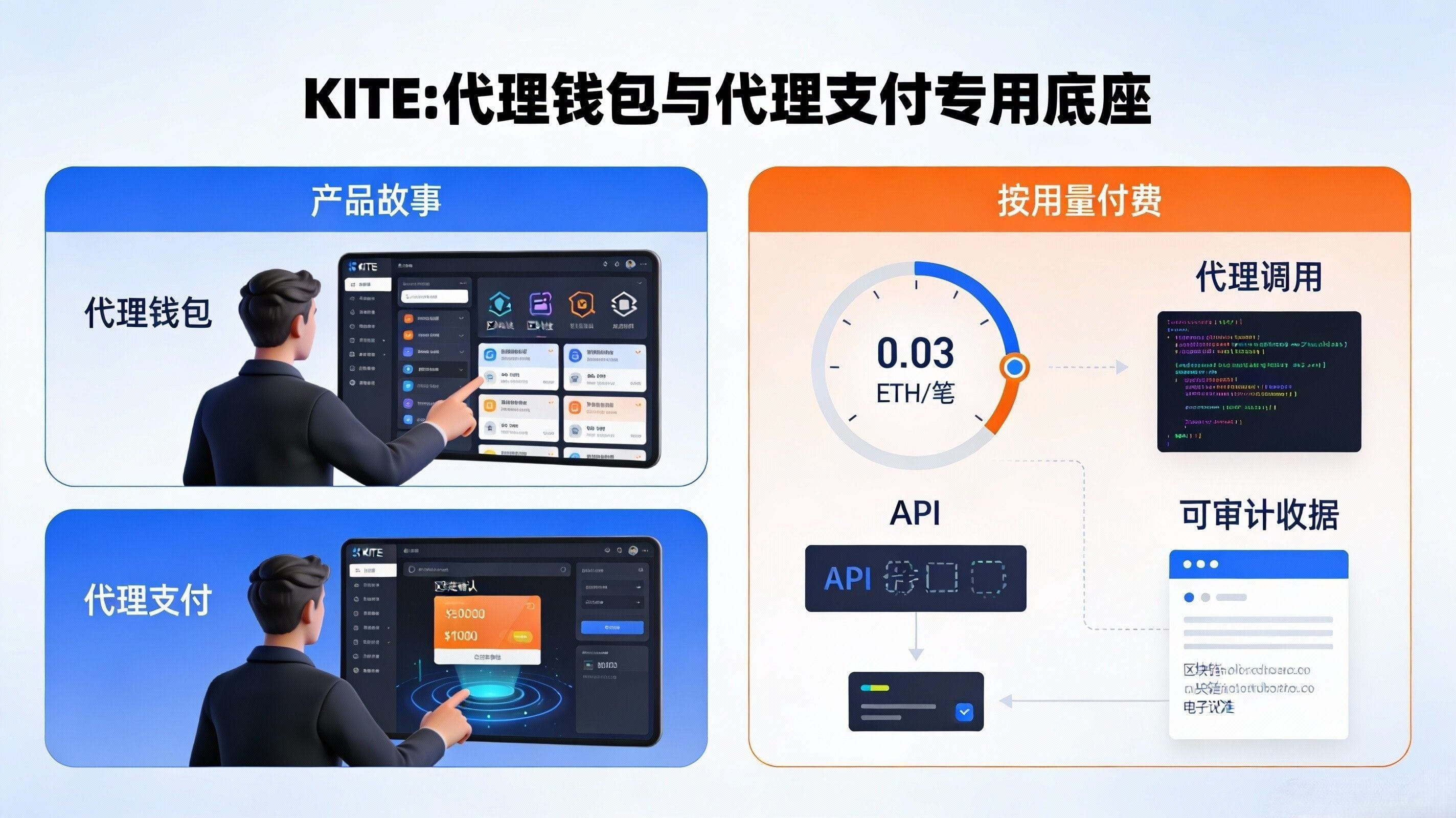
What does KITE need to offer the wallet at this level to deserve such distribution rights? Azu believes that at least three layers of 'usable value' should be provided, rather than just saying 'AI narrative is sexy.' The first layer is a product story that wallet users can immediately understand: KITE is not 'just another EVM,' but a dedicated base for 'proxy wallets and proxy payments.' Once the wallet understands this story, it can package it into a new category — previously, the wallet was about 'you managing your money,' and now it adds 'you give AI proxies to pay salaries, set budgets, and revoke rights at any time.' This is crucial for the wallet because wallets fear homogenization, and 'proxy wallets' represent a feature line that can be continuously iterated, not just a one-time co-branded sticker.
The second layer is behavior scenarios that can be continuously reused. The growth of wallets has never relied on a one-time airdrop screenshot but rather on 'something users will do every week.' If KITE only provides one-time tasks, the wallet's promotion will end once the task is completed; however, if KITE can turn 'pay-per-use, proxy invocation, and auditable receipts' into a habit, the wallet gains a long-term high-frequency reason: users will repeatedly come back to create/manage proxies, adjust limits, check payment receipts, and consume services in dApps. For wallets, this high frequency equates to retention, and retention equals business.
The third layer is the most realistic: the revenue potential. Why would wallets be willing to give up entry? Because there needs to be sustainable income behind the entry, whether from Swap/Bridge fees, transaction and routing revenues from on-chain interactions, fiat inflow and outflow channel revenues, or budget allocations for ecological projects. If chains like KITE want wallets to be 'willing to promote long-term,' they must show wallets a compound interest revenue curve: users come in not just to collect something once and leave, but will engage in real payments and exchanges on-chain, creating stablecoin flows and service consumption and settlements. These behaviors are what wallets most prefer as 'clean income.' In other words, KITE needs to provide the wallet not just with a story but also with a path to turn that story into cash flow.
This will also bring about a very obvious change in rules: in the past, chain growth resembled 'I pull the community, and you come to mine,' where entry was just an embellishment; in the proxy era, chains resemble 'I occupy the entry first, then use the entry to nourish the ecology,' with wallets becoming the core infrastructure of growth. User influence will also be very intuitive: when KITE becomes one-click available through wallets, ordinary people trying to 'hand over money to AI management' will feel like opening a new feature, rather than entering a strange laboratory. However, at the same time, risks will be amplified — the smoother the entry, the easier it is for people to authorize without understanding, so risk warnings, default limits, and whitelist guidance on the wallet side will become part of the experience, rather than a line of small print in a disclaimer.

Azu finally offers you an actionable guide: if you are an ordinary user, treat 'proxy wallets' as a revocable temporary authorization card, giving only small limits in the first week, connecting only to whitelisted services, and granting short-term permissions, reviewing receipts after each payment to establish a sense of security that 'I can hit the brakes anytime'; if you are a developer, do not just think about launching dApps, prioritize making the 'payment intent — payment — receipt binding' process deeply integrable with wallets, enabling one-click initiation, one-click confirmation, retries on failure without duplicate charges; if you are in project growth, do not just focus on exposure, but track quantifiable metrics at the entry level — new user retention brought by wallets, real payment counts, stablecoin balance retention, and dApp consumption frequency. Only with these metrics increasing will wallets upgrade you from 'event partner' to 'long-term entry partner.'
@KITE AI $KITE #KITE

