
When the market declines, a wave of withdrawals often occurs, and AMM slippage can soar to over 3%. Users who redeem late often suffer heavy losses; the chaos in net asset valuation highlights that it is not a significant shrinkage in the inherent value of assets, but rather a distortion in valuation caused by liquidity exhaustion. Even more challenging is the failure of strategies in a chain reaction, where liquidation and hedging mechanisms come to a standstill, creating a vicious cycle of 'panic selling → tighter liquidity → greater losses'—this is the inherent flaw of traditional DeFi protocols that rely on external liquidity.
It is worth noting that @Lorenzo Protocol through innovative architectural design, this risk is fundamentally avoided, and its 'shock-resistant' characteristics particularly meet the needs of conservative investors 🔥 The core logic is: not deeply binding with external liquidity, thereby isolating the transmission path of liquidity imbalance.
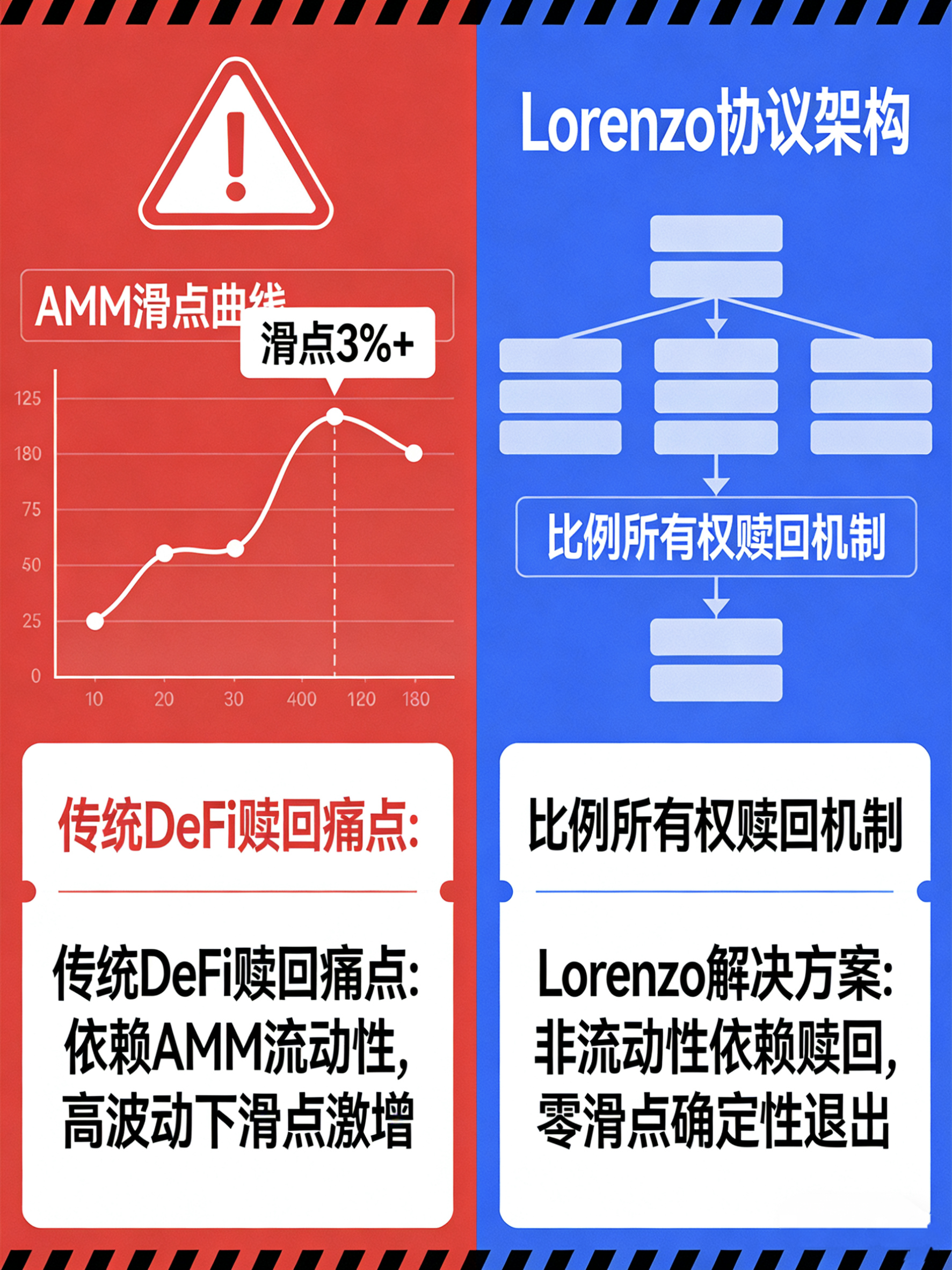
🔥 The redemption mechanism is independent, with no slippage concerns.
When users redeem, they receive proportional ownership of the investment portfolio, without the need to execute through AMM or order books, consuming no pool liquidity and not being affected by market fluctuations. Regardless of how the market changes, there is no need to rush to withdraw, fundamentally eliminating slippage risk and ensuring the stability of redemption returns.
📉 The net value anchors real assets, refusing distorted valuations.
The net value directly corresponds to the actual value of the held assets, relying neither on external liquidation processes nor being affected by execution conditions. Even if the market encounters liquidity stress, the net value remains objective and transparent, eliminating the issue of 'digital shrinkage,' allowing users to have a clear understanding of their asset status and avoid panic operations.
🌉 stBTC is stable across chains, with reliable anchoring logic.
The launched stBTC supports cross-chain circulation across 20+ chains, with unlimited redemption. The anchoring mechanism does not rely on arbitrage or third-party custody, but directly corresponds to the underlying Bitcoin exposure. Even in the event of a total market liquidity freeze, it can maintain anchoring stability, avoiding asset drift or decoupling risks.
During market turbulence, when other protocols face withdrawal pressure, high slippage, governance interventions, and other issues, Lorenzo, through its closed-loop architecture design, achieves a unity of redemption certainty, net value authenticity, and asset stability. The governance layer also cannot arbitrarily intervene in the core mechanism, further reducing human risk.
Liquidity imbalance is not an inevitable result of DeFi, but rather a product of protocol architecture choices. Lorenzo provides users with a more robust participation path through a design that 'does not rely on external liquidity.' For investors pursuing asset safety and averse to liquidity risk, this architectural innovation is worth a deeper understanding in conjunction with their own risk tolerance and investment needs.
@Lorenzo Protocol #LorenzoProtocol $BANK



