

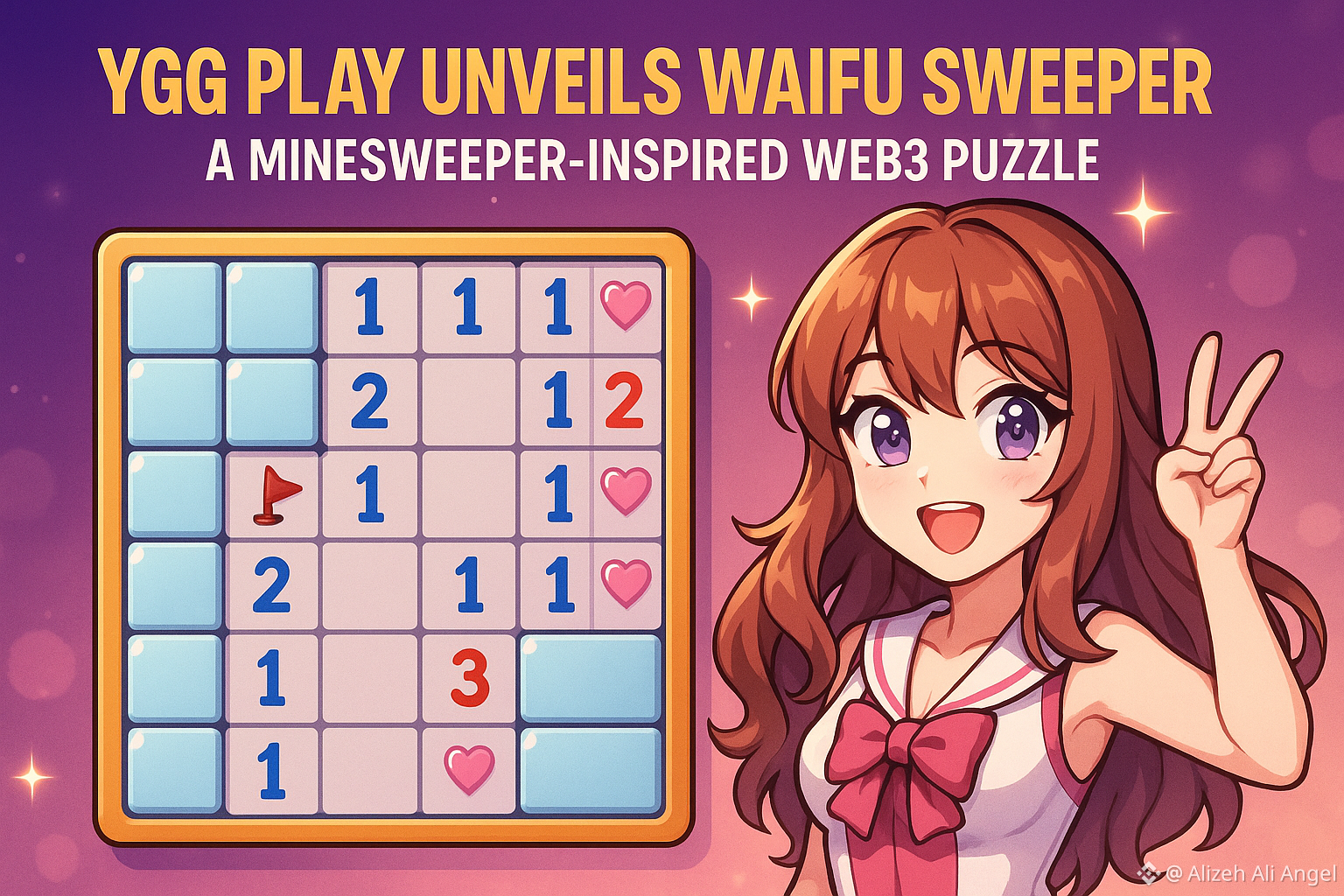
YGG Play’s reveal of Waifu Sweeper is easy to file under “quirky Web3 release”: a Minesweeper-inspired grid puzzle with anime companions and collectible rewards. What’s more interesting is how clearly it reflects where YGG wants to go next. This isn’t just another title with onchain dressing. It’s a small, deliberate proof point for YGG’s push from guild-era coordination into something closer to a modern publishing and distribution machine.
If you’ve followed Yield Guild Games since the early play-to-earn wave, the pivot makes sense. Guild coordination worked when the biggest problem was access—players needed assets, studios needed users, and the whole ecosystem rewarded speed over staying power. Then the cycle turned. Players stopped tolerating “work disguised as play,” and developers got tired of communities that arrived only for incentives and disappeared the moment those incentives weakened. A publisher’s job is harder and slower: onboarding that doesn’t feel like a chore, a release cadence that respects attention spans, and a reputation that survives past one token moment. YGG Play is basically YGG admitting that message boards and scholarships aren’t enough anymore; you need repeatable distribution and product discipline.
@Yield Guild Games That’s why the YGG Play Launchpad matters so much to this story. YGG is trying to build a hub where discovery and participation come first, and token access is downstream from that. On paper, the mechanism is straightforward: earn points through participation, then use those points to get access to early distributions. YGG Play has also described limits on how much any single wallet can take from an allocation pool, which is a small but real attempt to keep launches from becoming instant whale contests. It’s not automatically “fair”—any points system can turn into busywork—but it’s clearly designed to reward people who actually engaged with the games, not just people who showed up at listing time.
Waifu Sweeper fits that approach because the core loop is legible. A Minesweeper-like puzzle doesn’t give you much room to hide. If the rules are muddy, players sense it quickly. If the outcomes feel unfair, they leave quickly. That’s useful for YGG Play, because a game like this can act as a credibility check on the “skill” language Web3 loves to use. In plenty of projects, “skill” has meant “time spent clicking,” “money spent boosting,” or “access to better gear.” A logic puzzle is harder to fake. If the board generation feels fair and the reward curve doesn’t feel manipulative, the “skill-to-earn” claim becomes something players can actually test and argue about honestly.
The way YGG launched it is also very on-brand for the publisher it’s trying to become. The Art Basel Miami Beach tie-in, with a December 6, 2025 event co-hosted by YGG Play, Raitomira, and OpenSea, reads like a distribution move, not just a party. You’re borrowing attention from a cultural moment that already has gravity. And because Art Basel introduced Zero 10 as a digital-era initiative at the Miami Beach fair (with dates running in early December 2025), the “art + collectibles + interactive experience” overlap isn’t random; it’s a targeted attempt to meet audiences where they already are. This is YGG saying, quietly, that crypto-native reach isn’t enough. It wants new players who don’t wake up thinking about wallets.
On infrastructure, Waifu Sweeper is slated for Abstract, the Ethereum Layer 2 associated with Igloo Inc. (the Pudgy Penguins parent company), and marketed around consumer-friendly onboarding and app discovery through a central portal. Whether Abstract becomes a long-term “mainstream” home is still a live question, but the intent aligns with YGG Play’s priorities: reduce friction between curiosity and play. If a player has to clear five setup hurdles before they can click a tile, the puzzle doesn’t matter. Abstract’s portal framing—discover apps, manage a wallet, earn badges/XP in one place—fits the kind of low-friction funnel a publisher wants.
This is where the YGG angle becomes the main angle. A puzzle game like Waifu Sweeper doesn’t need a massive marketing budget if it can plug into an ecosystem that already has quest rails, creator amplification, and a habit of trying new releases. That’s what YGG is trying to productize: a repeatable path from “new game” to “active community,” with the Launchpad acting as the incentive glue. Reporting around the partnership frames it as a publishing deal intended to connect the studio (Raitomira) to YGG Play’s network and distribution layer, which is the part most indie teams can’t easily build alone.
I’m still cautious about the collectible layer, because “cute collecting” can slide into compulsion if rarity and rewards are tuned to push chasing behavior. But I get why YGG is making this bet. Small, readable, short-session games are easier to trust, easier to share, and easier to revisit. And right now, trust is the scarce resource in Web3 gaming, not ideas. If YGG Play can stack enough releases that feel straightforward and fair—and keep its access mechanics from turning play into unpaid labor—it has a real shot at becoming the kind of publisher that outlasts cycles, rather than just surviving them. Waifu Sweeper matters less as a single title and more as a signal: YGG wants to win on distribution and retention, not on hype.

