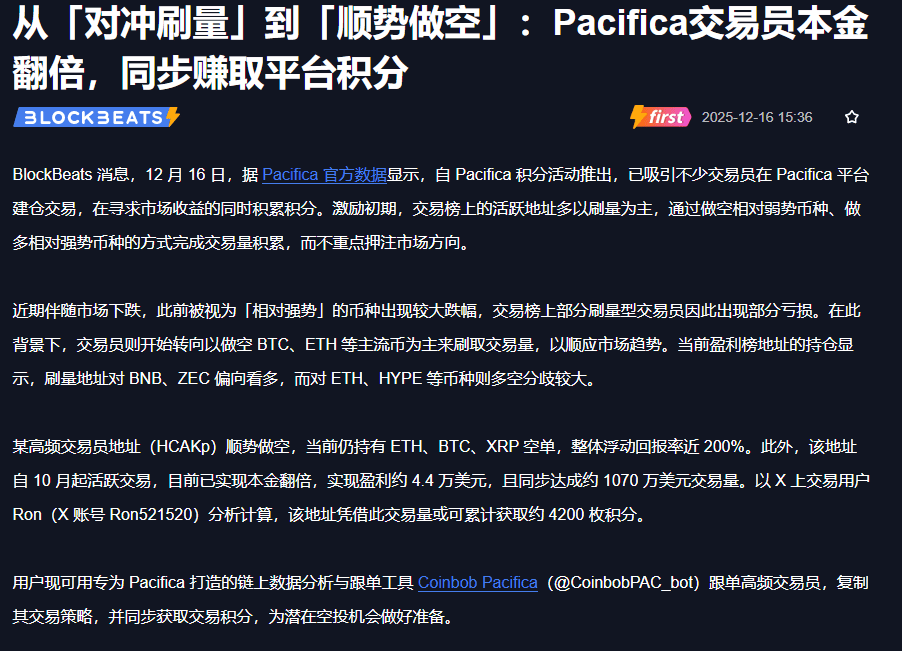
Seeing this news, I feel a bit emotional and also want to chat with my brothers. The circle is still the same, but the way of playing is really accelerating iterations.
My core point is just one sentence: this is not simply a story of 'following orders', but a precise hunt about 'trading purposes' and 'market stages'.
Let's first break down the insights in this picture.
From 'brushing volume' to 'going with the trend', it reveals the true rhythm of the event.
In the early stages of the event, why is it that the leaderboard is all about 'hedge brushing'? Because of the rules. The platform incentivizes trading volume with points, and smart traders immediately find the optimal solution: don’t bet on direction, just brush the trading amount, using minimal risk to reap the points. This is essentially an arbitrage behavior; the money made is not from the market, but from the event rules.
But now the market has dropped, and the wind has changed. Simple volume brushing strategies like going long on 'relatively strong coins' have started to lose money, indicating that the overall beta trend strength of the market has surpassed the alpha individual difference opportunities. At this time, top players quickly switch strategies, combining 'brushing points' and 'trend trading' into one. Shorting mainstream coins not only follows the market trend but also continues to brush volume to earn points. That doubling address is the hunter that perfectly executed this strategy.
The truth of 'doubling' is the victory of compound returns.
Don't just focus on his 'capital doubled, earning $44,000.' If you calculate carefully, he has been active since October; the market has provided a downward trend beta, and he has amplified this return-enhanced alpha through high-frequency trend operations. Meanwhile, each trade is also accumulating platform points as extra incentive returns for him. This is a triple return overlay. What he earns is far more than just directional money.
The emergence of the tool Coinbob is an opportunity, but also a trap amplifier.
The news finally pointed out the copy trading tool, which is a crucial step. It lowers the threshold for ordinary users to copy strategies but also greatly confuses 'causality.'
The danger lies in: beginners see 'following this address can double and earn points,' but veterans see 'this address succeeded through compound strategies in specific past market environments.' What if the market phase has changed? What if his strategy has been fine-tuned? The trades you follow may just be his positions opened for volume brushing, which you cannot understand. Tools allow you to 'synchronize,' but cannot make you 'synchronize thinking.'
So, brothers, what should we do next.
First, understand the game before deciding whether to place a bet.
Facing any platform's points and incentive activities, first ask yourself: what are the core rules of the activity? Is it trading volume, position, or invitation? In the current market phase of unilateral rise, fall, or fluctuation, what is the optimal strategy to complete this rule? Like the case of Pacifica, the optimal solution in the early stage was volume brushing, and the optimal solution during the decline was to short and brush volume. What you need to do is not blindly follow a certain 'profit leaderboard' address, but understand what the optimal solution is for the current phase.
Second, if you follow trades, please 'follow logic,' not 'follow code.'
If you decide to use a copy trading tool, be sure to take the time to understand the trading logic of the address you are following. Is he simply brushing volume, or is he trading with the trend? What is his position adjustment rhythm? Are his current short positions based on a bearish outlook for the future market, or just to complete a trading volume? Only follow strategies that you can understand and that are logically consistent. If you don't understand, it's better not to follow; that $44,000 profit has nothing to do with you, but the risk of liquidation is definitely related.
Third, always control your own risk switch.
There are no gods in the crypto market. Behind every 'doubling' carries risks and drawdowns that you may not be able to bear. Copy trading tools can copy his opening and closing positions, but cannot replicate his capital scale, risk tolerance, and instant decision-making. Be sure to set your own stop-loss line and ask yourself: if the market trend suddenly reverses, what will happen to this strategy? Am I ready?
Point activities are a nice dessert in a bear market, but they should never be treated as a staple food. What that trader earns is the triple money of trend, strategy, and activity rewards. What we can learn is his adaptive thinking model with clear goals, not a specific contract address.
The market is always changing; next time, the optimal solution may be different again. Maintain thinking, maintain respect, to not only survive longer in this circle but also achieve gains.
Let's encourage each other.