
Currently (December 16, 2025), the Bank of Japan's (BOJ) policy rate is 0.5%. The market highly expects a 25 basis point hike to 0.75% at this week's (December 18-19) monetary policy meeting, which would be the highest level in 30 years. Economist surveys show a greater than 90% probability of supporting this rate hike, primarily due to persistently high inflation above the 2% target, strong wage growth, and imported inflationary pressures from a weak yen. Although the rate hike may be small (Japanese interest rates remain significantly lower than global levels), its reversal through the yen carry trade mechanism could amplify the impact on global financial markets.
Core Mechanism: Reversal of Yen Carry Trade
• Arbitrage trading principle: For a long time, Japan's low/negative interest rates have enabled investors to borrow cheap yen and invest in high-yield assets (such as US stocks, technology stocks, cryptocurrencies, emerging market bonds, etc.).
• Impact of interest rate hikes: Increased borrowing costs for the yen + expected appreciation of the yen → investors liquidate positions (sell overseas assets and repay yen loans) → tightening global liquidity and increased pressure to sell risky assets.
• Historical evidence: Several BOJ rate hikes in 2024-2025 triggered market volatility (such as the global stock market crash in August 2024).
Impact on US stocks
• Negative pressures predominate: Arbitrage trading liquidation could lead to capital outflows from US stocks, particularly tech and growth stocks (the main targets of arbitrage funds). Expectations of interest rate hikes in 2025 have already increased volatility in US stocks, and some analysts believe this could trigger a "global margin call," forcing leveraged investors to sell.
• Specific manifestations:
US stocks (such as Nasdaq and S&P 500) are under short-term pressure and may experience a 5-10% pullback.
Highly valued technology stocks (NVDA, MSFT, etc.) are more sensitive because they rely on low-cost financing.
• Mitigating factors: The Federal Reserve may cut interest rates (offsetting some of the liquidity tightening), and rate hikes have already been partially priced in by the market (80-90% of expectations have been priced in). In the long term, if the Japanese economy remains stable, the fundamentals of the US stock market (such as AI growth) will still support a rebound.
• Historical analogy: In 2024, the BOJ's interest rate hike triggered a brief plunge in US stocks, but they subsequently recovered quickly.
Impact on cryptocurrencies
• High sensitivity, more obvious negative impact: As a high-risk, high-leverage asset, cryptocurrency is extremely sensitive to changes in liquidity and is often regarded as a "bellwether for arbitrage trading".
• Historical mode:
◦ In the past, after several BOJ rate hikes, Bitcoin (BTC) has fallen by an average of 20-30%.
▪ Interest rate hike in March 2024: BTC will fall by about 23-27%.
▪ Interest rate hike in July 2024: Drop of approximately 26-30%.
▪ Interest rate hike in January 2025: Drop of approximately 30-31%.
• Current expectation: This rate hike may push BTC down to the $70,000-$80,000 range (currently around $86,000-$90,000). Reasons include the ripple effects of leveraged liquidations and the spread of risk aversion.
• Other crypto assets: Altcoins, DeFi, etc. may see even larger drops (over 30%).
• Possible positives: If the rate hike signals are mild (BOJ emphasizes a gradual approach) and the Fed's rate cuts provide a hedge, the crypto market could rebound quickly. In the long term, rising crypto adoption (such as institutional inflows) could offset short-term shocks.
Summary of Overall Financial Market Impact
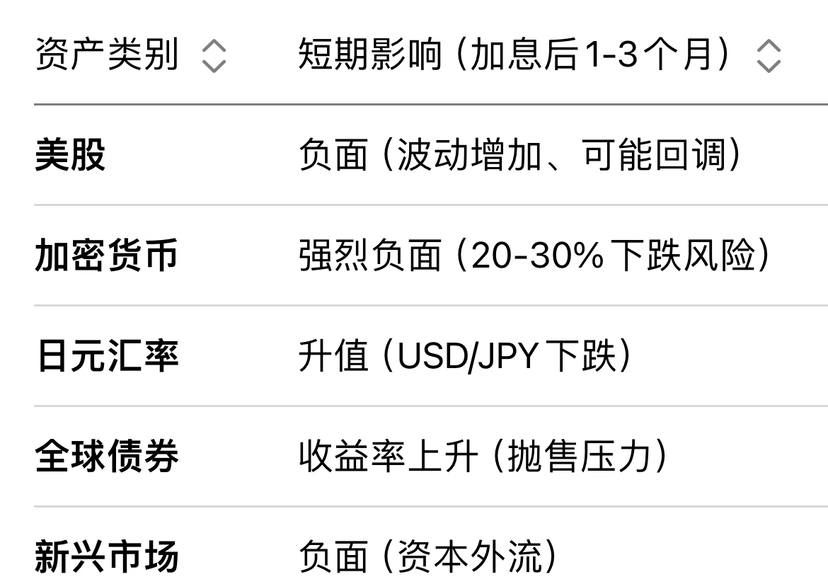
Risks and Outlook
• Worst-case scenario: If interest rate hikes exceed expectations (or are accompanied by hawkish guidance), a repeat of the global risk asset crash of August 2024 could occur.
• Baseline Scenario: The shock is manageable (already priced in), and the market rebounds after a short-term correction. Japan's interest rate hike is part of "policy normalization," aimed at sustainably controlling inflation, rather than aggressive tightening.
• Recommendation: Investors should pay attention to the BOJ meeting results on December 19th and Governor Kazuo Ueda's press conference (signals on future interest rate path). Diversified asset allocation and reduced leverage can help cope with volatility.
Overall, the yen interest rate hike signals Japan's departure from its era of loose monetary policy and serves as a "liquidity rebalancing" signal for global markets, with short-term pain outweighing long-term benefits. $BTC


