
This wave of market in 2025 is a bit magical:
On one side, BTC ETFs continuously attract capital, various L2s of BTCFi are blooming, while on the other side, AI Agents are exploding, and RWA scale is becoming more and more real money.
What needs to be processed on-chain is no longer just "the price of BTC/USDT", but:
Government bonds, funds, and stock index PoR report PDF
NFTs, physical commodity pegs, advertising materials images and videos
Text, metrics, and sentiment signals tossed around between AI Agents
Even live broadcasts and social channels' real-time events
The question arises: most oracles today are still "feeding decent prices but only feeding prices."
At this very moment, APRO was doing two things:
Listing on exchanges: Binance, Ourbit, and Ju.com have all listed AT. Binance even launched a promotion offering 15 million AT tokens, effectively landing its name on the front page of its marketplace. (NFT Evening)
Product Upgrade: APRO officially launches AI Oracle + ATTPs, with its roadmap including support for images/PDFs, videos, and live streaming over the next two years. (Binance)
If you only consider APRO as "Oracle 3.0", you're wasting your time.
A more accurate way to understand it is to view APRO as a "multimodal AI data layer" that is quietly rewriting the data infrastructure of DeFi, RWA, BTCFi, and even multi-agent networks.
APRO: Why will oracles eventually need to be fed more than just prices?
Oracles have an old problem:
In a simple world, price is enough; in a complex world, "only feeding prices" becomes a risk.
In several real-world scenarios, you can hardly solve a problem with just one number:
RWA Lending:
"What is the reserve ratio of this government bond fund?" It cannot be explained by a single price, but by an entire audit report, multiple custodians, maturity dates, and rating changes.Predicting the market:
"Did a certain candidate win or not?" "Is public opinion bullish or bearish?" What's needed is...A comprehensive assessment of text, news, and social media.。AI Agent:
The agent doesn't just look at the price; it reads PDFs, looks at images, and scrapes tweets before finally making a "yes/no/how much" decision.BTCFi / L2:
Bitcoin itself has very weak scripting capabilities, but L2 aims to do very complex things, requiring underlying...Multi-chain, multi-source, multi-modal dataA unified view. (Binance)
The typical approach of traditional oracles here is:
Add more data sources;
Add a TVWAP/TWAP algorithm;
Add a few more parameters, attempting to cram everything into the narrow tube of "price flow".
The problem is—
A PoR report is not a candlestick chart;
Emotions, public opinion, and compliance status are not indicators of stock price movements.
Images and videos, and certainly not candlestick charts.
APRO realized this and simply thought in reverse:
"Instead of forcing the world into a single price, we should acknowledge that the world is multimodal and then build an AI Oracle layer that can handle multimodal data."
This also explains why such a strange string of things appears in APRO's roadmap:
Price, RWA, VRF → Images/PDFs → Videos → Live Streaming → Privacy PoR → Self-developed LLM → Fully Open Network. (Binance)
In other words, what APRO wants to earn is not just "oracle fees," but all the data bills for "machines understanding reality" in the coming years.
How did APRO's multimodal data engine come about?
1) APRO's AI parsing layer: First, translate the world into a machine-readable format.
The first layer of APRO is actually doing a very "dirty" job:
Translate the noise of the human world into structured signals that machines can understand.
This layer of work includes:
Text and PDF:
Audit reports, financial statements, PoR reports, and regulatory notices all need to undergo OCR + semantic parsing to extract fields such as "reserve ratio, exposure, maturity, and restriction clauses"; (Blockweeks)Images and charts:
The RWA project requires that warehouse photos, pledge certificates, and even photos of offline locations be identified by "time, location, subject matter, and unusual areas"; (Binance)Videos and Live Streams (Roadmap):
In the future, APRO plans to support the analysis of video and live streams, meaning that a "verifiable narrative summary" can be woven from live-streaming e-commerce, offline events, and meeting outcomes. (Binance)
These things cannot be processed directly on the blockchain;
APRO uses AI models off-chain to compress these into sets of "machine-readable facts".
The significance of this step is very simple:
For the agent, it no longer needs to roll a bunch of crawlers and models itself;
For contracts, they only deal with "structured fields," leaving the complex world to APRO's AI layer.
2) APRO's OCMP + multi-source verification: providing a "review link" for each modality.
AI alone is not enough; AI can also experience hallucinations.
APRO's architecture emphasizes one thing: multi-source + traceability. (JuCoin)
It uses a combination of OCMP (Off-Chain Message Protocol) and multi-source verification:
Multiple nodes pull data from different data sources;
Each system runs the same parsing/scoring process locally.
Sign the result;
Then, the accounts are reconciled and aggregated through the OCMP network to form a consensus result;
Finally, APRO pushes or provides this "consensus signal" to the chain.
This process can be illustrated like this:
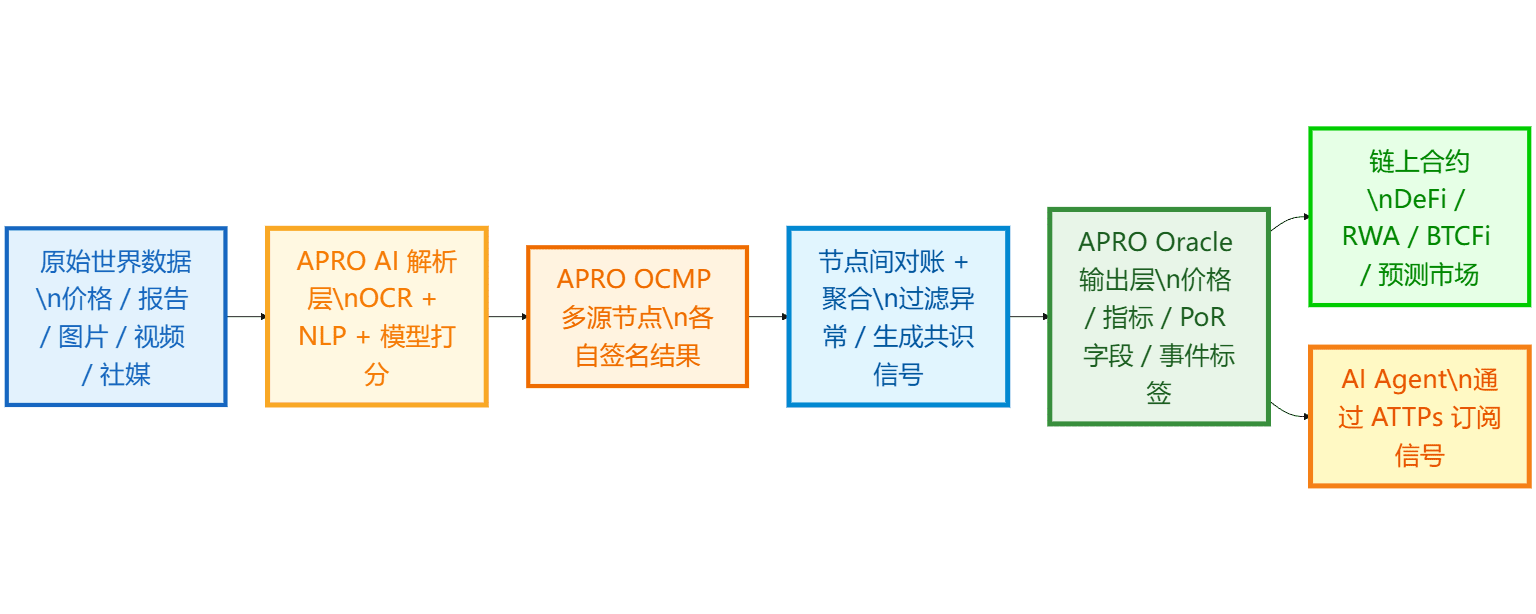
The advantages of this OCMP design are:
Every key decision (a certain price, a certain PoR field, whether a certain event occurred) can be traced back to the node signature and original source afterward;
If a node exhibits abnormal behavior over a prolonged period, the AI layer's scoring and on-chain challenge mechanisms will reduce its economic returns or even result in penalties. (JuCoin)
For the oracle industry, this is more solid than simply shouting "we are multi-source, we are decentralized"—it provides a traceable chain of evidence.
3) APRO's ATTPs: Establish a dedicated line for a multi-agent network.
Another important reason for APRO's recent surge in popularity is that AI Oracle + ATTPs has actually been launched, not just on PowerPoint slides. (Foresight News)
The positioning of ATTPs (AgentText Transfer Protocol Secure) can be roughly understood as:
"HTTPS + WebSocket for AI Agent, an encrypted communication protocol specifically designed for multi-agent networks."
It mainly does three things in APRO:
Unified entry point:
Instead of searching for APIs, the Agent can access various modal data—prices, social media, signals, random numbers, etc.—prepared by APRO through ATTPs.With metadata:
Behind each piece of data is metadata such as "source / time / credibility / whether it has been challenged". The agent can filter as needed, instead of blindly consuming data.Verifiable:
If a key decision made by an Agent needs to be written back to the blockchain, it can be done through the APRO channel with the signature and context, allowing other contracts and Agents to verify and challenge it.
what does that mean?
For multi-agent networks, APRO is not just a "data provider," but also a **"ledger + arbitrator"**.
For on-chain applications, the statement "I trust this agent's judgment" finally has a verifiable technical path, rather than blind trust.
4) APRO's multi-chain layout: First, flag all the potential hotspots.
Multimodal data has limited value if only one chain is used.
APRO's ambition is to lay its Oracle layer at the intersection of the BTCFi + BNB + EVM multi-chain ecosystem:
From the outset, it has emphasized being "an oracle network built for the Bitcoin ecosystem," supporting BTC L2, Runes, RGB++, and more; (Ourbit)
Simultaneously, it signed a partnership with BNB Chain, entered Binance Alpha, and then launched official spot trading and events, directly embedding APRO into BNB's DeFi/AI/prediction market scenarios; (Binance)
It also integrates with new public chains like Aptos, following a "multi-chain, one Oracle language" approach. (Aptos Network)
There is a very practical consideration behind this multi-chain strategy:
"APRO will plant its flag wherever there is a surge in demand for combined AI, RWA, and BTCFi."
Once these platforms truly reach a certain scale, APRO will naturally become that "cross-ecosystem shared data layer," rather than being locked into a local story within a single chain.
The chain reaction brought about by APRO
1) For regular users: The first question you can ask is, "Where did this data come from?"
Today, most users who use DeFi only look at three things:
interest rate;
LTV;
Liquidation price.
Oracles are a black box to them; they only remember their existence when something goes wrong.
If APRO combines multimodal data with a traceable chain of accountability, it yields a very interesting result:
The wallet and front-end can be displayed directly:
This price is from APRO;
How many nodes and sources are behind it?
Latest PoR report update time;
Is there a historical record of this challenge?
You don't need to know all the details, but you can at least make a simple choice:
“I want to allocate more of my portfolio to those agreements that are willing to show me their data sources.”
This isn't a short-term speculative tactic, but it will change how capital prices risky assets in the long run.
2) For developers: From "reading prices" to "attaching a complete perception system"
For developers, the changes brought about by APRO's multimodal oracle are more intuitive:
past:
In the contract, you only read latestRoundData();
All the complex logic is handled by building a bunch of custom off-chain services.
With APRO:
You can read the price, PoR field, and AI-evaluated event tags all within a single SDK;
You can directly subscribe to the AI analysis results of a specific news/sentiment/event stream to determine your rates, settlement parameters, or reward strategies. (Binance)
This is equivalent to attaching an "external world perception system" to the protocol.
APRO handles the entire process for you: data acquisition → parsing → verification → chain feeding.
3) For institutions and RWA: Audit reports become "machine language" for the first time.
For RWA to truly grow, there are two key roles:
Asset managers who are willing to endorse their products;
An auditing firm that is willing to sign.
What ACs hate most is the "invisible and intangible" black box risk on the blockchain.
APRO's approach to PoR is actually quite "institution-friendly":
Structure the key information in the PoR report and turn it into fields that can be called by the contract;
Write the update frequency and non-compliant status into the on-chain state as well;
This allows lending protocols and stablecoin protocols to configure their own risk control logic by field, instead of passively trusting the team. (NFT Evening)
From an institutional perspective, this is equivalent to:
"My compliance team and my contracts are finally speaking the same language."
“I can break down PoR risk into a series of indicators and incorporate them into my own risk control model.”
This is why traditional giants like Franklin Templeton are willing to stand on the APRO cap table: they are essentially betting on an infrastructure story that combines "AI + Oracle + RegTech". (Gate.com)
APRO's position in this wave of multimodal AI
Finally, let's shift our focus back to the traders.
Currently, APRO is clearly still in the middle of the "product → integration → narrative formation" stage:
The launch on Binance, the AT event, and listings on major exchanges have brought the name to the forefront; (NFT Evening)
AI Oracle + ATTPs has been implemented, and multi-chain coverage and the positioning of BTCFi are now being incorporated into every project analysis; (Foresight News)
The roadmap lists a full suite of "multimodal heavyweights"—images, PDFs, videos, live streaming, privacy PoR, self-developed LLM, and a completely open network—making its ambition hard to ignore. (Binance)
If you're considering APRO as a long-term investment target, I'll be watching three lines:
Realization rate of the multimodal roadmap
Image/PDF → Video/Live Stream → Privacy PoR: Have these nodes been launched on time, and how many actual calls have been made?
It's not about writing white papers, but about looking at the blockchain, the SDK, and cooperation announcements.
The penetration rate of AI Oracles and ATTPs in the Agent ecosystem
How many head agent/multi-agent frameworks default to treating APRO as the "external reality entry point"?
How many decisions are made by “stating: source APRO”, instead of being hidden in a private backend?
How much of APRO's revenue is being reinvested in security and data quality?
Does AT's fee, staking, and incentive structure truly reward "high-quality data" and "long-term nodes"?
Are APRO willing to allocate a portion of its profits to safety and challengers in the long term, instead of just spending money on marketing?
If this wave of multimodal AI truly comes to an end, looking back:
Oracles that only feed "single price" data will naturally be pushed to the margins;
What will truly remain is the data layer that can understand text, images, videos, and live streams, as well as communicate with contracts and agents.
APRO is clearly betting that it will become that data layer.
As for whether we will win this bet, it is worth keeping APRO on our watchlist—not focusing on the next candlestick, but on how it handles every product node, every integration, and every data incident.



