
When the time enters 'whale rebalancing season', you will notice a very interesting phenomenon:
On-chain large addresses start to withdraw part of their positions from volatile assets and reinvest in stablecoins—
But they won't just ask 'which one has a higher interest', but will first ask:
'Which stablecoin can withstand my size?'
Once the size reaches 'whale level', the pain points completely change:
It's not just about the safety of the principal, but also the need for sufficient depth in deposits and withdrawals;
It's not just about high interest rates, but also that the returns must have sources that can be broken down;
It's not just about resisting inflation, but also that liquidity cannot be cut off entirely due to regulation or blacklists.
The ambition of USDD 2.0 lies here:
What it wants to do is not a 'pure retail high-yield coin,' but a decentralized interest base that can hold large stablecoin positions—
especially at this time when macro uncertainty and large funds are repositioning.
USDD 2.0: first, fill in the 'whale's bottom line'
From the perspective of whales, several basic settings of USDD 2.0 just happen to meet their bottom line requirements:
USDD 2.0 is an over-collateralized USDD stablecoin
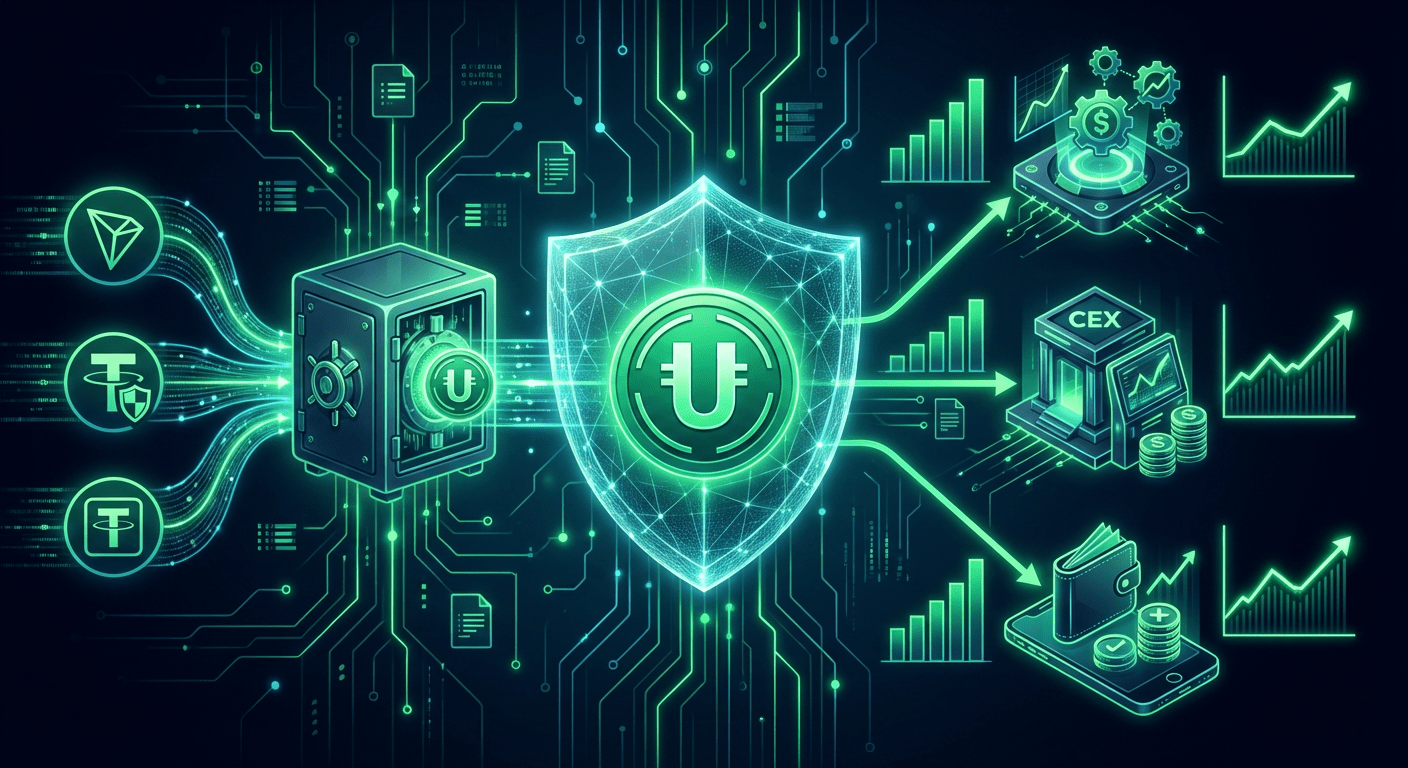
Collateral assets include TRX, sTRX, USDT, etc., locked in on-chain contracts;
The overall collateral rate is consistently above 100%, and when it touches the liquidation line, it will trigger an auction to recover, avoiding systemic bad debt accumulation;
This means: when large funds enter, they are looking at a complete asset sheet, not the promises of a specific team.
USDD 2.0 is a completely on-chain, non-freezable stablecoin
Minting USDD depends on whether you have collateral, not whether you 'pass KYC on a certain platform';
The contract layer has no blacklist and does not accept 'single-point permission to freeze assets', which is especially important for whales operating in multiple jurisdictions;
Whales care more about: 'Do I have the option at any time, rather than being stuck by some centralized entity.'
USDD 2.0 now has a whole multi-chain connection with CEX/Wallet
The main battlefield is in TRON, but it has already been natively integrated with ETH, BNB, and other main chains;
Supported by JustLend DAO, HTX Earn, Pancake USDD–sUSDD pool, and Binance wallet Yield+ and other entrances;
For large funds, this means: positions can flow between different scenarios and will not be stuck by any single protocol.
These three points combined mean that USDD 2.0 has at least obtained a qualification from the whales:
'We can discuss whether to share a piece of the pie in the stablecoin basket.'
Whales care more about 'can I exit?'
Retail investors look at 'how much can I earn after going in';
Whales first look at 'when I want to exit, is there anyone to take over'.
USDD's PSM: guarantees the 'entry and exit' for large positions
USDD 2.0 uses the PSM (Peg Stability Module) structure to do something very realistic for large funds:
Allow USDT / USDC to be exchanged for USDD at a ratio close to 1:1, even large entries and exits will not cause slippage;
When market panic occurs and USDD drops below $1 in the secondary market, arbitrageurs will use cheap USDD to PSM to exchange back for $1 mainstream stablecoins;
When USDD is slightly above $1, reverse arbitrage will also be pushed back to the pegged range.
For whales, this is equivalent to an on-chain 'entry-exit pass':
It's not about how deep the order book of a particular CEX is, but whether the reserves of the PSM pool itself are thick enough;
It's not about betting that a certain platform won't shut down, but using contracts to lock in the right to 'redeem at face value at any time.'
This is why in the design of USDD, PSM is not an 'optional' supporting role, but one of the main characters that gives large positions peace of mind.
Give large positions a 'modelable interest curve'
Whales and retail investors have a key difference:
Retail investors can get in on a whim, while whales must write everything into models.
USDD itself: the 'low-volatility note' of the principal layer
USDD compresses price fluctuations within a very narrow range through over-collateralization + PSM;
For models, this part can be approximated as the '1 dollar face value' base used to absorb liquidity buffers during position fluctuations.
sUSDD: turning USDD into a floating rate bond
Whales can first break down a USDD position and pledge it as sUSDD;
The APY earned from sUSDD comes from the real earnings of Smart Allocator in various DeFi protocols;
For risk control models, this is equivalent to holding an on-chain floating rate bond with USDD as the principal and protocol cash flow as the coupon.
The advantage lies in:
Interest sources are public: which protocols Smart Allocator has invested in, how large the positions are, and how the historical yield rates have changed are all on-chain;
Interest can be adjusted: when the overall DeFi interest environment declines, strategies can change targets and reduce leverage, but all of this is done under contractual constraints;
Interest can be compared: whales can directly compare the historical APY curve of sUSDD with the borrowing rates of USDT/USDC and CEX Earn rates in one chart to make decisions.
Outer activities: the 'optional acceleration gear' for whales
BNB Chain's USDD–sUSDD LP + Merkl rewards;
Activities of JustLend DAO and HTX Earn;
Binance wallet Yield+ liquidity incentives...
These are 'sweeteners' for retail investors, but optional acceleration gears for whales:
If you want to be more stable, just eat the sUSDD benchmark interest rate;
If you want to squeeze a bit more, throw part of your position into the activity pool for extra incentive returns;
Always aware: which part of the yield comes from real cash flow and which part comes from short-term subsidies.
The three most important things in the eyes of whales
Switching the perspective entirely to whales/institutions, we will find that USDD 2.0 has three relatively special points.
USDD 2.0 gives whales a 'clean decentralized base'
For many large funds, the biggest pain point in the past was:
Either relying on 'freezable' centralized stablecoins or holding some decentralized stablecoins with opaque mechanisms.
The combination of USDD 2.0 is relatively simple and straightforward:
Rules are written in the contract: collateral ratios, liquidation logic, PSM mechanisms, Smart Allocator restrictions, all fixed on-chain;
Assets are laid out on-chain: collateral positions, PSM pools, Smart Allocator positions, just look at the chain, no need to wait for the team to write a PDF;
Minimal permissions: non-freezable, open minting, exit paths have PSM backing.
For whales, this translates into one sentence:
'You may not be the most compliant, but you are one of the few decentralized stablecoins that dare to lay all the asset sheets bare for me to see.'
USDD / sUSDD is one of the few stable positions that can be 'written into interest models'
Institutions and whales like to ask two questions when making allocations:
What is the historical volatility range of this interest curve?
How does its source change in different macro environments?
The advantage of USDD 2.0 + sUSDD lies in:
The source of interest is clearly broken down: real DeFi interest + incentive subsidies;
The base of interest can be tracked: Smart Allocator's exposure to different protocols can analyze risks on a position-by-position basis;
The trend of interest is predictable: when the overall DeFi interest environment changes, the adjustments USDD can make are written into the contract, rather than relying on human decisions.
This is especially important during a cycle of 'the Federal Reserve raising interest rates to lowering interest rates':
Everyone knows interest rates will change, but they care more about 'why this line changes'.
USDD 2.0 at least provides an answer that can be written into a PPT.
USDD 2.0, for large funds, is a tool for 'diversifying regulatory and compliance risks'
The last point is easily overlooked by retail investors, but it is very realistic for whales/institutions:
Some jurisdictions have high acceptance of 'freezable centralized stablecoins' due to regulatory friendliness;
But for large funds, putting all positions in this type of stablecoin is equivalent to concentrating regulatory authority in the hands of a few entities;
The decentralized, non-freezable, and fully on-chain transparent model of USDD 2.0 can instead serve as a hedging tool for 'diversifying regulatory paths.'
From a strategic perspective, this is very common:
One part of the position is placed in compliant stablecoins (for easy reporting and fund flows);
One part of the position is placed in decentralized stablecoins (to hedge against single-point freezing and political risks);
What USDD 2.0 wants to occupy is this latter part.
During the whale rebalancing season, do you want to share a 'similar interest curve'?
Finally, shift the perspective back from whales to ordinary players.
From a retail investor's perspective, you don't need to have tens of millions or hundreds of millions in positions,
to utilize the interest curve of USDD 2.0 and sUSDD.
You can simply understand it as:
Whales are looking: 'Is USDD 2.0 worth putting into my stablecoin basket as a decentralized interest base?'
Retail investors can ask: 'Should I use part of my position to follow this interest curve and earn some coupons?'
USDD 2.0 will not be the answer of 'zero risk and guaranteed profit'—
The price fluctuations of collateral assets, the risks of DeFi strategies themselves, and changes in the macro environment are all written in reality.
But in the 'whale rebalancing season' of 2025,
If you are reassessing your stablecoin positions,
Apart from that basket of USDT / USDC,
USDD 2.0 / sUSDD is this 'decentralized interest curve',
At least it's worth opening the chart and taking a serious look.
Ultimately, which path to choose is still your choice;
What can be done with the boat to seek the sword is to help you find the path of USDD 2.0,
Try to break it down more clearly.
This article does not constitute any investment advice, and the returns and risks related to USDD / sUSDD are subject to official disclosures and actual on-chain data, please make decisions based on your own risk tolerance.


