
A Quiet Shift in How Intelligence Is Built
Crypto has already changed how money moves. Artificial intelligence is changing how decisions are made. What most people do not realize yet is that the next big shift is not about faster chains or smarter models. It is about how intelligence is organized and shared.
KITE enters this space without noise. It does not promise shortcuts or overnight revolutions. Instead, it focuses on structure. The kind of structure that allows systems to grow without breaking.
KITE Token supports a modular ecosystem where AI tools, data resources, and computational power operate independently while remaining connected. This idea may sound simple, but its impact is deep.
Why Modularity Matters More Than Platforms
Most AI systems today are built like towers. One company controls the model, the data, the pricing, and access. These towers grow fast but age poorly. Innovation slows. Costs rise. Control tightens.
KITE avoids this design completely.
Instead of a tower, KITE builds a marketplace of parts. Each part does one job well. AI models exist as modules. Datasets exist as modules. Compute exists as a module. Anyone can create one. Anyone can use one.
This approach mirrors how real innovation happens. Small components improve independently while still working together.
The KITE Modular Ecosystem
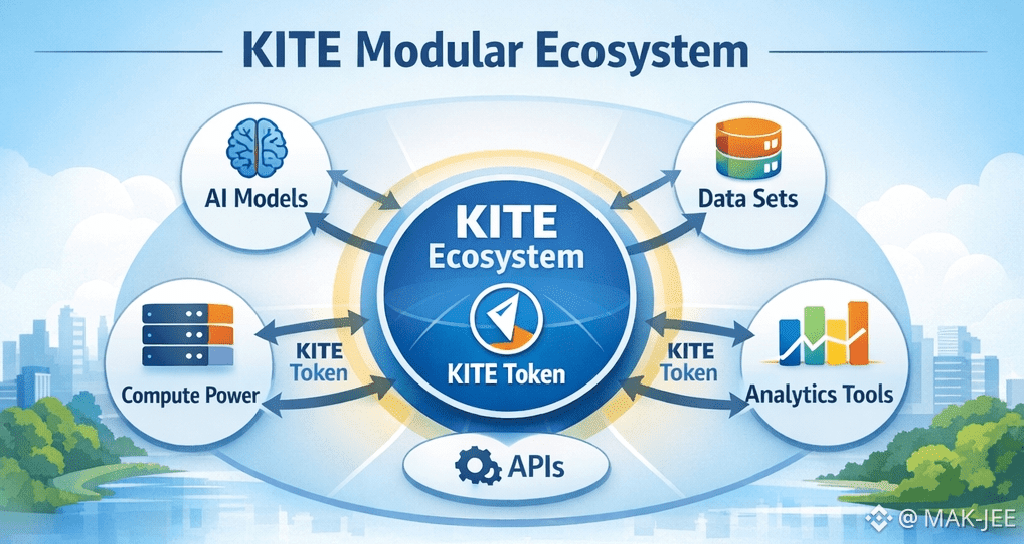
This image represents KITE as a connected network rather than a single product. At the center sits the KITE ecosystem, powered by KITE Token. Around it are independent modules such as AI models, datasets, analytics tools, APIs, and computing resources.
The image shows value flowing between users and creators. No module owns the system. The system exists because all modules participate.
This visual helps explain why KITE is flexible by design.
Understanding the Modular Marketplace in Simple Terms
Think of KITE like a digital tool market.
A user might need an AI model today and a dataset tomorrow. A startup might combine multiple modules to build a product without owning infrastructure. A researcher might publish a dataset and earn from its usage.
KITE allows all of this without permissions or gatekeepers. Users pay only for what they use. Builders earn only when they provide value.
This balance keeps the ecosystem healthy.
The Infrastructure Behind KITE
KITE is built using a layered architecture that avoids common mistakes seen in AI and blockchain projects.
The system separates trust, computation, and interaction into distinct layers. This keeps performance high while maintaining transparency.
How KITE Works Internally
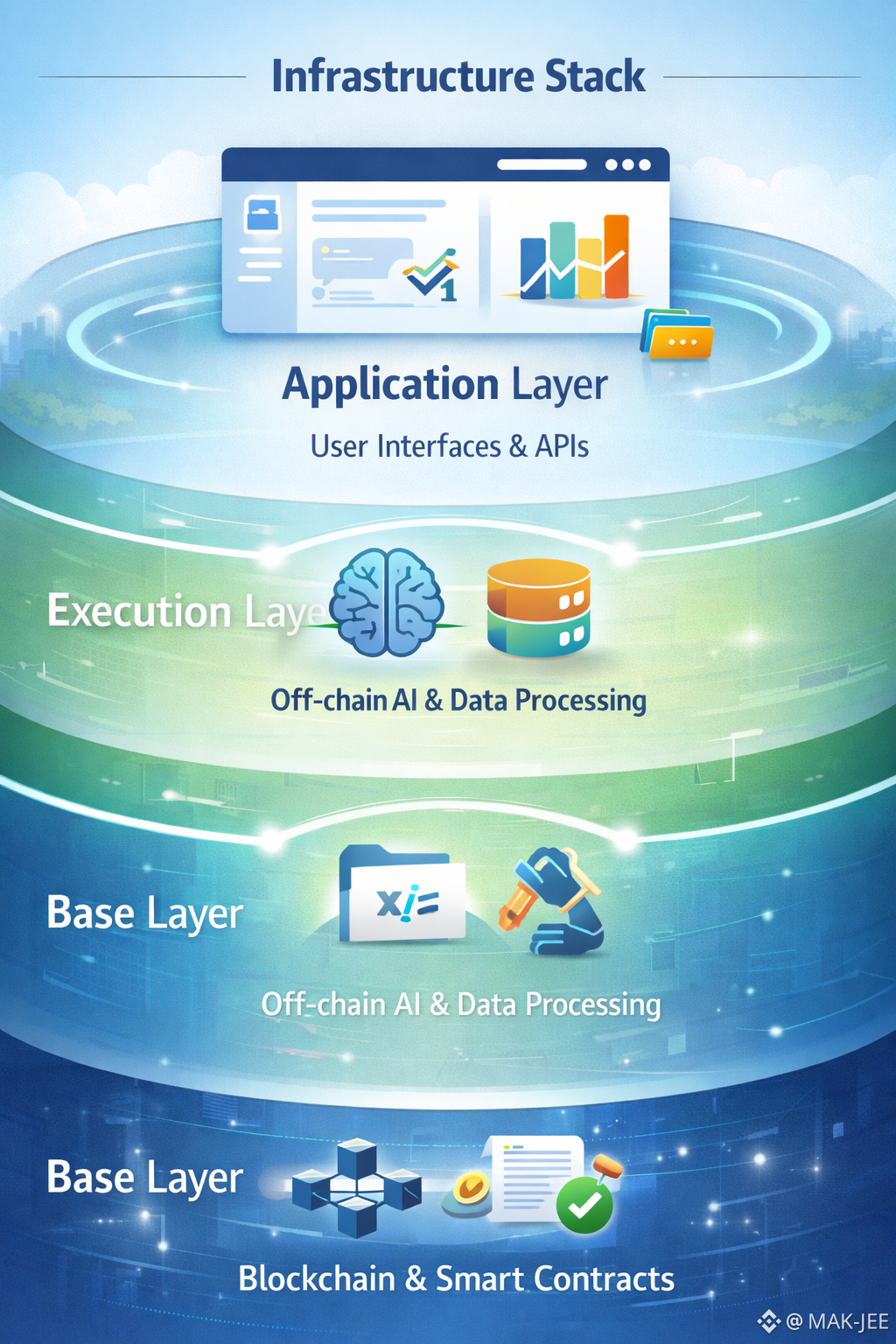
Application Layer
This is where people interact. Dashboards, APIs, and interfaces live here. Users do not see complexity. They see tools that work.
Execution Layer
This layer runs AI models and processes data off-chain. Heavy computation happens here so the network stays fast. Results can be verified without slowing usage.
Base Layer
This is the foundation. Blockchain and smart contracts handle ownership, access control, payments, and settlement. Rules are enforced by code, not trust.
Together, these layers allow KITE to scale without sacrificing efficiency or security.
The Role of KITE Token Inside the System
KITE Token is not decoration. It is functional.
Every action inside the ecosystem uses KITE. Accessing AI services. Renting computing power. Using datasets. Hosting modules.
This creates real demand based on usage, not speculation. As activity grows, token relevance grows with it.
KITE also enables governance, allowing contributors to influence how the ecosystem evolves.
How Value Moves Inside KITE
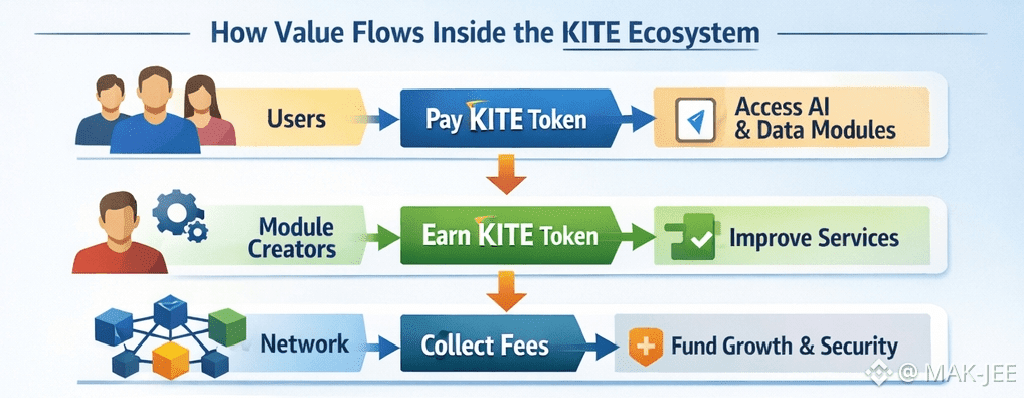
The infographic explains the economic flow clearly.
Users pay KITE to access services.
Creators earn KITE when their modules are used.
The network collects fees to support security and growth.
This loop rewards contribution, not hype. Nothing depends on promises. Everything depends on usage.
Why Modular Networks Grow Faster
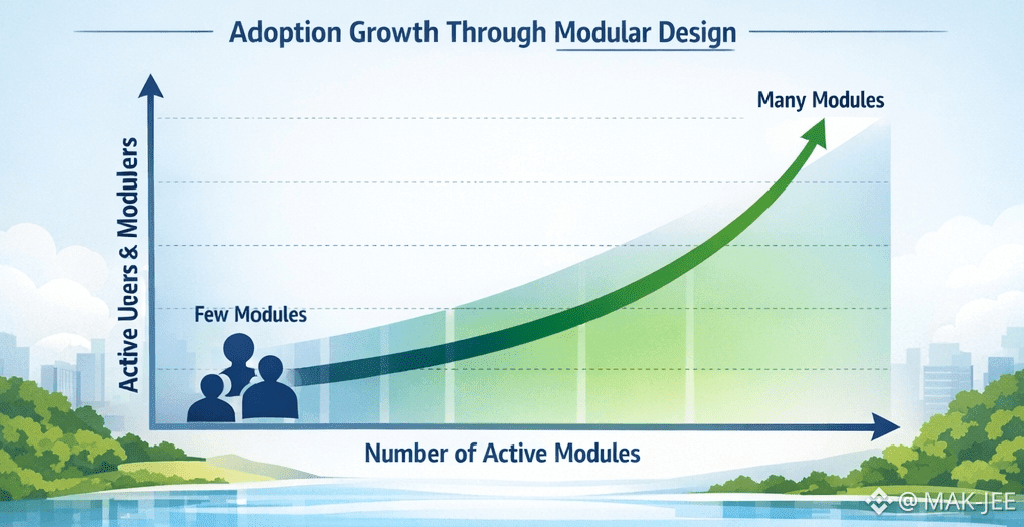
The chart shows adoption over time.
At first, growth is slow. As more modules join, usefulness increases. As usefulness increases, more users arrive. More users attract more builders.
Growth accelerates naturally.
This is how strong ecosystems behave.
Real Use Cases That Fit the Present
KITE is not built for a distant future. It fits real needs today.
Startups avoid heavy infrastructure costs. Researchers monetize specialized data. Developers build faster by combining existing tools. Non-technical users access advanced AI without complexity.
The system grows stronger with every useful module.
Market Timing and Long-Term Thinking
AI adoption is increasing rapidly, but access remains centralized. Crypto infrastructure exists, but meaningful utility is still catching up.
KITE connects these two worlds.
It does not try to dominate AI. It organizes it. It does not force blockchain everywhere. It uses it where trust and incentives matter.
In the middle of writing this, I want to add one honest perspective. As Muhammad Azhar Khan (MAK-JEE), I believe the strongest projects are the ones that focus on coordination rather than control. KITE follows that path.
Centralized AI Versus Modular Intelligence
Centralized systems rely on ownership. Modular systems rely on participation.
One limits innovation. The other invites it.
KITE is built for contribution, not restriction.
Risks Worth Acknowledging
No serious project is without risk.
Adoption takes time. Education is required. Competition will appear.
But these are execution challenges. The design itself is sound. Incentives are aligned. Structure supports growth.
That combination matters more than short-term attention.
Final Thoughts: Infrastructure Always Lasts Longer Than Hype
Trends change quickly. Foundations do not.
KITE Token supports an ecosystem designed to organize intelligence in a fair, open, and flexible way. Its modular structure reflects how technology evolves in the real world.
For those looking beyond surface narratives, KITE is not just another token. It is a framework for how intelligence can move freely without losing value.
That is what makes it worth watching.

