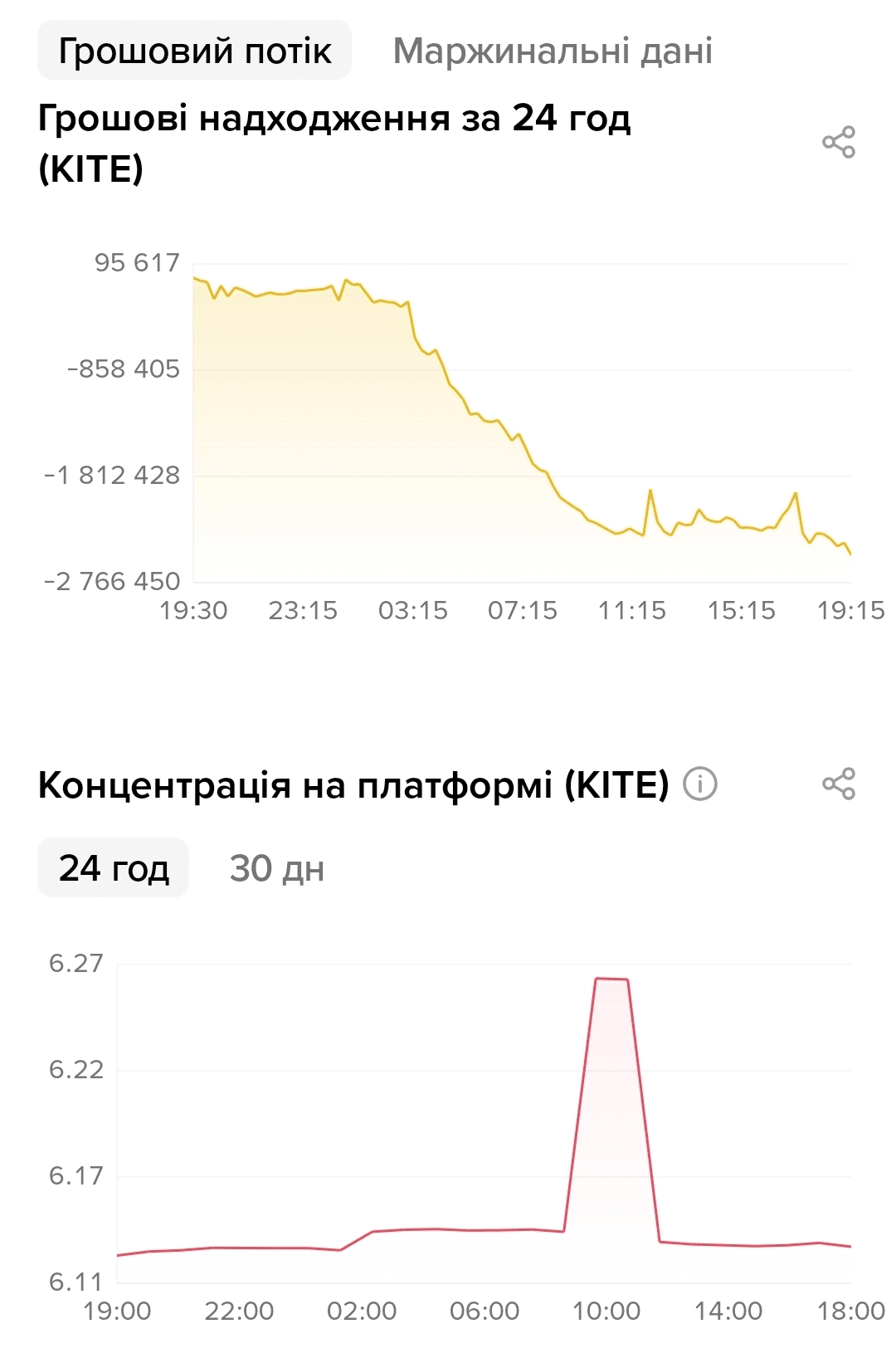
You know, recently a developer friend of mine told me a story that impressed me. He created a small startup where AI agents automatically optimized advertising campaigns for small businesses. Everything worked great until the moment of settlements between agents of different clients. One agent bought advertising space from another, a third provided analytics, and a fourth provided creatives. And each time, it was necessary to set up integrations with different payment systems, convert currencies, wait for transaction confirmations, and pay crazy fees. He said: "Can you imagine, my agents spend more time on payment infrastructure than on actual work". And that’s when I thought — what if there was a universal currency for all AI agents? Something that works quickly, cheaply, globally, without intermediaries. And could $KITE become this very basic asset for the new economy of machines?
At first, this idea seemed a bit crazy to me. A reserve currency is serious business. The US dollar became the world's reserve currency thanks to America's economic power, the stability of its institutions, and trust. The euro, yen, pound — all of them are backed by huge economies. And here some token from a young blockchain project is supposed to become the base currency for the AI agents' economy? Sounds like a utopia. But the more I dug, the more I understood — perhaps it is not such a utopia after all.
First of all, let's be honest — why did the dollar become a reserve currency? Not because it is the most stable or backed by gold (the Bretton Woods system has long since ceased to exist). But because it is the most convenient tool for international trade. Everyone accepts it, it is liquid, and the infrastructure for dollar transactions exists everywhere. This is the network effect in its purest form — the more people use the dollar, the more valuable it becomes, and the more people want to use it.
Now think about the economy of AI agents. This is a completely new space where there are no established currencies or payment systems yet. Traditional fiat money works poorly there — slowly, expensively, with a ton of regulatory constraints. Bitcoin is too slow and volatile. Stablecoins like USDC are a better option, but they are still tied to the traditional financial system with its problems. What if agents need a currency that is specifically created for them, optimized for their needs?
Here lies the potential of $KITE. It is a token native to a platform specifically built for AI agents. Fast transactions, low fees, embedded security system through three-tiered identification. If KITE becomes the dominant platform for autonomous transactions between agents — and everything is heading that way — it logically follows that $KITE will become the base currency of this ecosystem. Not through any decrees or mandates, but simply because it is the most convenient tool.
Imagine a situation in 3-5 years. Millions of AI agents are working in various fields — from logistics to finance, from marketing to healthcare. They are constantly interacting with each other, buying and selling services, data, computing resources. And all of them use $KITE as the base currency for transactions because it simply works. An agent from Ukraine can instantly settle with an agent in Japan. The fee is a penny. No currency conversion. No delays. No banks acting as intermediaries taking their cut.
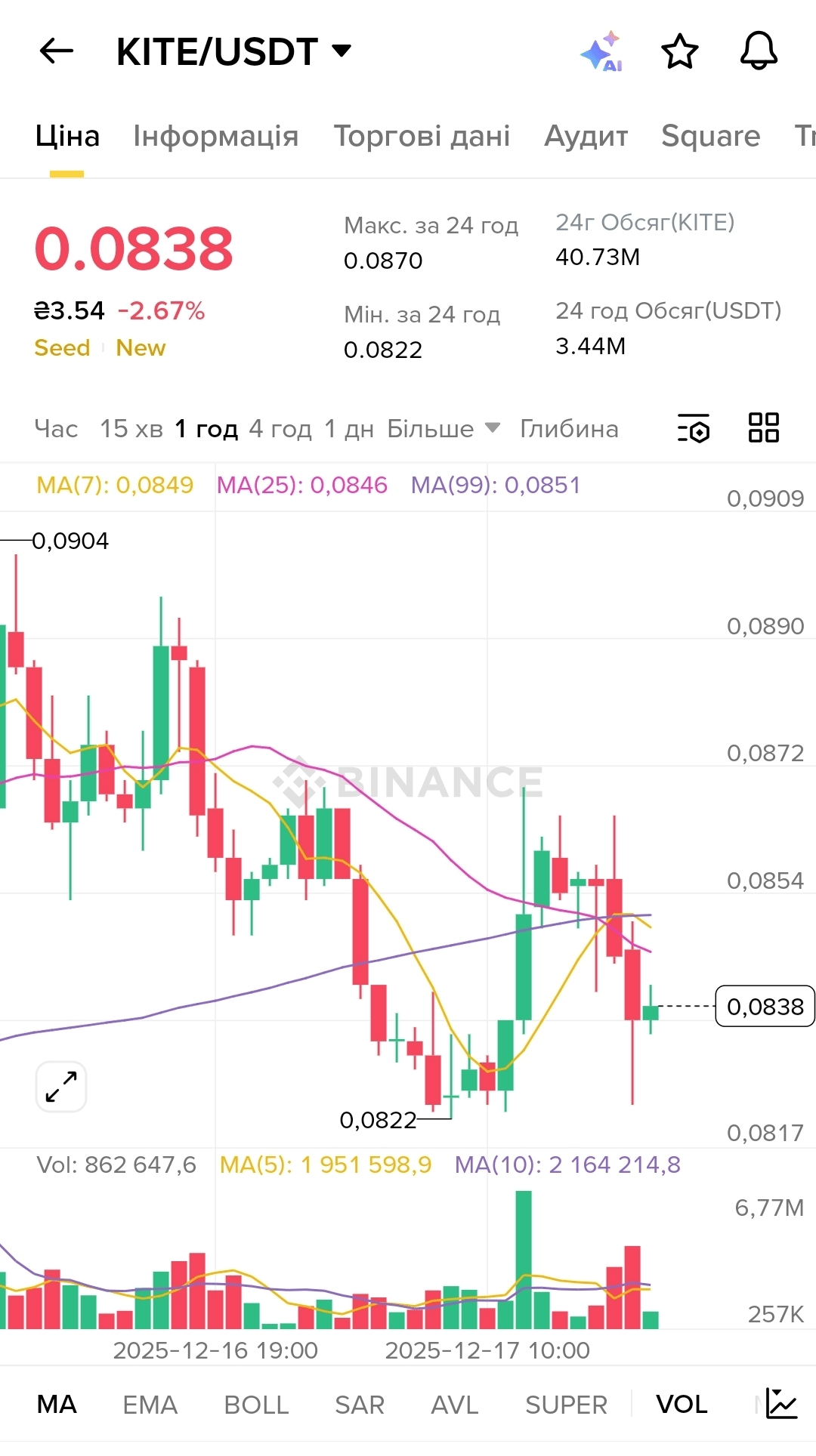
I'm looking at the chart right now — the price is 0.0838, down 2.67% for the day, typical fluctuations for a young token. But if $KITE really becomes a reserve asset for the AI economy, these fluctuations will smooth out. Because there will be constant, stable demand from agents who need the token for operational activities, not for speculation. It's like with the dollar — yes, it fluctuates too, but much less than altcoins because a huge part of its supply is used in the real economy, not just sitting on exchanges.
But here's the question — can a token that is so volatile right now become a stable reserve asset? After all, one of the main functions of a reserve currency is to be a store of value. No one wants to hold reserves in something that can drop by 20% in a day. And here are several scenarios for how this can develop.
The first scenario is natural stabilization through increased market capitalization. When the project is small, it is easy to manipulate; a few large traders can swing the price. But when the market cap grows to billions of dollars, volatility decreases because much larger volumes are needed to move the price. Bitcoin in its early days was fluctuating by 50% a week. Such fluctuations are rare now.
The second scenario is the implementation of stabilization mechanisms at the protocol level. For example, algorithmic stabilization through burn/mint mechanics, where part of the fees is burned during high demand, creating deflationary pressure. Or treasury management, where part of the network's income goes into a reserve fund used to stabilize the price during sharp fluctuations.
The third scenario is a hybrid model. $KITE remains a volatile asset for investors and stakers, but stablecoins tied to $KITE or collateralized by it are used for the operational needs of agents. This way, agents can avoid volatility in current operations, but the underlying value still accrues to $KITE.
I also think about the parallels with how traditional reserve currencies developed. The British pound sterling was the dominant reserve currency in the 19th century not because Britain was the largest economy (the US was already larger then) but because London was the financial center of the world, and most international trade went through British banks and insurance companies. Network effect and primacy.
The US dollar became the reserve currency after World War II not only because of economic strength but also because of the Bretton Woods system, which institutionalized its role. But even after the collapse of Bretton Woods, the dollar remained dominant because the infrastructure was already built, everyone was accustomed to it, and switching costs were high.
KITE has a chance to occupy a similar position in the world of AI agents precisely because they are entering this space early, building infrastructure from scratch, creating standards. If they succeed — and this is a big 'if' — in becoming the platform on which most of the AI agents ecosystem is built, then $KITE will automatically become the de facto reserve currency of this economy. Not by design, but by adoption.
Of course, there are serious challenges. Competition from other platforms that also want this market. Regulatory risks — governments may try to control or limit the use of cryptocurrencies in autonomous systems. Technical risks — if the network crashes or is hacked, trust will disappear instantly. Economic risks — if the tokenomics is poorly designed, hyperinflation or, conversely, a deflationary spiral may arise.
But you know what impresses me? The very possibility that we can witness the birth of a new reserve currency in real time. Historically, this has happened once a century — the pound replaced gold, the dollar replaced the pound. Perhaps we are now on the verge of a moment when $KITE or some other token becomes the base currency for the parallel economy of machines. An economy that could eventually become larger than the human one, as machines can operate 24/7, process more information, and make decisions faster.
And when I look at the current price of 0.0838 and think about this potential, I realize — even if there is a 10% chance that $KITE will become a reserve asset for the AI economy, it makes it one of the most interesting asymmetric bets in crypto. Because the difference between 'another altcoin' and 'the base currency of a new global economy' is not 2x or 10x, it's hundreds or thousands of x. Yes, the risks are huge. But the potential reward is commensurate. And that is why I continue to follow the development of @GoKiteA with such interest, despite all the fluctuations and uncertainties.