
Lorenzo Protocol did not begin as an abstract idea about finance. It started with a practical problem. On-chain yield strategies were becoming harder to use, not easier. Users had to manage staking, bridging, rebalancing, and risk on their own. As strategies grew more complex, the tools stayed fragmented. Lorenzo’s answer to this problem became the Financial Abstraction Layer, often called FAL. It is not a surface feature. It shapes how the protocol works from the inside.
Most DeFi systems expose users directly to raw mechanics. You stake here, lend there, and track results across dashboards. This approach works for simple actions, but it breaks down fast. Managing advanced yield requires time, attention, and constant monitoring and traditional finance solved this long ago with funds and structured products. Blockchain systems mostly did not.
Lorenzo Protocol tries to close that gap without hiding what happens to user funds. The Financial Abstraction Layer sits between deposits and yield generation. Users do not place funds into individual strategies themselves. They deposit into products governed by FAL. This layer controls allocation, tracks outcomes, and enforces rules around issuance and redemption.
The word “abstraction” matters, but not in the way people often think. FAL does not hide data. It hides friction. Users are not required to understand every strategy detail to participate. At the same time, the system remains verifiable on chain. Token supply, balances, and value updates are visible.
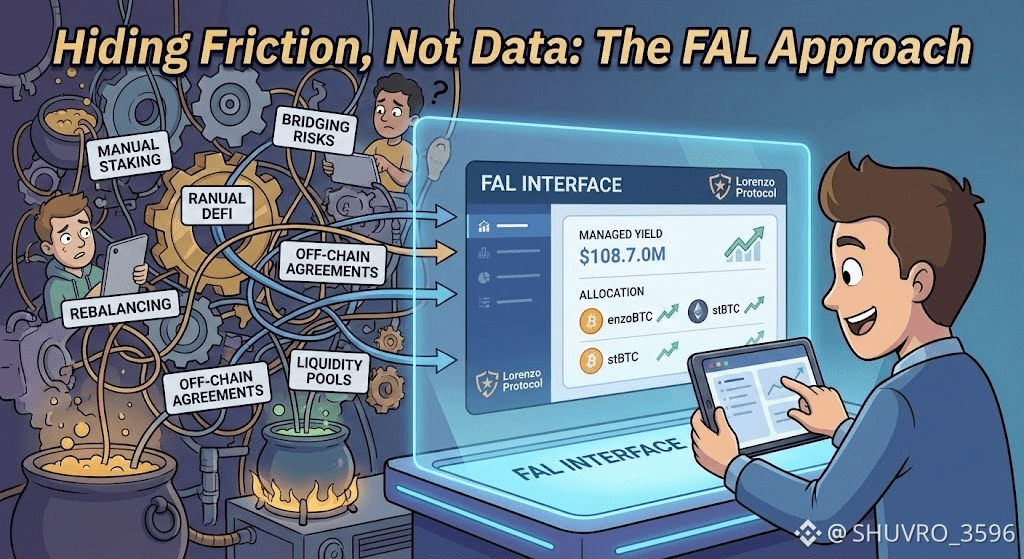
This design changes how financial products can exist on chain. Without FAL, most DeFi products are narrow. One pool, one yield source, one risk profile. With FAL, Lorenzo can group multiple strategies under a single product. Capital can move across staking, liquidity provision, or off-chain yield agreements while remaining part of one structure.
Performance is measured at the product level, not the strategy level. This matters. It allows users to hold a single token that represents managed exposure instead of juggling positions. The structure feels closer to asset management than yield farming.
This approach also explains why Lorenzo can issue structured tokens such as enzoBTC, stBTC, and stablecoin-based yield products introduced through 2024 and 2025. Each token reflects a defined claim. Some focus on principal exposure. Others isolate yield. That separation only works because FAL tracks inputs and results with strict accounting.
Without a system layer like this, splitting value cleanly becomes fragile. Accounting errors appear. Redemption logic breaks. Trust erodes. Lorenzo avoids that by design, not by marketing.
The Financial Abstraction Layer is not built only for end users. Builders benefit from it as well. Creating a financial engine from scratch is difficult. Risk models, accounting logic, and payout rules take time to get right. With FAL, much of this already exists.
A wallet, payment app, or platform can integrate Lorenzo products and offer yield without owning the strategy logic. The app controls the interface. Lorenzo handles the financial core. This separation lowers development cost and reduces duplicated work across the ecosystem.
Trust remains a concern whenever strategies involve off-chain activity. Lorenzo does not claim otherwise. Instead of hiding this reality, FAL focuses on reporting. Strategy results are recorded on chain. Vault balances and token values can be checked directly. Users do not rely on updates pushed through announcements alone.
This approach does not remove risk. It removes blind spots and users can see what they hold and how it performs, even when part of the process happens outside the blockchain.
FAL also acts as a bridge between on-chain systems and real-world yield sources and some strategies cannot live fully on chain yet. Institutional staking, real-world asset returns, and certain trading systems still operate off chain. FAL allows these to plug into on-chain products while keeping accounting consistent.
Results flow back on chain. Tokens update. Users interact with a single product. Complexity stays behind the scenes. This is not a shortcut. It is a structured compromise based on where infrastructure stands today.
There are limits. Strategy quality still matters. Partners matter. Market conditions matter. Structured products are not simple savings accounts. Users still need to understand what they hold.
Lorenzo does not position FAL as a guarantee. It is a framework. Its value comes from structure, clarity, and repeatability.
Over time, this kind of foundation work tends to matter more than surface features. New products can be built without redesigning the system. New integrations can happen without breaking standards. Growth becomes easier to manage.
Lorenzo Protocol’s Financial Abstraction Layer reshapes how yield and asset management operate on chain. It reduces manual effort, improves transparency, and supports more advanced products without hiding risk. In a space focused on short-term yield, Lorenzo focused on structure. The Financial Abstraction Layer is the result.
#lorenzoprotocol @Lorenzo Protocol $BANK

