You know, when I first saw the chart of sharp declines in my portfolio, I felt that unpleasant chill in my stomach. Minus 10%, minus 15%, minus 20%... And the first thought is always the same: "Maybe I should sell everything now before it gets even worse?" This is a normal human reaction — our brain is evolutionarily wired to avoid losses. But do you know what I realized over the years in crypto? That the biggest mistakes I made were precisely when I succumbed to emotions. And @falcon_finance gave me a tool that helps me stay away from panic decisions and maintain a long-term vision even when everything around is red.
Let's first honestly acknowledge: holding is psychologically difficult. Especially when you see how your $5,000 turns into $3,500 in just a few days. Reason says: "This is temporary; the market will recover." But emotions scream: "Sell now before you lose everything!" And this is where most people break. They sell at the bottom, lock in losses, and then a month later watch the price rebound and gnash their teeth. I've gone through this more than once until I realized the main thing: you need a mechanism that breaks this emotional cycle.
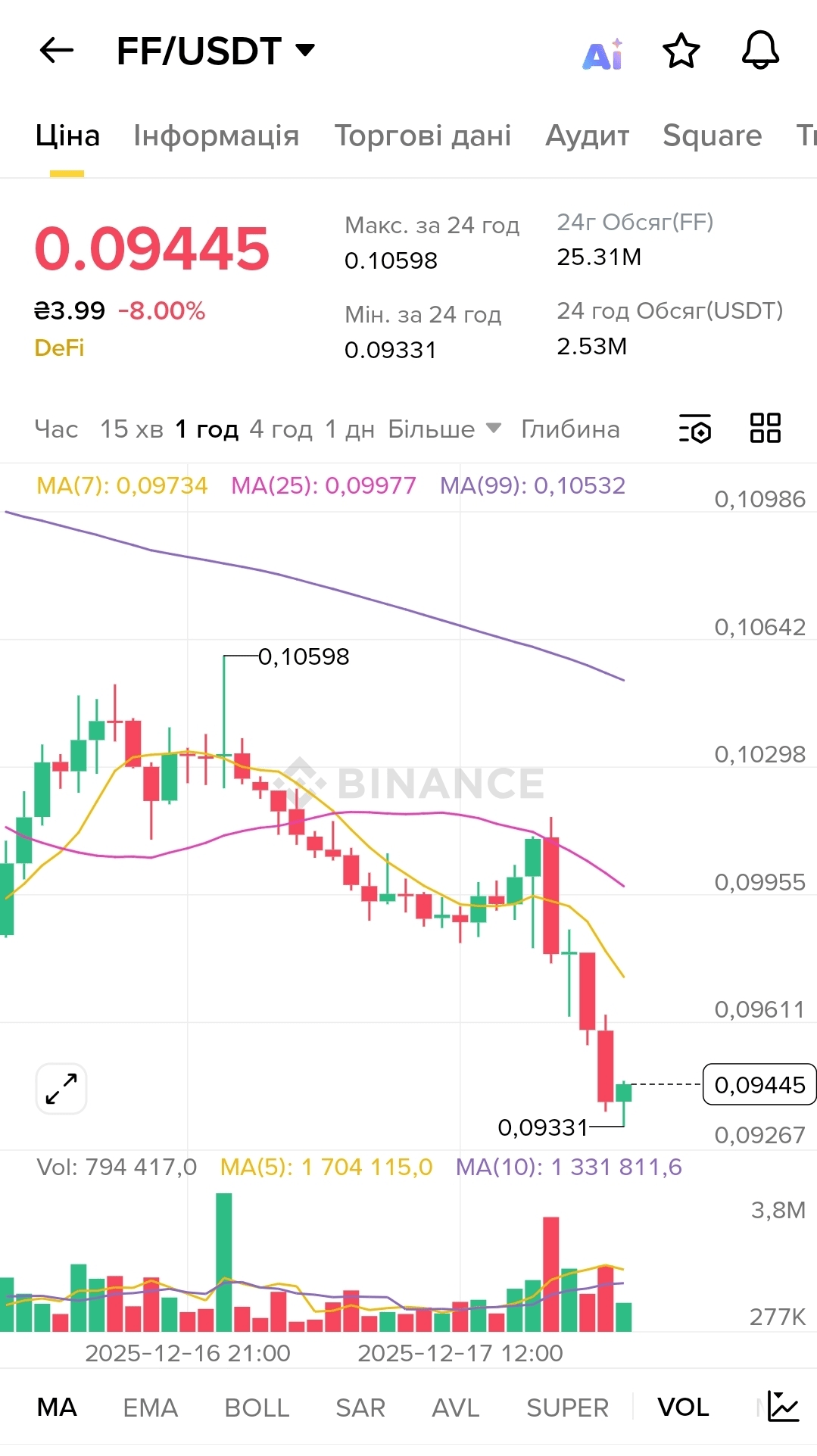
Look at the current chart \u003cc-46/\u003e— price 0.09445 USDT, a drop of a horrific 8.00% for the day. In the last 24 hours, the maximum was 0.10598, the minimum 0.09331—this is a fluctuation of 13.6%. These are the moments that are the most psychologically challenging. You see how in a day you lose almost 14% of your value, and panic starts in your head. But now imagine: instead of just watching these numbers in helplessness, you had already staked some of your tokens in #FalconFinance and received USDf. You already have liquidity in hand, and you can breathe easily. The psychological pressure instantly decreases.
The first emotional trap that Falcon Finance helps to avoid is the fear of missing out. FOMO, fear of missing out. You hold tokens, they grow, suddenly you see another opportunity—a new project, a hot NFT drop, a profitable farming pool. And the internal struggle begins: if I sell tokens for this opportunity, I'll miss their growth. If I don't sell—I lose the new opportunity. This is a classic dilemma, and it causes huge stress.
And now another scenario: you previously received USDf by collateralizing part of your portfolio. When a new opportunity arises, you simply use the ready liquidity. No need to sell anything, no need to make a tough choice, no need to regret the decision later. Your base assets \u003cc-65/\u003e continue to grow (or fall—this is the risk), but you have caught a new opportunity. Emotionally, this is a completely different experience, much less anxiety-inducing.
Look at the moving averages: MA(7) at 0.09734, MA(25) at 0.09977, MA(99) at 0.10532. The short-term is below the medium-term, and the medium-term is below the long-term—a classic downtrend picture. When you look at this as a holder without any tools, it induces despair. But when you have a strategy through @falcon_finance, when part of your capital is already converted into stable USDf and is working in safe pools, you look at the same chart with much greater calm. Yes, the token is falling, but this is not all your capital, and you have a plan.
The second emotional trap is the regret after selling. The classic: you sold tokens for $0.08 because you panicked, and a week later they are $0.12. And it's a hellish feeling: "If only I had waited a little longer..." It eats you from the inside, undermines your confidence in your own decisions, and leads to even more emotional mistakes in the future. I know people who have completely given up on crypto because of such situations—not due to real financial losses, but due to emotional exhaustion.
With the ability to obtain liquidity without selling, this trap can be avoided. Your tokens stay with you; you do not make an irreversible decision to sell. Need money—received USDf. The situation changed—you can return USDf and reclaim your collateral. Flexibility reduces emotional burden because you are not risking making a mistake from which there is no turning back.
I look at trading volumes—25.31 million for the day for the token and 2.53 million USDT—and see increased activity. Increased volumes during a downturn usually indicate panic, as people dump positions massively. And here is where the difference between those who have a plan and those who act emotionally manifests. The former wait, the latter sell at the bottom and regret it later. The availability of alternative liquidity tools helps to fall into the first category.
The third emotional trap is the feeling of helplessness during drawdowns. When the market falls, and you are just a holder, you cannot do anything. You sit and watch as the numbers turn red, feeling like a passenger in a car without a steering wheel. This horrific feeling of loss of control amplifies stress exponentially. People start compulsively checking prices every five minutes, lose sleep at night, conflict with loved ones—all due to this feeling of helplessness.
And now imagine: you have part of your capital in stable USDf, which works in farming pools and generates income regardless of what happens with $FF. Suddenly, you are no longer a helpless observer. You have an active strategy, you are doing something, you control the situation at least partially. Psychologically, this is a huge difference. You are not a passive victim of market fluctuations, but an active participant with a plan and tools.
The current hourly trading volume is 794,417.0 units, while MA(5) shows 1,704,115.0, and MA(10) is 1,331,811.6. Do you see that huge red bar on the volume chart? This is the moment of capitulation when weak hands give up. And do you know who usually gives up? Those who don’t have a plan B. Those who urgently need money and have no other way to get it except selling at the bottom. And what if they had the opportunity to receive USDf as collateral in advance? Perhaps they would have held on.
The fourth emotional trap is FOLO, fear of losing out, the fear of being left with nothing. When the market falls by 20-30-50%, catastrophic scenarios start to unfold in the mind: "What if this goes to zero? What if I lose all my savings?" Rationally, you understand that Bitcoin and quality projects are unlikely to go to zero, but emotions are stronger than logic. And under the pressure of this fear, people sell everything at the bottom.
Diversification across different types of assets reduces this fear. When part of your capital is in volatile tokens, part in stable USDf, and perhaps some in tokenized real estate or gold, you understand: even if the crypto market crashes very hard (and it can), not all your capital will disappear. There is a safety cushion. And this knowledge helps keep nerves under control and prevents panic decisions.
Look at the current price 0.09445 and compare it with the maximum of 0.10598 for the day—a drop of 10.9%. If your entire portfolio is in $FF, it means a real loss of more than 10% in a day. Painful. Scary. It triggers a desire to flee. But if 50% of your capital is in USDf, your real loss is only 5.5%. This is much easier to handle psychologically. The same market, the same event, but a completely different emotional experience.
The fifth emotional trap is the capital lock-in syndrome. When all your money is in long-term holdings, you feel financially constrained. Want to buy something in real life? You have to sell tokens. An emergency situation arises? You have to sell tokens. Saw a wonderful investment opportunity? Sell again. And each time, it's an emotionally difficult decision with a sense of sacrifice—you are sacrificing long-term growth for short-term needs.
#FalconFinance changes this equation. Your capital is no longer locked in. You can obtain liquidity without sacrificing your long-term position. This is psychologically liberating. You are no longer trapped by your own investments. And this feeling of freedom helps maintain a long-term strategy because you know: if something happens, you have an exit that does not require selling at unfavorable conditions.
The sixth emotional trap is social pressure and FUD. When the market falls, social media is flooded with panic: "It's all a scam!", "Crypto is dead!", "Get out now!" If you don't have a clear plan and tools, it's very easy to succumb to this pressure. You start to doubt: "Maybe they are right? Maybe I am foolish for holding?" And at the moment of greatest weakness, you sell.
But when you have a strategy through @falcon_finance, when you see that part of your capital is working and generating income even during a downturn, it's much easier to ignore the noise. You are not emotional; you are on a plan. Tokens may drop, but your USDf generates 15% annual returns in liquidity pools. This is a concrete, tangible result that helps avoid panic moods.
Look at MA(99) at the level of 0.10532—this is the long-term average level. The current price of 0.09445 is 10.3% lower. For a person without a plan, this is a disaster. For a person with a strategy, this is a temporary anomaly and perhaps even an opportunity to buy cheaper, using USDf that was obtained earlier. The same fact, but a completely different emotional reaction, depending on the availability of tools.
The seventh emotional trap is the regret of unmade actions. "If only I had sold at the peak...", "If only I had bought more at the bottom...", "If only I..." This endless replay of alternative scenarios drains you mentally and takes focus away from the present, where you can actually do something. And why does this regret arise? Because you feel you lost control, that you missed opportunities, that you did something wrong.
When you have flexible capital management tools, there is less regret. Didn’t sell at the peak? No big deal, you took USDf earlier and used it for other opportunities. Didn’t buy at the bottom? That’s okay too, because you didn’t sell your holdings and are still in the game. The flexibility of the strategy reduces the number of moments you later regret, thus decreasing the overall emotional burden.
The eighth and most important emotional trap is the lack of trust in your own decisions. Every mistake, every timing failure, every missed profit undermines your confidence. And eventually, you start doubting every decision you make, leading to analysis paralysis or chaotic actions without a strategy. I've seen people destroy their portfolios simply because they lost faith in themselves.
And do you know what helps build trust? Having a system that works independently of your emotional states. When you know: even if I panic now, even if the market is doing crazy things, I have part of my capital in stable strategies via USDf that continue to work. This systematization, this structuring helps you feel competent, even when things are not going perfectly.
Do you know what the greatest value of Falcon Finance is from a psychological perspective? It's not even the specific yield figures or technical capabilities. It's peace. The peace of mind that comes when you know: you have a plan, you have tools, you are not helpless in front of the market. And this peace allows you to make rational long-term decisions instead of emotional short-term ones. In crypto, where 90% of people lose due to emotional mistakes, the ability to remain calm and maintain a long-term vision is the most valuable skill you can have. And if the protocol helps develop this skill—that's already a sufficient reason to use it.
\u003ct-35/\u003e\u003cm-36/\u003e\u003cc-37/\u003e