

Written by: 0xTodd
Let's talk about Visa's support for stablecoin settlement.
First of all, many people may not fully understand how Visa (or Mastercard) actually works.
Visa itself does not issue cards and does not lend to merchants; it is purely an intermediary, mainly responsible for information processing and rule-making.
For example, in the United States, Visa's operational process is mainly divided into three stages:
Phase one: Authorization (Can the money be withdrawn?)
When a cardholder swipes their card at a merchant, the merchant's acquiring bank sends the transaction information to VisaNet. VisaNet identifies the card number and routes the request to the issuing bank. The issuing bank checks the account balance or credit limit and responds with 'approved' or 'declined.' Visa then relays the result back to the acquiring bank and then to the merchant.
Phase Two: Clearing
Usually at the end of each day or after the trading batch is completed. The acquiring bank packages all transaction data for the day and sends it to VisaNet. VisaNet performs netting calculations.
It calculates the net position of each bank. For example, customers of Issuer A spent a total of 100 million USD today, while merchants of Issuer A (if it is also the acquiring bank) should receive 20 million USD today. Therefore, Issuer A's net obligation is to pay 80 million USD.
Phase Three: Settlement (Transfer Money)
Based on the net amount calculated from clearing, Visa instructs the settlement bank to transfer funds between the accounts of the issuer and the acquirer. Previously, it was done through channels like wire transfers.
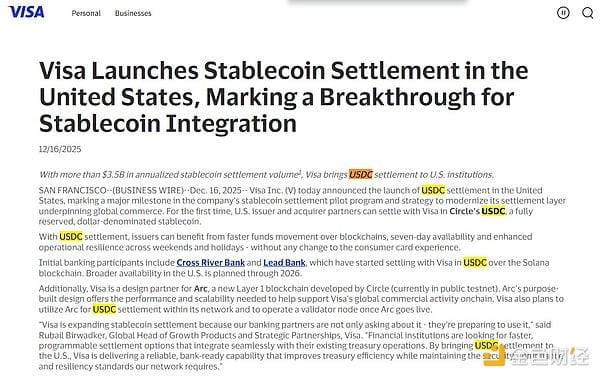
This time, Visa announced support for $USDC, which does not mean that retail investors can spend stablecoins through Visa, but rather that card issuers and merchants can use stablecoins to settle accounts in the third phase.
To translate, it means: Previously, the bank of Visa owed the merchant of Visa, and it could only be settled through traditional bank transfers (USD fiat currency). But now, they can directly transfer USDC from their cryptocurrency wallets to Visa to settle this debt.
Coincidentally, Mastercard also officially announced yesterday that it will support stablecoin settlements in the Middle East. And Visa this time is in the United States, which shows that as I predicted earlier, after the passing of the US Stablecoin Innovation Act, the entire industry is accelerating forward crazily.

However, it should be noted that Visa here refers to "Select partners". Implicitly, this is not a feature open to all US banks, and it is estimated that it is primarily aimed at crypto-related financial institutions or enterprises.
In summary, this is still somewhat impressive, meaning the idea that stablecoins = real money is becoming more solidified. The more people accept "stablecoins = real money," the more real stablecoins become = real money, and the tighter the anchor becomes.

