

Even if Japan's interest rate hike triggers turmoil in the short term, it will not change the global long-term trend of monetary easing.
Article author: Long Yue
Source: Wall Street Journal
As the Bank of Japan's monetary policy meeting on December 19 approaches, market concerns about its potential hawkish interest rate hike are intensifying. Will this move end the era of cheap yen and trigger a global liquidity crisis? The latest strategy report released by Western Securities on December 16 provides an in-depth analysis of this.
With high inflation, Japan's hawkish interest rate hike is imperative.
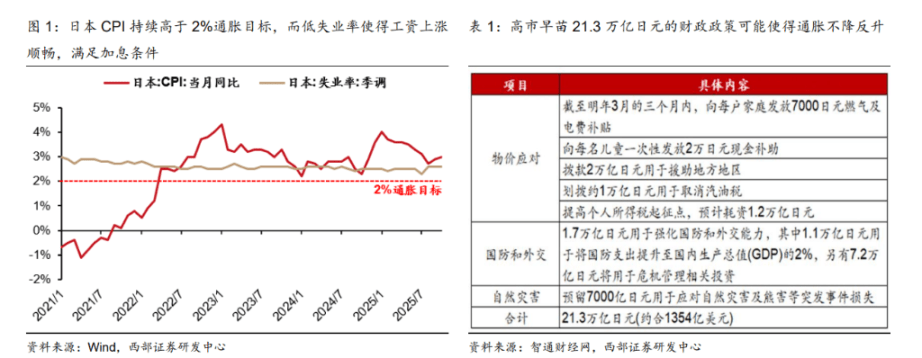
The report pointed out that there are multiple driving factors behind the Bank of Japan's interest rate hike this time. First, Japan's CPI has continued to exceed the official inflation target of 2%. Second, the unemployment rate has remained low at below 3% for a long time, creating favorable conditions for nominal wage growth, and the market has high expectations for wage increases in next year's 'Shunto' (spring labor negotiations), which will further increase inflationary pressure. Finally, the 21.3 trillion yen fiscal policy launched by Takemura Saeko may also exacerbate inflation.
These factors have jointly forced the Bank of Japan to adopt a more hawkish stance. The market is concerned that once interest rate hikes are implemented, it will lead to a concentrated closing of a large number of 'carry trades' accumulated during the era of YCC (Yield Curve Control), thus causing liquidity shocks in the global financial market.
Theoretical analysis: Why the most dangerous phase of liquidity shocks may have already passed?
Although the market is worried, the report analyzes that, theoretically, the current impact of the Bank of Japan's interest rate hike on global liquidity is limited.
The report lists four reasons:
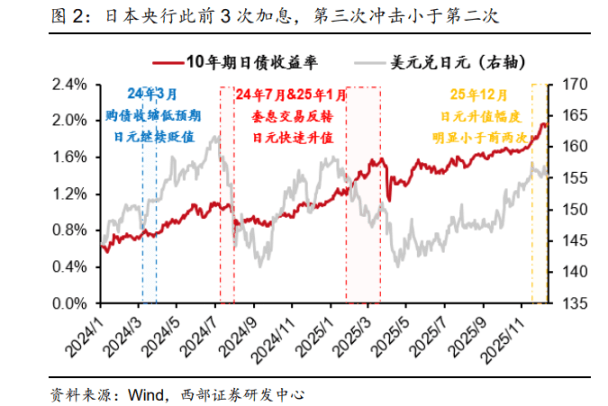
Risks have been partially released: The Bank of Japan has raised interest rates three times since March last year. Among them, the interest rate hike in July last year combined with the exit from YCC indeed caused a significant liquidity shock, but the impact of the interest rate hike in January this year has significantly weakened, indicating that the market's adaptability is increasing.
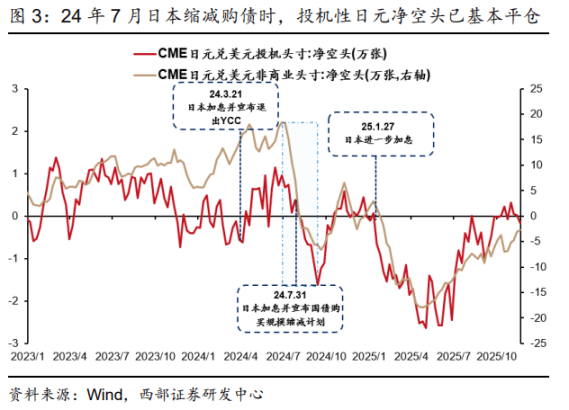
Speculative positions have exited early: According to futures market data, most speculative yen shorts had already closed their positions by last July. This indicates that the most active and likely to trigger a chain reaction 'carry trades' have already receded, and the most dangerous phase of liquidity shocks has passed.
Different macro environment: Currently, the U.S. has not experienced a 'recession trade' similar to that in July last year, pressure on the dollar to depreciate is not significant, while the yen itself shows weakness due to geopolitical and debt issues. This has weakened expectations for yen appreciation, thereby alleviating the urgency for closing 'carry trade' positions.
The Federal Reserve's 'safety net': The report specifically mentions that the Federal Reserve has begun to pay attention to potential liquidity risks and has initiated a balance sheet expansion (similar to QE) policy, which can effectively stabilize market liquidity expectations and provide a buffer for the global financial system.
Actual risks: 'catalysts' in a fragile market.
The report emphasizes that theoretical safety does not mean being carefree. The current fragility of the global market is the real root of the potential shocks that could be triggered by the Bank of Japan's interest rate hike. The report describes it as a 'catalyst'.
The report analyzes that the significant shock caused by the Bank of Japan's interest rate hike last July was due to the resonance of two major factors: 'the closing of a large number of active carry trades' and 'the U.S. recession trade'. Currently, the conditions for the former have weakened. However, new risks are emerging: the global stock market, represented by U.S. stocks, has experienced a 'big bull market' lasting 6 years, accumulating a large number of profit-taking positions, which poses fragility. At the same time, concerns about the 'AI bubble theory' in the U.S. market have resurfaced, leading to strong risk aversion among investors.
However, the current global stock market, represented by U.S. stocks, has already experienced a 6-year 'big bull market', which itself has fragility. At the same time, concerns about the 'AI bubble theory' have resurfaced, and risk aversion among funds is high, making the yen's interest rate hike a potential 'catalyst' for triggering global liquidity shocks.
In this context, the certain event of the Bank of Japan raising interest rates could very well become a trigger, inducing a panic flight of funds and thus triggering a global liquidity shock. However, the report also provides a relatively optimistic judgment: this liquidity shock is likely to force the Federal Reserve to implement stronger easing policies (QE), so the global stock market, after a brief sharp decline, is likely to recover quickly.
Watch more, act less, keep a close eye on the 'triple whammy' signal in stocks, bonds, and currencies.
In the face of this complex situation, the report advises investors to 'watch more, act less'.
The report believes that since the Bank of Japan's decisions are essentially 'open cards', but the choices of funds are difficult to predict, the best strategy is to maintain observation.
Scenario 1: If there is no panic flight of funds, the actual impact of the Bank of Japan's interest rate hike will be very limited, and investors need not take action.
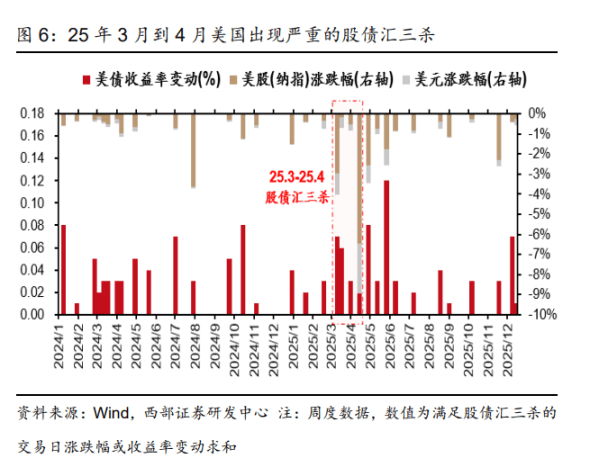
Scenario 2: If the panic of funds really triggers a global liquidity shock, investors need to closely monitor a key signal—whether the U.S. market experiences 2-3 consecutive occurrences of the 'triple whammy' (i.e., simultaneous declines in the stock, bond, and currency markets). The report points out that if a situation similar to early April this year reoccurs, it indicates that the probability of a liquidity shock in the market has significantly increased.
Finally, the report believes that even if the Bank of Japan's interest rate hike causes turmoil in the short term, it will not change the overall trend of long-term monetary easing globally. In this context, the strategic allocation value of gold remains favorable. Additionally, with the expansion of China's export surplus and the Federal Reserve's restart of interest rate cuts, the yuan's exchange rate is expected to return to a long-term appreciation trend, accelerating cross-border capital inflows and benefiting Chinese assets. The report is optimistic about AH shares experiencing a 'Davis double play' in profits and valuations. For U.S. stocks and bonds, the report holds a fluctuating view.