

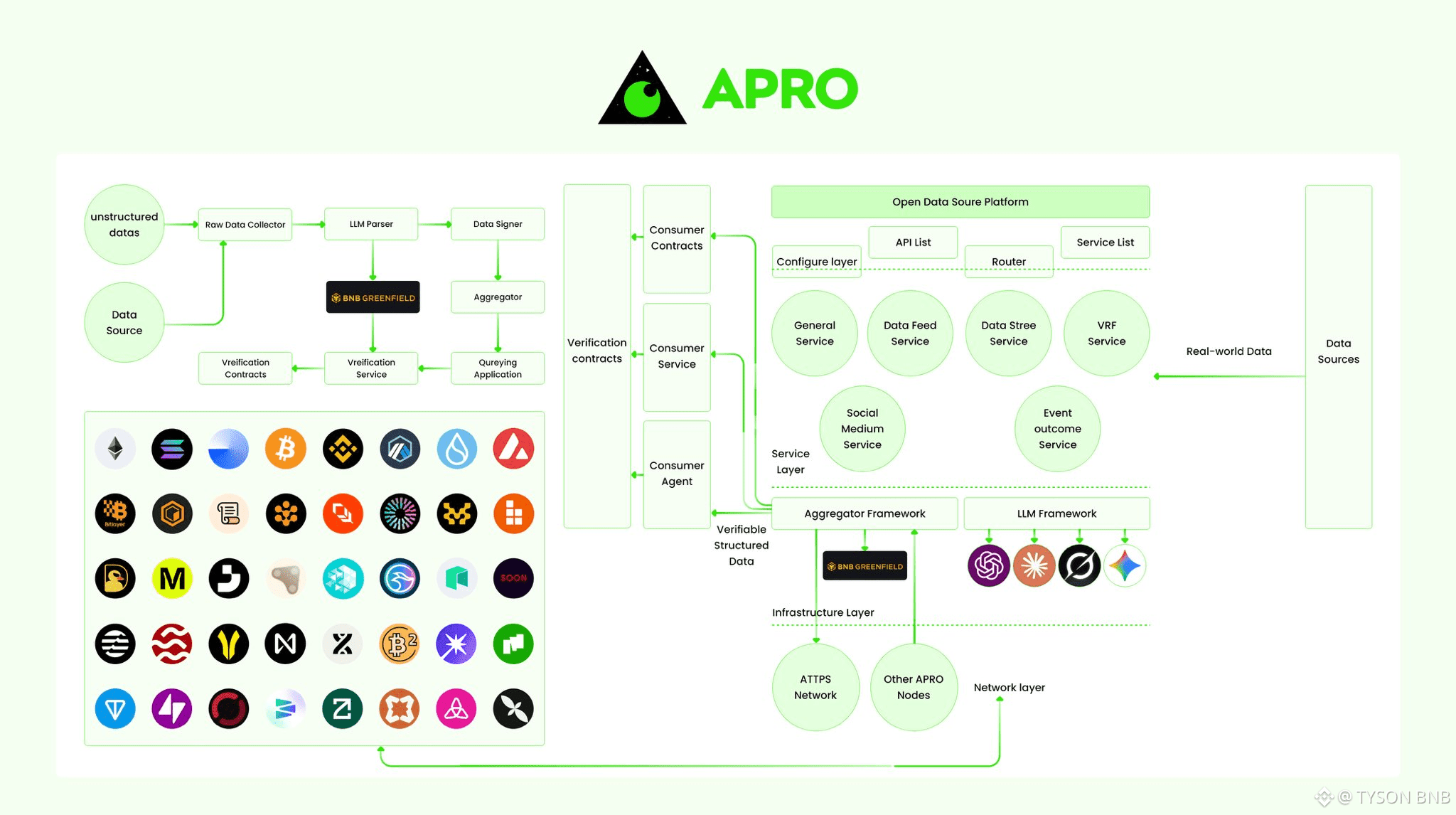
 Traditional smart contracts were designed for a world where humans were the primary actors. A user submits a transaction, the contract executes deterministically, and the state updates. This model is elegant, simple, and extremely powerful but it begins to fracture the moment DeFi evolves from manual interaction to continuous automation. APRO’s automation stack emerges precisely at this fracture point.
The difference between APRO and traditional smart contract interaction is not incremental. It is philosophical. One treats execution as an isolated event. The other treats execution as an ongoing system responsibility.
Traditional smart contracts are event-driven rather than state-aware
A traditional model smart contract responds to direct calls. They lack an understanding regarding the context in which an operation is being performed. They only know the operation is being carried out and not why. They do not require any context. Context is treated as an extrinsic entity. They lack the concept of priority. A transaction has equal chances as any other.
This works when:
Actions are infrequent
Humans supervise outcomes
Failure cost is limited
It breaks when:
Multiple agents act simultaneously
Strategies span time and conditions
Execution order becomes critical
APRO starts from the assumption that execution is continuous and contested, not isolated and calm.
Intent vs Transaction: The Core Structural Divide
Traditional interactions require users to translate intent into transactions manually. Each action is a guess: “execute now and hope conditions are still valid.”
APRO introduces a missing abstraction: intent persistence.
Users and agents declare:
What they want to achieve
Under what constraints
With what priority
Over what duration
Execution is no longer a blind trigger. It is a governed process that continuously evaluates whether acting now is correct.
This is the single biggest difference between APRO and traditional contracts. One executes instructions. The other manages responsibility.
Execution Order Is Undefined in Traditional Systems
Smart contracts execute deterministically once called, but the system as a whole has no opinion on order. If ten transactions arrive simultaneously, miners or validators decide ordering. Priority is accidental, not intentional.
APRO treats execution order as first-class infrastructure.
Its automation stack introduces:
Explicit task prioritization
Resource-aware scheduling
Conflict resolution between agents
This prevents low-value or opportunistic actions from crowding out critical operations. Traditional contracts cannot do this because they were never designed to arbitrate between intents.
Traditional Automation Is Script-Based. APRO Is System-Based.
Most “automation” today is a layer of scripts on top of smart contracts. Bots monitor conditions and fire transactions. Coordination is external. Failures are silent.
APRO replaces scripts with system-level automation.
Automation is:
On-chain governed
Context-aware
Verifiable
Interruptible
If conditions change, execution adapts. If conflicts arise, execution is delayed or reordered. This is impossible with standalone bots interacting with passive contracts.
Handling Errors: Deterministic Failures vs Managed Degradation
In traditional smart contract interactions, failure is binary. Either a transaction will succeed or it will revert. But if several actions are cascaded in an automatic manner, a single revert can lead to a system failure.
APRO brings Managed Degradation into
Tasks can:
It is more likely that a person will
Retry with better conditions
Prioritize YIELD operations with higher risks
Expire safely without state corruption"
With
This ensures that long-cycle automation is survivable. The traditional contract model presumes the presence APRO assumes reality.
Authority Is Static in Traditional Models
Once permission is granted in a traditional system, it persists until revoked manually. This is tolerable for humans. It is dangerous for agents.
APRO’s automation stack integrates:
Scoped authority
Time-bound execution rights
Contextual permission enforcement
Authority decays naturally. Automation cannot silently accumulate power. This is essential when software acts faster and longer than humans ever could.
Transparency Moves From “What Happened” to “Why It Happened”
Traditional contracts are transparent in outcome, not rationale. You can see what executed, but not why it executed at that moment.
APRO’s stack records:
Priority decisions
Context evaluations
Execution paths
Rejection or delay reasons
This transforms automation from opaque behavior into auditable logic. Debugging, governance, and trust all improve as a result.
Composability Without Chaos
Traditional smart contracts compose functionally, but not behaviorally. When composed, they amplify unpredictability.
APRO enables behavioral composability. Multiple automated strategies can coexist because:
Priorities are enforced
Resources are scheduled
Conflicts are mediated
Composition no longer means collision.
Why This Shift Matters Long-Term
As AI agents, automated treasuries, and autonomous strategies become normal, the traditional interaction model becomes a liability. Systems that cannot reason about execution context will drown in their own complexity.
APRO does not replace smart contracts. It evolves how they are used.
Smart contracts remain execution engines.
APRO becomes the execution governor.
Closing Perspective
The difference between APRO’s automation stack and traditional smart contract interactions is the difference between a calculator and an operating system. One executes commands perfectly. The other manages complexity continuously.
DeFi’s first era was about trustless execution.
Its next era is about trustworthy automation.
APRO is not trying to make smart contracts faster or cheaper. It is trying to make them livable in a world where execution never sleeps, agents never stop, and mistakes compound instantly.
That is not an upgrade.
It is a structural evolution.

