

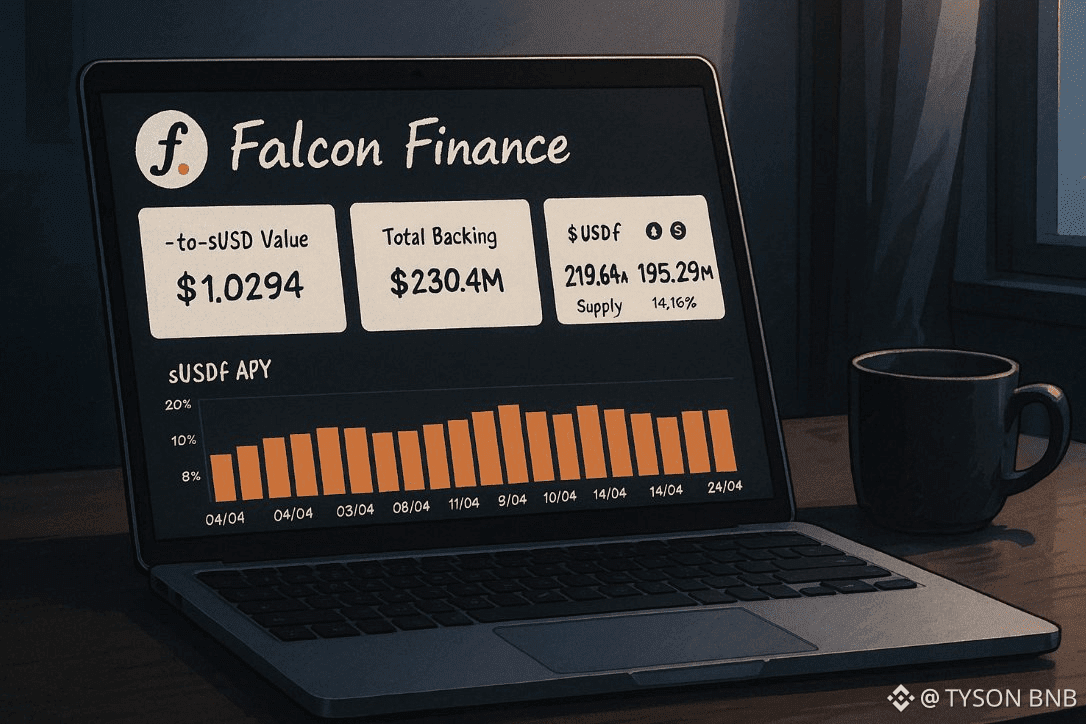
 Fee models are often treated as a monetization afterthought. A percentage here, a spread there, justified loosely as “protocol revenue.” In calm markets, these choices seem harmless. Under stress, they reveal what the protocol actually values. Falcon Finance’s fee model is built with a clear stance: protocol revenue should increase when the network becomes more stable, not when it becomes more fragile.
This principle sounds obvious, but it is rare in practice. Many DeFi systems earn the most when users take excessive risk, churn positions rapidly, or push the system toward liquidation-heavy states. Falcon is designed to do the opposite.
Why Misaligned Fees Destabilize Synthetic Systems
Synthetic asset systems are especially sensitive to incentives. If fees are highest during:
Aggressive minting
Excessive leverage
Rapid position turnover
Liquidation cascades
then the protocol is financially rewarded for behavior that weakens its own foundations. Over time, this creates a perverse loop: instability generates revenue, which encourages designs that tolerate or even amplify instability.
Falcon explicitly avoids this loop.
Its fee model is structured so that predictable, well-collateralized, and well-managed usage is the most profitable usage for both users and the protocol.
Fees relate to execution, not merely activity.
The most important design decision made by Falcon is that it charges for the reliability of execution rather than volume.
“Fees are associated with”:
Possessing the Ability to
Facilitating Execution Certainty
Absorbing risk through structured collateral arrangements
It means, therefore, that the protocol earns because, as a service, it provides a protective cover to the system, and this happens regardless of the occurrence of any transaction. Revenue reflects operational responsibility, not speculative excitement.
In effect, Falcon monetizes stability work.
Stable Behavior Is Cheaper by Design
Falcon’s fee structure is intentionally asymmetric. Well-managed positions with conservative parameters face lower effective costs over time. Riskier behavior encounters higher friction.
This is not punishment. It is pricing reality.
Stable positions:
Consume less execution bandwidth
Stress fewer risk buffers
Are easier to unwind predictably
They cost the system less to support, so they pay less. Risky behavior costs more to manage, so it pays more. Fees become a signal, not just a toll.
Liquidation Fees Are Designed to Contain, Not Incentivize
In many protocols, liquidation fees become a hidden revenue engine. The system profits when users fail. This subtly biases design toward tolerating frequent liquidations.
Falcon views Liquidation Fees as control mechanisms, rather than revenue streams.
These are responsible for:
Ensure fast, reliable unwinding
Remunerate the executioners decently
Prevent spillover into healthy positions
They were designed to efficiently resolve risk rather than maximize protocol earnings. Thus, incentives for liquidations remain tied with the well-being of the network.
USDF circulation increases the predictability of revenue
Falcon’s synthetic stable asset, USDf, has a stabilizing effect within thefee model. This is because the usage of the USDf, which is a credit-neutral expression instead of a yield-bearing asset, results in predictable and explainable fees.
As USDf starts circulating:
Demand for settlement rises
Execution infrastructure is used regularly
It reduces variability in revenues
This smoothes income for the protocol across market cycles. Falcon does not require extreme market conditions for solvency. Income is tied to normal activity, not crisis activity.
Fees Scale With System Maturity, Not Market Frenzy
One of the very important yet subtle features of the Falcon design is that the fee income increases with the reliability of the system and usage, not only during times of volatility in markets.
As execution improves:
More serious participants rely on the system
Larger positions are comfortable operating within it
Long-lived strategies become viable
This creates a positive feedback loop: better stability attracts higher-quality usage, which generates sustainable revenue, which funds further stability improvements.
Why This Matters for Long-Term Participants
Users can tolerate fees. What they cannot tolerate is fee uncertainty.
As Falcon’s model relates cost to behavioral and structural levels of services, predictability is achieved. The respondents are able to model their expenses and make decisions on how to behave within this system.
This makes the system predictable and prevents mass departures during stressful events and opportunistic turnover during peaceful events.
Protocol Revenue Without Extraction
Perhaps the most important outcome of Falcon’s fee design is that protocol revenue does not come from quietly extracting value from users. It comes from operating a system that users actively want to rely on.
Revenue is earned by:
Keeping execution reliable
Keeping risk contained
Keeping collateral safe
This alignment builds trust over time. Users do not feel harvested. They feel serviced.
Falcon Finance’s business model is a direct reflection of its philosophy that stability is not a cost but a product. Falcon Finance’s design ensures that the revenue streams for the protocol reward good behavior and not the other way round, as Falcon Finance avoids the pitfalls common in synthetic markets.
In the long run, the most valuable DeFi protocols will not be the ones that earn the most during chaos, but the ones that remain solvent, predictable, and trusted when chaos arrives.
Falcon’s fee model is designed precisely for that test.


