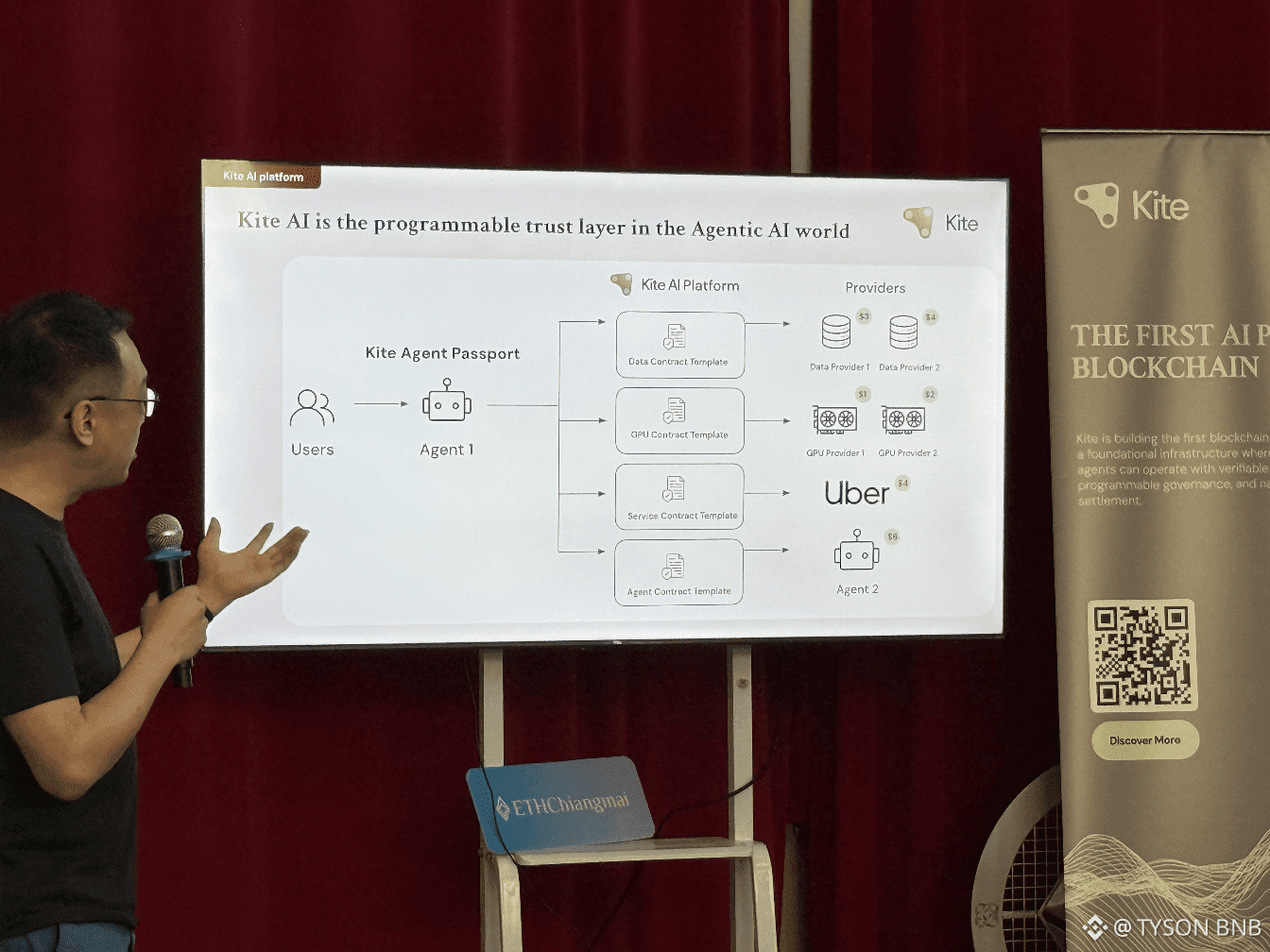
 The most important systems on the internet are rarely the most visible ones. DNS does not brand itself to users. Payment rails do not ask for attention. Operating systems fade into the background once they work well enough. Economic infrastructure follows the same rule: the closer it gets to everyday usage, the less it should be noticed.
Kite is designed with this principle at its core. It is not trying to become a destination app, a consumer brand, or a surface-level product. Its long-term role is quieter and more structural to act as an invisible economic layer that powers apps and services without demanding that users understand, touch, or even know about it.
Visibility Is a Liability for Economic Infrastructure
When economic layers are visible, they introduce friction. Users must learn new concepts, approve new permissions, manage new balances, and make new decisions. This slows adoption and fragments experience.
Kite assumes the opposite: economic logic should live beneath the interface, not inside it.
Apps should focus on what users want to do communicate, create, play, coordinate, earn while Kite handles how value moves, how actions are verified, and how incentives remain aligned in the background.
The less users think about Kite, the more successful it becomes.
Apps Want Outcomes, Not Tokens and Transactions
Most apps do not want to become financial products. They want:
Reliable micro-payments
Verifiable user actions
Background rewards
Automated settlements
Fraud-resistant incentives
What they do not want is to force users to understand wallets, gas fees, bridges, or cryptographic approvals.
Kite provides economic outcomes, not financial ceremony. Apps integrate functionality paying creators, rewarding contributions, charging usage, coordinating agents while Kite executes the economic logic invisibly.
This separation allows apps to remain user-first while still being economically native.
Micropayments Only Work When They Are Unseen
Internet-scale value exchange happens in tiny units. Likes, views, tasks, moderation actions, background computation none of these tolerate explicit payment prompts.
Kite’s micropayment architecture is designed to disappear:
Payments net in the background
Execution is batched intelligently
Fees are abstracted away
Settlement feels instant but does not interrupt flow
Users experience value exchange as part of interaction, not as a financial event. This is critical. The moment payment becomes noticeable, granularity collapses.
Kite keeps granularity invisible.
Agent-Native Economics Operate Behind the UI
As apps increasingly rely on agents recommendation agents, moderation agents, automation agents, AI assistants economic coordination must happen machine-to-machine, not human-to-human.
Kite is built for this world.
Agents:
Earn micro-rewards
Spend small budgets
Trigger conditional payments
Coordinate execution priorities
All of this happens without UI prompts. Humans set intent and boundaries once. Kite enforces economics continuously.
This makes Kite less like a product users interact with and more like an economic operating system services depend on.
Proof and Verification Without User Burden
One of the hardest problems for apps is proving that actions actually happened. Centralized platforms solve this by trusting themselves. Decentralized systems often push proof complexity onto users.
Kite avoids both extremes.
It provides verifiable proof-of-action at the infrastructure level. Apps do not need to explain cryptography. Users do not need to sign every event. The system verifies actions quietly and enforces rewards automatically.
Trust is achieved structurally, not socially.
Apps Keep Their Identity; Kite Stays Neutral
Kite does not compete for user identity. It does not try to own the relationship between users and apps. This neutrality is intentional.
Apps retain:
Branding
UX
User relationships
Product differentiation
Kite supplies:
Economic coordination
Identity abstraction for agents
Execution guarantees
Incentive plumbing
Because Kite stays neutral, it can sit behind many different apps without forcing them into a shared surface or ecosystem politics.
Invisible Layers Scale Better Than Visible Ones
Visible platforms hit scaling limits quickly. Support load increases. UX fractures. Governance becomes political.
Invisible layers scale differently. They are judged by:
Reliability
Predictability
Low maintenance
Minimal friction
Kite’s architecture aligns with this scaling logic. Once integrated, it does not require constant tuning or explanation. It simply keeps working.
This is why infrastructure that lasts tends to disappear from conversation.
Why This Matters for Mass Adoption
Mass adoption does not happen when users learn new systems. It happens when systems disappear into familiar experiences.
If every app must teach users DeFi, adoption stalls.
If DeFi becomes something apps use, adoption accelerates.
Kite is built for the second outcome.
It allows apps and services to become economically expressive without becoming financially complex.
The Quiet Network Effect
Kite’s network effect is not social. It is structural.
As more apps rely on Kite for:
Micropayments
Agent coordination
Verified actions
Background incentives
the cost of replacing it increases not because of lock-in, but because of embedded functionality. Removing Kite would mean rebuilding economic logic from scratch.
This is how invisible infrastructure becomes indispensable.
Kite is positioned as an invisible economic layer because that is where real power accumulates. Not at the interface, not in branding, not in attention but in the systems that quietly make value exchange possible at scale.
By staying behind apps and services rather than competing with them, Kite maximizes its reach while minimizing friction. Users do not need to know Kite exists. Developers do not need to explain it. Agents simply operate within it.
The most successful economic layers will not be the ones people talk about the most they will be the ones people stop thinking about entirely.
Kite is building for that future.

Kite: An Invisible Economic Layer Behind Apps and Services
Disclaimer: Includes third-party opinions. No financial advice. May include sponsored content. See T&Cs.


KITE
--
--
Explore the latest crypto news
⚡️ Be a part of the latests discussions in crypto
💬 Interact with your favorite creators
👍 Enjoy content that interests you
Email / Phone number
Relevant Creator

@TaSaN007