

There’s a quiet evolution happening beneath the surface of decentralized finance, one that feels less like the fanfare of a flashy launch and more like the careful construction of something durable and long-lasting. That’s what I see in the way @Falcon Finance long discussed as one of the more forward-leaning stablecoin and collateral infrastructure protocols in crypto seems to be shifting its emphasis. It’s moving from a purely innovation-driven narrative to one where institutional stability and real-world credibility are no longer abstract goals but active design pillars.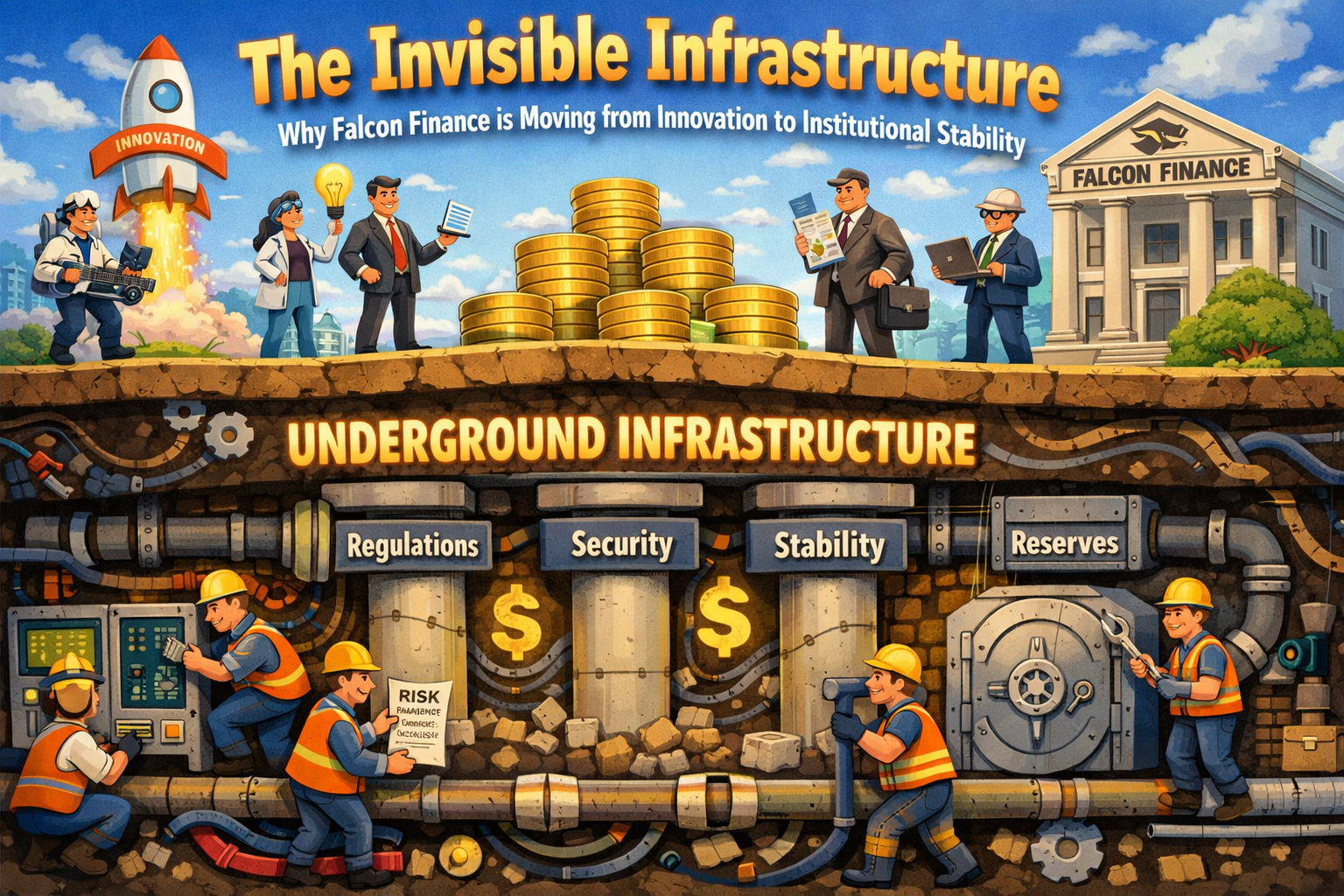
When Falcon first gained attention, it felt to many of us like yet another protocol trying to reinvent pieces of DeFi. But this wasn’t a reinvention for its own sake. The team set out to build what they called a universal collateralization infrastructure a system where a broad range of assets could effectively be turned into USD-pegged liquidity without the rigid ceilings and manual processes of traditional finance. The idea was to unlock liquidity rather than trap it, to let assets sit productive instead of dormant. This was an idea that resonated, particularly during periods where yield felt out of reach elsewhere.
But innovation in crypto often runs headlong into real world expectations: predictable risk, compliance, audited reserves, and partnerships that signal trust from outside the insular circles of early adopters. That friction isn’t a bug — it’s reality. And increasingly, protocols that want to survive and matter have to meet it head-on. What I’m noticing with Falcon Finance isn’t just a change in marketing, but a series of practical shifts that point toward institutional readiness.
Take the launch of an on-chain insurance fund — not a token gimmick, but a real pool of capital designed to act as a buffer in times of market stress. Established with $10 million in initial funding and structured so that portions of protocol fees flow into it over time, this isn’t just about protection. It’s about building confidence for participants who have traditionally steered clear of DeFi because they see risk as asymmetrical. By creating a transparent, verifiable fund that can absorb certain stresses, Falcon is aligning more with how traditional finance thinks about capital cushions.
Another signal worth noting is the strategic investments and partnerships the protocol has been securing. Investments from firms like M2 Capital and collaborations with other financial infrastructure players aren’t incidental. They represent real capital commitments and a vote of confidence from entities that operate at or near institutional standards. When investors with reputations to protect put money into a project, they’re not just funding code — they’re backing frameworks they believe can endure.
The updates tell a clear story: Falcon is trying to act more mature. A new governance token plus an independent foundation means oversight is separated from development. That kind of split is common in regulated systems, and it suggests they’re thinking about accountability — not just growth.
It’s easy, when you’re steeped in crypto culture, to underestimate how important these structural moves are to people outside it. For many traditional institutional investors, transparency isn’t a buzzword; it’s a requirement. Proof of reserve systems, audited collateral dashboards, and independent governance foundations are not optional if you want a bank or asset manager to even sit at the table. Falcon’s moves in these areas, taken together, signal an understanding of that reality — a recognition that innovation without trust is like building a house without a foundation.
In my own time covering and writing about DeFi, I’ve watched cycle after cycle of optimism followed by disillusionment. And I’ve noticed something: the projects that last are rarely the wildest, loudest launches. They are the ones that understand risk and design with it in mind. I think that’s a big part of what’s motivating this shift with Falcon — not abandonment of innovation, but maturation of purpose.
And there’s a broader context here, too. We’re not living in the same DeFi world we were five years ago. Conversations about decentralized finance now routinely include regulatory compliance, institutional onboarding, and cross-border asset tokenization. Concepts that once lived at the fringes of financial discourse — like tokenized real-world assets or synthetic dollars that represent diversified collateral — are increasingly in the mainstream dialogue. Falcon’s roadmap includes bridges to these areas, further underscoring that selling a vision of DeFi to institutions requires more than technical novelty.
So why does this all matter now? Partly because the market has matured. Users and investors have learned — sometimes the hard way — that sustainability and stability count for more than the highest fleeting yields. And partly because the broader financial system is paying attention. The last year has seen regulators and traditional finance players engage with crypto not as a speculative fringe but as something that might actually interface with real capital flows. Entities looking to participate at that level are being forced to put down roots.
That doesn’t mean Falcon Finance is abandoning creativity or becoming a stodgy institution. Far from it. What it means is that the invisible infrastructure beneath it — the design philosophy, the risk frameworks, the governance mechanisms — is evolving from purely experimental code into something that could feasibly support institutional engagement at scale. In other words, it’s growing up without giving up.
DeFi can feel like a storm — exciting, but unstable. That’s why a more grounded path isn’t a retreat. It’s the move that turns experiments into real trust. Because new ideas alone don’t last — the winners are the ones that build stability on top of them.
@Falcon Finance #FalconFinance $FF


