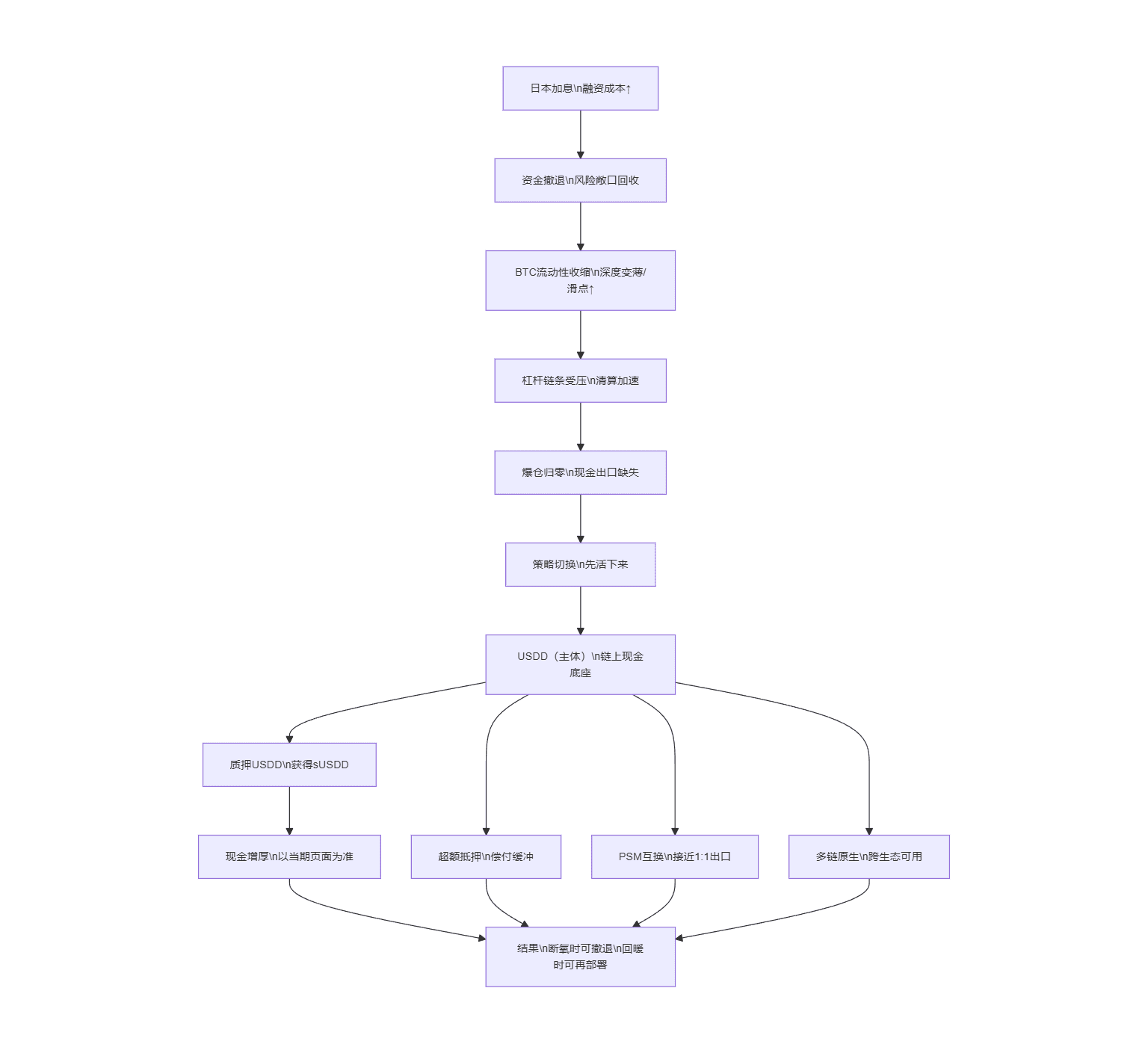
The moment the Bank of Japan raised interest rates, my position was already dead—not dead in price, but dead in liquidity. As the cost of yen financing rose, arbitrage funds withdrew, and risk exposure was uniformly reclaimed, BTC's order book exhibited the most dire state: you could see the price jumping, but couldn't find the depth to fill your order. You thought you were trading, but in reality, you were betting that 'the market always has oxygen.'
I was the one who went bankrupt to zero in this state of hypoxia: the leverage hadn't had time to save itself, and slippage first breached the margin; you thought you lost to the trend, but what you truly lost to was—when the funding channels tightened, you had no 'cash exit'. It was after that night that I started to configure differently: I no longer used all my funds to challenge the liquidation line, but instead replaced my base position with something more like a 'on-chain cash project': USDD.
Because in an era when liquidity can be suddenly withdrawn, the value of USDD is not 'telling stories', but 'allowing you to retreat, wait, and continue to make money'.
Why USDD is the protagonist: it solves the problem of 'how to survive when oxygen is cut off'.
First, clarify the core of USDD: USDD 2.0 is no longer the early path that was easily misunderstood; it is more like a structured project that breaks stablecoins down into—over-collateralization + PSM anchoring module + multi-chain native + staking to generate sUSDD. You can understand it as answers to four questions:
1) Why is it close to 1 dollar?
USDD 2.0 follows the over-collateralization logic: every USDD is backed by over 1 dollar in value of on-chain assets, with collateral rates typically maintained in a higher buffer zone (based on on-chain verifiable standards). This means it is not maintained by 'confidence', but by 'repayment structure'.
2) How to pull back when deviating?
PSM provides a near 1:1 exchange/arbitrage channel, essentially giving the market a hard anchor point: when deviation occurs, arbitrage will pull the price back towards the anchor point along the channel. Its most critical variable is only one: how deep the pool is.
3) What is relied upon 'to be available' during oxygen cut-off?
USDD emphasizes multi-chain native and DeFi composability: when a certain chain is congested or a certain scenario fails, you can still migrate funds to where they can continue to operate—this is especially important on nights of 'funds unified recovery'.
4) Without leverage, how does money continue to work?
This leads to what I truly needed after my liquidation: USDD → sUSDD. You stake USDD and obtain sUSDD; returns are reflected in the form of 'the exchange ratio of sUSDD to USDD increasing' (performance is based on the current page and on-chain data, not a promise). For someone who has experienced going to zero, the significance of this structure is very simple: without betting on direction, cash can still gradually thicken.
Bold assumption: Next time 'Japan raises interest rates again', how do you not go to zero?
I rewrote the tragic incident of that night into a more useful script—same sudden interest rate hike, same BTC liquidity contraction, but this time my actions were completely different:
The first reaction is not 'to add positions and hold on', but to first pull out the risk exposure, putting it into on-chain cash like USDD, allowing yourself to exit the liquidation line chase.
The second step is not to wait to die with an empty position, but to convert the part of USDD prepared for long-term parking into sUSDD, allowing cash to generate returns while waiting (based on the current page).
The third step is to keep a small portion of unstaked USDD as 'emergency ammunition': because the moment liquidity comes back, opportunities usually only give cash, not explanations.
You will find that the core of this logic is not 'smarter', but 'harder to die': put high volatility in the offensive position and stable cash in the bottom position; you can lose in offense, but the bottom position cannot go to zero.
The benefits and paths of staking: explained in one sentence.
The biggest benefit of staking for me is only one: changing the income from 'must rely on the market' to 'cash can also grow'.
The path is also very simple (no detours):
First, exchange the stablecoins you have for USDD (use the most straightforward entrance in your ecosystem: on-chain exchange, swap channels, etc., based on current availability).
Then at the USDD staking entrance, convert USDD to sUSDD (what you receive is a 'growing certificate', with growth reflected in the change of exchange ratio).
When you need to exit or re-attack, exchange sUSDD back to USDD, and then migrate/exchange to the scenario you want to go to as needed.
The key to this process is not 'how high the returns are', but 'do you have a route to return to cash at any time'. Those who have experienced liquidation understand: being able to retreat is what makes it possible to talk about making profits.
Ending: Japan's interest rate hike taught me one thing—don't gamble against liquidity.
The most severe aspect of events like Japan's interest rate hike is not the event itself, but it triggers 'funds to act in unison': retreat, shrink the balance sheet, and recover risk exposure. BTC becomes a liquidity meat grinder at such times—and I don’t want to feed myself into it again.
So I put the protagonist in USDD: it is not to let you flaunt profits, but to allow you to settle, retreat, wait, and strike again when the market runs out of oxygen. If you have experienced a liquidation to zero, you will understand: true Alpha is not about predicting direction, but designing a cash system that is not easy to die.
Disclaimer: The above content is a personal research and opinion of 'carving a boat to seek a sword', used only for information sharing and does not constitute any investment or trading advice.
@USDD - Decentralized USD #USDD以稳见信