

@Lorenzo Protocol I’ve been thinking lately about how much talk there is around transparency in crypto. Not the surface-level idea that you can open a block explorer and see transactions every public chain has that but something deeper, something that bridges the raw openness of on-chain data with the kind of clarity regulators and auditors actually trust. It’s one thing for a ledger to be public; it’s another for that data to be shaped into reports that satisfy compliance frameworks, internal controls, and the kinds of requirements auditors demand. That gap between raw transparency and regulator-ready reporting is where a project like @Lorenzo Protocol has been quietly staking a claim.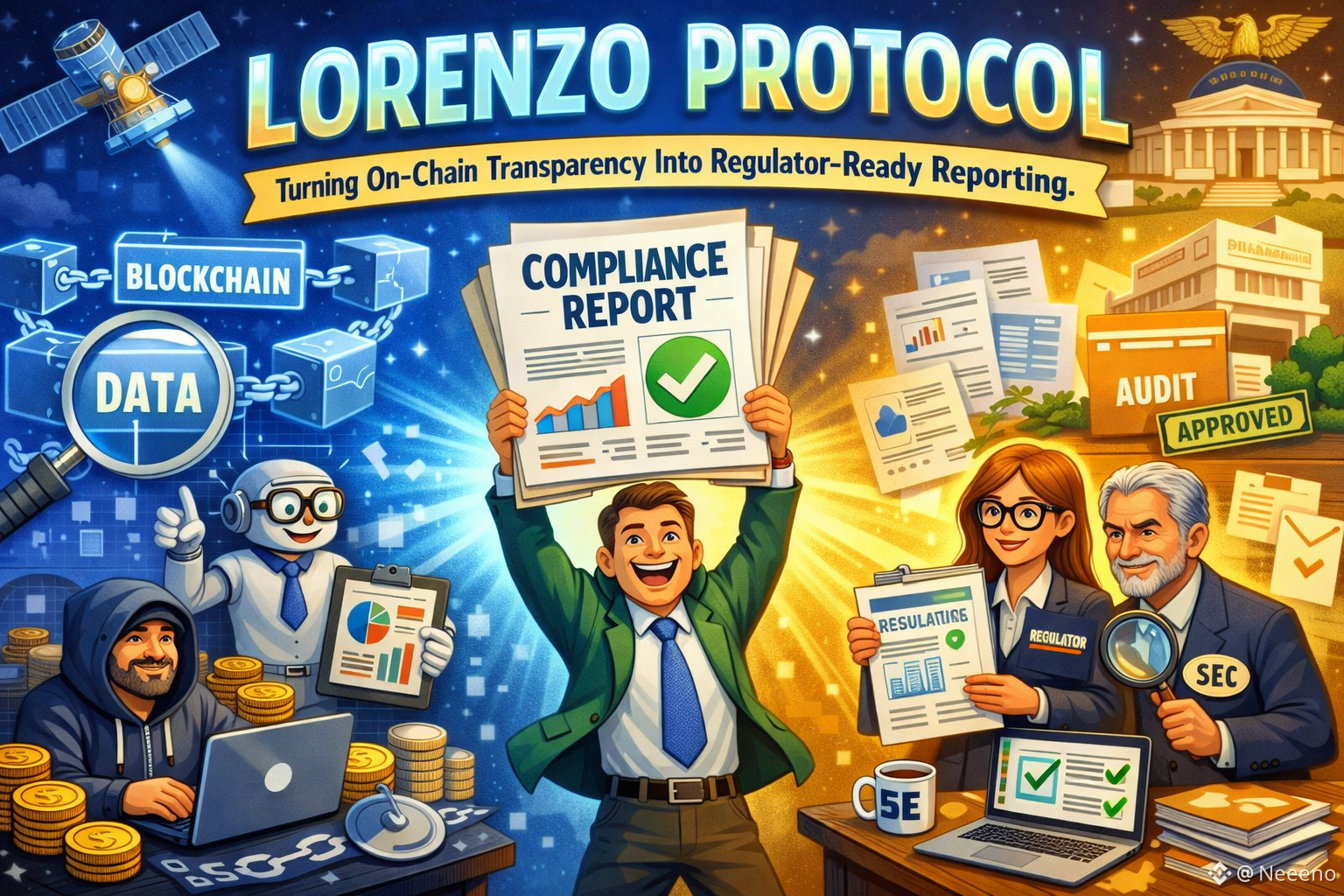
Here’s the key starting point: blockchains keep track of actions in public, so anyone who can read the data can see what happened But visible isn’t always useful. Regulators don’t want strings of hex or transaction hashes; they want timelines, risk assessments, reconciliations, and narratives that fit into existing frameworks. Financial institutions are similar. They need outputs they can audit, explain, and integrate into reporting systems that, in many cases, were built before Web3 existed at all. Lorenzo’s idea isn’t just to show data, but to make it meaningful to the people who must live with it beyond the blockchain.
This shift, from simply being transparent to being compliant by design, is part of why the conversation around Lorenzo feels timely. In the last year, there’s been real pressure on crypto projects to step up their reporting standards. Regulatory bodies in the U.S., Europe, and Asia have repeatedly flagged weak on-chain auditability as an obstacle to registrations and licenses for crypto funds and trading platforms. They’re not saying that blockchains are fundamentally opaque—nothing could be farther from the truth—but that the raw form of blockchain data doesn’t map neatly onto the audit processes that regulators and accountants use.
The market is basically proving the point. Big finance is experimenting with regulated dollar stablecoins on public chains, and exchanges are being tougher about token listings. A national bank launching a blockchain-native stablecoin isn’t just adoption—it’s a warning label: “play by real compliance rules, and produce real reports. In that environment, a protocol that can take blockchain transparency and shape it into something regulators and auditors can use isn’t just useful—it’s necessary.
Lorenzo Protocol, in its current form, has grown beyond a simple yield-generation platform. It’s building structured financial products on chain—things like on-chain traded funds, BTC yield instruments, and tokenized vaults—where every action is recorded on a public ledger. That’s the easy part. The harder part is presenting that record in a way that satisfies institutional standards around control, consistency, and reconciliation. That’s the promise behind what they have called their Financial Abstraction Layer, a piece of infrastructure designed to make blockchain activity intelligible in traditional compliance contexts.
It’s worth pausing on that term, because it reflects a growing pivot in blockchain design: from raw decentralization to structured transparency. There’s a natural tension here. Many early advocates of public blockchains prized the idea that anyone could look at the data and verify what’s happening.
Enterprises don’t treat “verified” as “I can see it on the blockchain.” They want reporting that proves the transaction was correct, allowed under policy, and compliant with external rules. That means adding context and structure—tags, reasons, exceptions, and controls—which blockchains don’t come with out of the box.. Lorenzo’s approach acknowledges that need.
I’ve watched a number of Web3 projects struggle with this idea.
Crypto projects often promise “full transparency.” Then reality hits: serious partners want audit-style proof—documents, procedures, and controls.
Blockchains show transactions. Auditors want the full story: why things happened, how records match up, what rules exist, what broke the rules, and how the system prevented or handled problems. That kind of setup has to be designed early, not patched in later.
That’s why the Lorenzo narrative lately feels like it’s coming from real pressure in the market. People want projects that can show transparency in practical, governance-friendly ways—not just talk about it.. We’ve seen partnerships and integrations that speak to this trend, and discussions around institutional adoption increasingly revolve around compliance, auditability, and regulatory alignment.
I don’t want to oversell any of this. There are real skeptics who point out that on-chain transparency doesn’t automatically equate to regulatory acceptance.
They’re not wrong: compliance isn’t “we have the data.” It’s “we can prove who did what, why, and under which rules.” The big shift is when projects treat transparency as something you design for—so it creates real audit-ready reports—instead of something you just say in marketing.It suggests a maturation in how builders think about the relationship between decentralized systems and regulated institutions.
For anyone watching this space, that’s the deeper story worth paying attention to. Not just that a protocol is trying to be transparent, but that it’s engaging with the very real question of what transparency means in contexts where livelihoods, fiduciary duties, and legal obligations are on the line. It’s a subtle shift, but an important one—one that may define which blockchain infrastructures truly scale beyond hobbyist markets into the mainstream financial world.
@Lorenzo Protocol #lorenzoprotocol $BANK

