In one hour, it dropped from 4.8 to 0.8:
Behind the flash crash of the meme coin is actually a structural flaw in perpetual contracts and AMM.
Yesterday, another meme coin completed its 'mission'.
This coin is called Light, which claims to be a 'Bitcoin ecological project'. It started on December 10th and was pumped dozens of times in just a few days. Then, within one hour, the price plummeted from $4.8 directly to $0.8, almost completing a standard 'runaway flash crash'.
If you think this is coincidental, you might be underestimating the maturity of this play.
One, it's not about how much capital there is, but 'how little spot is released'
Light's operation methods are actually very classic:
The project party controls the vast majority of the spot chips
Only releases a very small portion of the spot into the market
Does not go to mainstream exchanges, only chooses small exchanges or DEX
This time Light mainly pulled the market on PancakeSwap (CAKE).
Let's look at a very key set of data:
The 24-hour trading volume of this trading pair on CAKE: 45 million USD
Accounted for 42% of the total network trading volume
Reverse calculate the total network 24-hour trading volume to only about 100 million USD
But the project party claims this is a 'fully circulating' project.
If estimated at a daily trading volume of 100 million USD, the real circulating and freely tradable spot scale may only be at the million USD level.
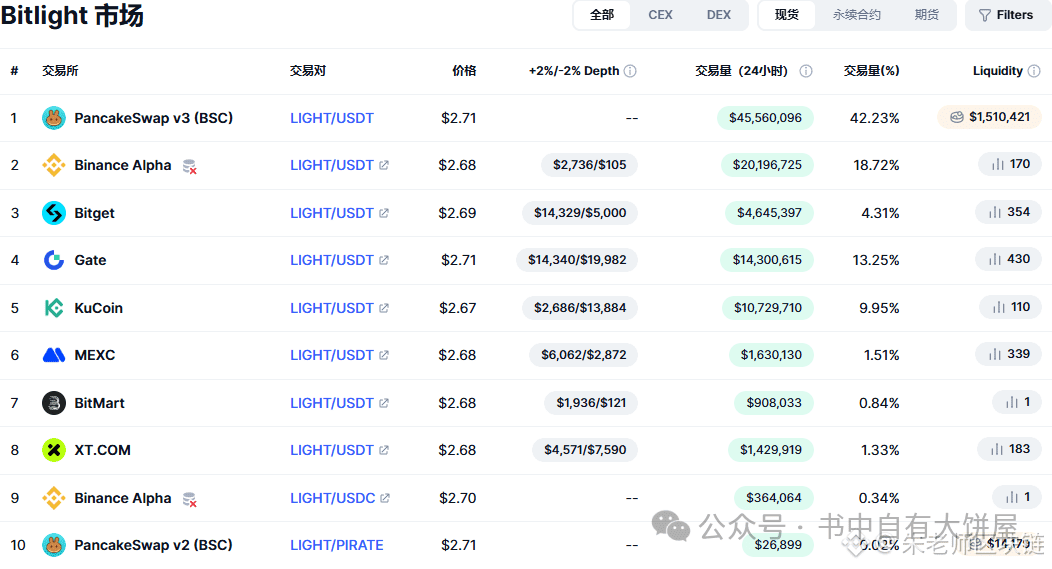
Two, locking up spot with high APR makes liquidity 'thinner'
I further looked at the scale of the AMM pool for this trading pair on CAKE:
Peak pool total: about 1.5 million USD
After the flash crash: only 900,000 USD left
Meanwhile, the pool APR once increased from 100% to 300%
The purpose of this step is very clear:
It's not to let you make money, but to make you deposit the spot into the pool.
Because once the spot is locked in the pool:
The chips freely circulating in the market further decrease
The project's control over prices is even stronger

Three, the fatal flaw of AMM: small pools, fixed prices
DEX uses AMM (constant product formula) pricing mechanism:
Prices are not determined by 'market consensus', but by 'how much is left in the pool'.
This leads to an extremely dangerous result:
Want to make the priceDouble
Only need to buyAbout 20% of the tokensWant to make the priceTen times
Only need to buyAbout 34% of the tokens
In other words:
As long as you control a small pool of millions, you can create a 'price illusion' worth billions.
And Light's overall market value reaches 1.1 billion USD.
This is typical:
Using a 'small pool' to manipulate a 'pretended large pool'.
Four, spot is a tool, the real harvesting is in contracts
Let's take a look at the data from the contract market.
X's 24-hour contract trading volume on Light: 1.9 billion USD
DEX spot trading volume: about 80 million USD
What does this mean?
The size of the contract market is more than 20 times that of the spot.
Thus, this game becomes:
Want to pull the market
Control DEX spot prices with very little capital
Open a large number of long positions on contracts at the same timeWant to run away
Contract closes long positions
Directly crash the DEX
Controlling the spot ≈ controlling the contract anchor price
And the cost may only require 1% of the spot market value.
Five, perpetual contracts: Why is it becoming the 'dealer's artifact'
Many underestimate the structural risks of perpetual contracts.
Perpetual contracts have no delivery date; their only 'stabilizer' is just one:
Funding Rate
When the contract price deviates from the spot:
Exchanges will punish one side through the funding rate
Forcing the market to 'chase the spot price'
But on these meme coins, the funding rate often:
Settled every hour
Up to 2%
This means:
If you go against the trend
You may have to pay up to 48% of the holding cost in one day
In two days, it can wipe out your principal
You don't even need to be liquidated,
Time itself will kill you.

Six, history has proven: such things cannot survive in traditional finance
The concept of perpetual contracts was first proposed by Nobel economist Robert Shiller in 1992, and it was Arthur Hayes of BitMEX who truly made it happen.
But ironically:
Arthur Hayes himself hardly plays contracts,
But it brought a monster to the entire crypto market: 'no expiration date + high-frequency liquidation'.
In the traditional financial system:
With futures delivery
With options hedging
With regulation
With central bank backing
Even in extreme manipulation behavior, the central bank will intervene directly.
The most typical example is the manipulation of silver by the Hunt brothers in 1980:
Controlled 70%-80% of the global circulating silver
Cooperate with futures bulls
Pulled silver from $6 to $50
Severely impacted the real industry
In the end, the Federal Reserve and regulatory agencies intervened directly,
Bankrupted the Hunt brothers.
Seven, the real problem is only one
Futures have magnified the risk, but at least:
With delivery dates
With leverage limits
With regulatory constraints
And perpetual contracts:
No expiration date
Extremely high leverage
Web3 exchanges are almost unregulated
24-hour trading, can run away in 1 hour
The most fatal is:
Only 1% of the capital is needed,
To manipulate an item with a 100 times volume.
This is not 'high risk',
This is structural unfairness.
And retail investors are almost always the last ones to take the fall because in this game, you can't defeat someone who can control the dealer with very low costs!$ETH