

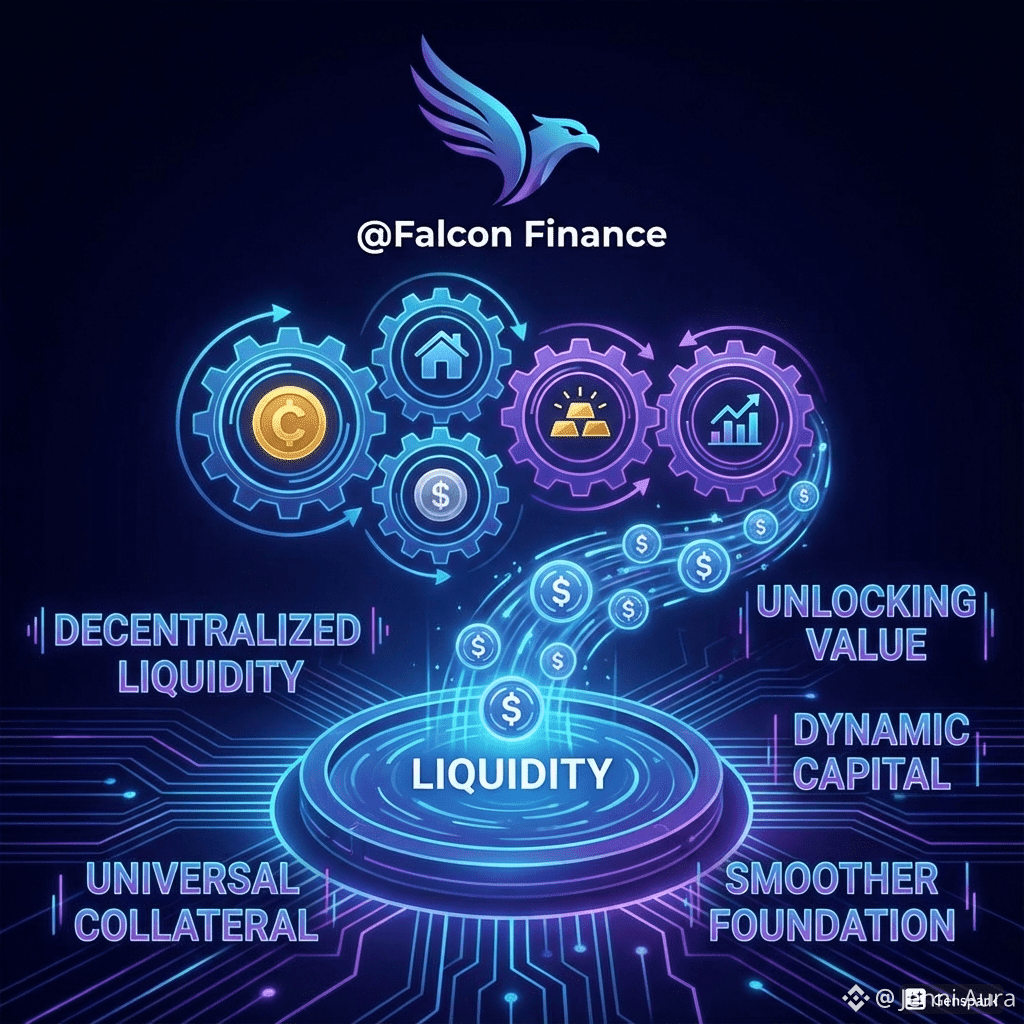
Most DeFi projects die the same way: they chase growth until the math stops working. Falcon Finance is doing something rare—building slower, boring people with transparency, and betting that discipline beats dopamine.
The Real Problem Nobody Wants to Solve
Here's the situation every long-term holder faces: you believe in your assets, but life doesn't wait. Property tax comes due. The business needs capital. Your parents need help. Traditional answer? Sell and watch the price double next month. DeFi answer? Borrow at 40% APY and pray liquidation doesn't find you.
Both options suck. That's not a hot take—it's just math that forces bad decisions.
Falcon Finance built USDf specifically for that gap. Deposit collateral, mint synthetic dollars, keep your upside. Want yield? Stake into sUSDf. Don't want yield? Hold liquid dollars. The choice itself is the point—you're not locked into someone else's risk appetite just to access your own capital.
Why "Market-Neutral" Is the Most Underrated Edge
Every blowup in crypto history has the same prequel: someone made a huge directional bet with other people's money and called it "yield." Terra. Celsius. FTX. The pattern is boring, and people keep falling for it.
Falcon's documented strategy is different—funding-rate arbitrage, basis trades, cross-exchange arbs, options positioning. These aren't moon-or-bust plays. They're grind-it-out strategies that extract value from market structure, not price direction. The whitepaper explicitly frames this as market-neutral and diversified across approaches, not concentrated in one magic trade.
Does that mean zero risk? Of course not. But it means the system isn't betting your collateral on Ethereum going to $10K. It's extracting spread, collecting basis, and farming inefficiencies that exist whether markets go up, down, or sideways. That's not exciting. It's durable. And durable is what survives multiple cycles.
The Transparency Play That Changes the Game
Here's where Falcon stops being theory and starts being different: they run a public Transparency Dashboard with live reserve data and strategy allocation breakdowns. As of recent reports, the largest allocation is options-based strategies, with smaller slices in spot/perps arbitrage, cross-exchange arb, and statistical models.
Why does this matter? Because in traditional finance, "how did you make this return?" is page one of due diligence. In crypto, it used to be treated like FUD. Falcon flipped that—made transparency the product, not the PR. Daily reserve updates, published audits, custody structures designed to eliminate single points of failure.
You can audit the math. You can challenge the assumptions. You can leave if you disagree. That's not just better disclosure—it's a structural moat. When the next crisis hits and everyone's scrambling to prove they're solvent, Falcon's already been showing receipts daily.
Timing: Why This Wins in 2025
The collateral landscape is shifting under everyone's feet. Tokenized treasuries, onchain equities, real-world assets—what used to be conference vaporware is now live infrastructure. That changes user expectations. If yield comes from actual diversified sources instead of recursive token incentives, users start demanding proof, not promises.
Falcon's collateral model fits that moment. It's not "deposit our token, earn more of our token" ponzinomics. It's "deposit real assets, mint dollars backed by market-neutral strategies and transparent reserves." The former works until it doesn't. The latter works until you mess up execution—which is a much better risk profile.
Distribution matters too. USDf deploying on Base isn't just a headline—it's strategic positioning. Base is where retail and institutional activity are converging in 2025. Being early to growing liquidity beats being established in stagnant pools. Falcon's betting on meeting demand where it's moving, not where it used to be.
The Edge Case That Proves the Model
Every financial system gets tested by edge cases. Overcollateralization helps, but it's not a cheat code. Market-neutral strategies still need functioning markets, liquid venues, and operational discipline when everyone rushes the exit.
This is where Falcon's design philosophy matters most. Discipline isn't a marketing term—it's a survival mechanism. Don't overpromise yields. Don't chase growth by underpricing risk. Don't use incentives as a substitute for real demand. Those rules sound obvious, but the DeFi graveyard is full of projects that forgot them when growth got tempting.
Falcon's bet is simple: the users who matter—the ones with capital, time horizon, and pattern recognition—are tired of getting rugged by complexity theater. They want boring infrastructure that works when volatility spikes, not leverage that evaporates when you need it most.
Why "Liquidity Without Regret" Isn't Just Marketing
Regret in crypto comes in two flavors: selling too early, or reaching for yield and losing everything. Falcon's offering a third option—stay exposed to what you believe in, but give yourself room to operate.
Need cash without selling? Mint USDf. Want yield without degen risk? Stake sUSDf with transparent, diversified backing. Want to exit? Redeem. The system doesn't force you into one risk profile just to access your own capital. That flexibility is the actual product.
Late 2025 feels like an inflection point. The "move fast and break things" era is over. The "show me the receipts" era is beginning. Institutional capital is coming onchain, and it's bringing institutional diligence with it. Projects that treated transparency as optional are going to get filtered out fast.
The Real Bet
Falcon isn't betting on hype. It's betting that enough users are ready to trade excitement for something that actually compounds: clearer mechanics, visible assumptions, and a system built to earn trust the long way.
Most DeFi projects optimize for the screenshot—the big number, the viral thread, the "we're so back" moment. Falcon optimized for the boring stuff: daily updates, diversified strategies, overcollateralized design, custody separation, transparent allocations.
That's not the strategy that wins Twitter. But it's the strategy that wins when the music stops and everyone checks who's actually solvent. And in crypto, the music always stops eventually.
The winners aren't the loudest. They're the ones still standing when the noise clears. Falcon's building for that moment.
@Falcon Finance #FalconFinance $FF



