

@KITE AI For a long time, stablecoins were easiest to describe as crypto that tries to behave like cash. Useful, maybe, but mostly living inside trading apps and pilots. Lately the conversation has shifted. Stablecoins are being treated less like a product and more like plumbing: a way to move value at any hour, across borders, without waiting for banks to open. That change matters on its own, but it matters even more now because AI is also changing shape.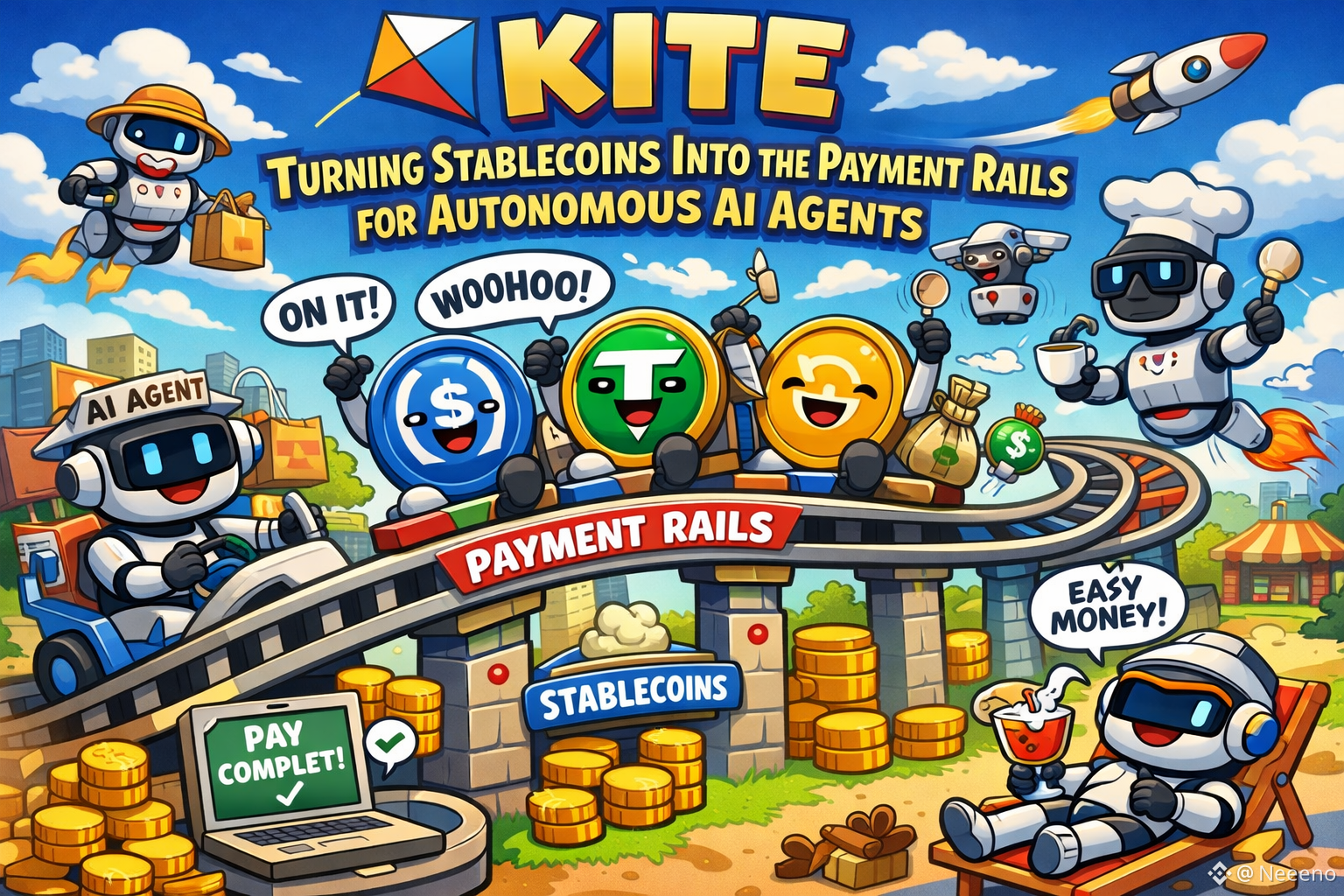
The past year has made “agents” feel real. Not just chatbots that answer questions, but systems that can take a goal and carry it through: find an option, compare tradeoffs, place an order, follow up, and keep going. The moment you try to let an agent finish the job, you collide with payments. Planning is easy to simulate. Spending money is not.
@KITE AI is one of the projects trying to take that collision seriously. It describes itself as an AI payments blockchain, built so autonomous agents can transact using stablecoins with an identity and a set of constraints. The phrasing can sound grand, but the problem underneath is plain. Most payment rails assume a human. They expect a bank account, a card, a billing address, and the ability to pass little tests designed to slow down fraud: logins, one-time codes, and customer-service hoops that were never designed for software.
Stablecoins are attractive here for a simple reason: they behave like money that software can hold and move directly. Settlement can happen, and it can happen 24/7. That’s why you’re seeing mainstream payment companies talk about stablecoin settlement in a more matter-of-fact way than they used to. Visa has expanded stablecoin settlement using USDC with bank partners, pitching it as a way to move funds outside traditional banking cutoffs. Shift4 has announced a stablecoin settlement platform for merchants, positioning it as a global settlement option across multiple stablecoins and chains.
Kite’s bet is that agents need more than “a wallet.” They need rails designed for machine behavior. Kite’s materials emphasize agent-native identity and a stablecoin-first payment flow, including an Agent Payment Protocol path for settlement. In human terms, that points to three requirements that keep coming up in every serious conversation about agent payments: who is the agent, what is it allowed to do, and how can someone audit what happened later
That middle question is the one I keep circling. In my own life, the messiest spending problems are rarely dramatic. They’re small. A subscription I forgot. A renewal notice I skimmed. A fee that seemed too minor to fight. If an agent is paying for services, calling APIs, buying data, or booking logistics, those small leaks can add up quietly. And because software can operate in loops, the leaks can scale. That’s where “payment rails for agents” stops sounding like a crypto slogan and starts sounding like basic risk management.
The timing is different because agentic commerce is showing up in places that usually wait until a trend is unavoidable. Mastercard’s forward-looking notes on payment trends for 2026 explicitly mention building guardrails around agentic commerce, with verification and stronger authentication as central themes. Google Cloud has introduced an Agent Payments Protocol (AP2) as a set of building blocks for secure transactions involving agents, another sign that big infrastructure players are paying attention.
Regulation is pushing in the same direction. Stablecoins used to sit in a haze of “maybe someday.” Now, central banks and governments are stating expectations about backing and redemption in clearer language. The Bank of Canada, for instance, has said stablecoins should be backed by high-quality liquid assets and redeemable at face value, with regulations expected in 2026. You can read that as constraint, but you can also read it as permission: clearer rules make it easier for real businesses to experiment
When people ask why this topic is trending now, I come back to a simple tension: autonomy is scaling faster than trust. We can build agents that look competent quickly, but it takes longer to build systems that constrain them, monitor them, and assign responsibility when something goes wrong. Payments force that issue because they turn a vague fear into a concrete charge.
I don’t think Kite, or any single network, magically solves it. Stablecoins still depend on issuers and reserves. Blockchains still have outages. Identity systems can be compromised. But it’s meaningful that the conversation has moved from “should stablecoins exist” to “how do we use them safely,” and from “agents are demos” to “agents will need budgets.” If Kite works, the victory will look boring: small, permissioned spending by autonomous tools, with clear limits and an auditable trail that people can inspect afterward.

