
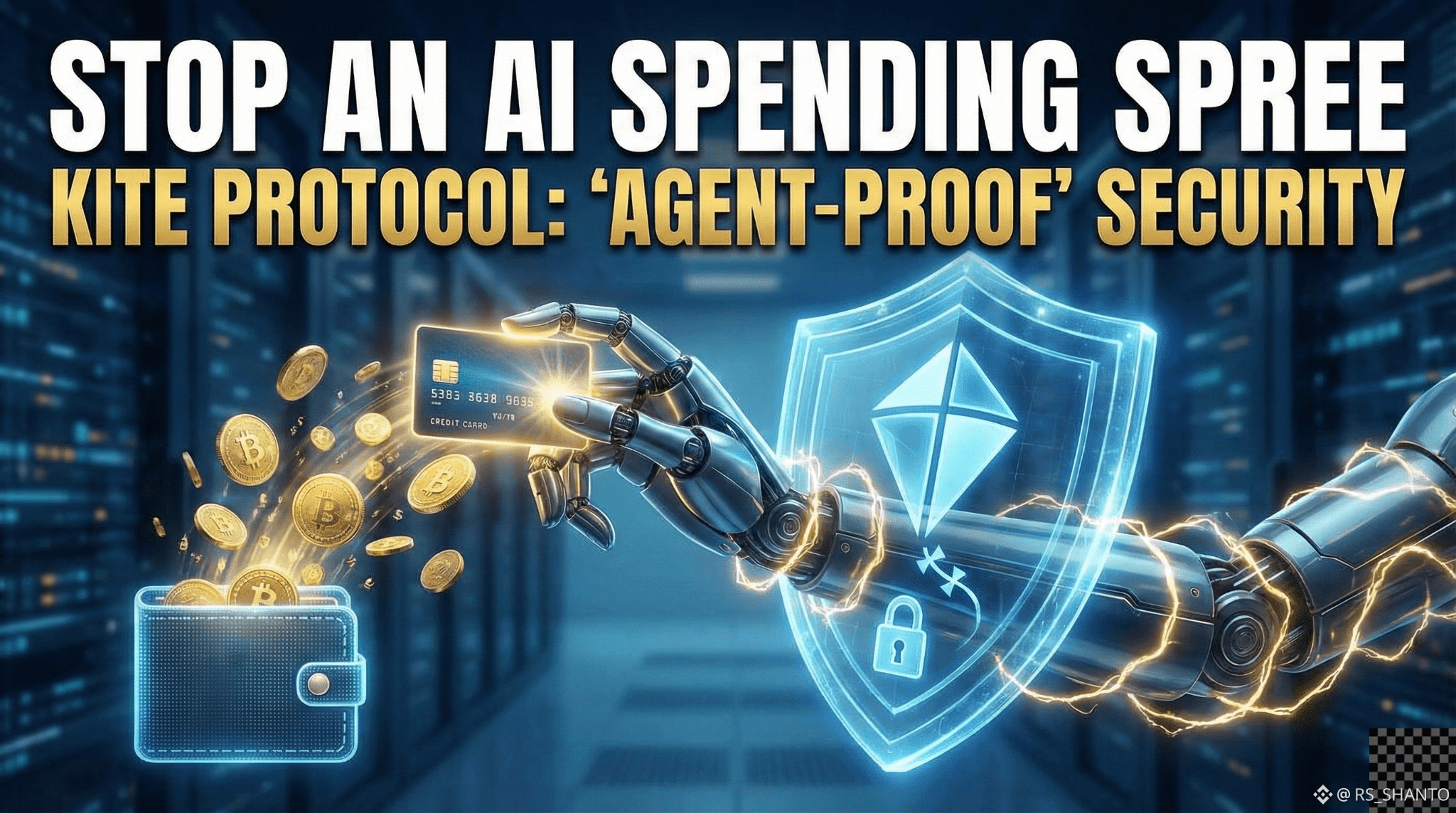
We're rapidly approaching a world where your AI assistant doesn't just suggest a vacation it books the flights, reserves the hotel, and rents the car, all while you’re busy living your life. This autonomy is the promise of the agent economy. But it introduces a terrifying question for any user or developer: how do you set hard, unforgeable financial boundaries for software? Giving an AI your credit card is unthinkable. Giving it a private key with unlimited access is reckless. The missing link for safe, mainstream adoption isn't smarter AI; it's smarter money with built-in guardrails.
This is the critical innovation at the heart of @KITE AI 中文 . Beyond enabling payments, Kite is pioneering programmable economic safety for autonomous agents. It recognizes that for AI to be a true extension of ourselves, it must operate within a financial "sandbox" where the rules are enforced by cryptography, not just good intentions.
From Trust to Verification: The SPACE Framework's Security Core
Kite's architecture, the SPACE framework, bakes security into its foundation. Two features stand out as game-changers for user trust:
1. Cryptographic Spending Limits: Imagine deploying an AI agent for customer service with a strict monthly budget. On traditional networks, that agent could be exploited or malfunction to drain a wallet. On Kite, the spending limit ($500/month, for example) is not a soft guideline in the AI's code; it's a hard-coded rule on the blockchain. The network itself rejects any transaction that violates it, creating a truly agent-proof financial container.
2. The Delegated Identity Layer: This solves the private key dilemma. Users don't give an AI agent their master private key. Instead, they generate a unique, restricted-purpose key for that specific agent. This key can only perform actions within its predefined permissions (like spending from a specific budget pool). It creates a clear, auditable chain of custody from user to agent to action.
KITE: The Token That Secures the Agent Economy
In this system, the $KITE token is the cornerstone of security and coordination. Its role extends beyond simple payments:
Validator Staking: Operators who run the network's nodes must stake KITE, aligning their economic incentive with honest validation of transactions and the enforcement of those critical spending rules.
Security Budget: The protocol uses KITE to fund its security model, including slashing mechanisms for bad actors and rewards for those maintaining network integrity.
Governance of Safety Parameters: As the ecosystem evolves, KITE holders will vote on key security upgrades, shaping how the network protects users from new and complex threats.
Why This Matters: Unlocking Institutional and Mainstream Use
This focus on programmable security isn't just for crypto-natives. It's the key that unlocks institutional and mainstream adoption. A hedge fund will never let an AI trading algorithm loose on a wallet with unlimited funds. But it might deploy one on Kite with a strict, cryptographically enforced risk ceiling. A game developer can confidently implement AI-driven characters that earn and spend micro-payments, knowing a bug can't bankrupt the system.
The Bottom Line
While others build more powerful AI engines, @KITE AI 中文 is building the trusted chassis and control systems. They understand that adoption won't be driven by capability alone, but by confidence. By making it possible to delegate economic agency without surrendering ultimate control, Kite is solving the deepest psychological and practical barrier to the agent revolution.
The future belongs to autonomous agents, but only if we can trust them. Kite is building the foundation for that trust, one programmable rule at a time.
#KITE #Web3Security #DeFi #AutonomousAgents #Blockchain $KITE
