
The data from the encryption research and consulting company Memento Research shows that most tokens issued in 2025 did not bring returns to early buyers. In contrast, tokens listed with a lower fully diluted valuation (FDV) significantly outperformed those with higher valuations and larger competing volumes.
 Source: Memento Research
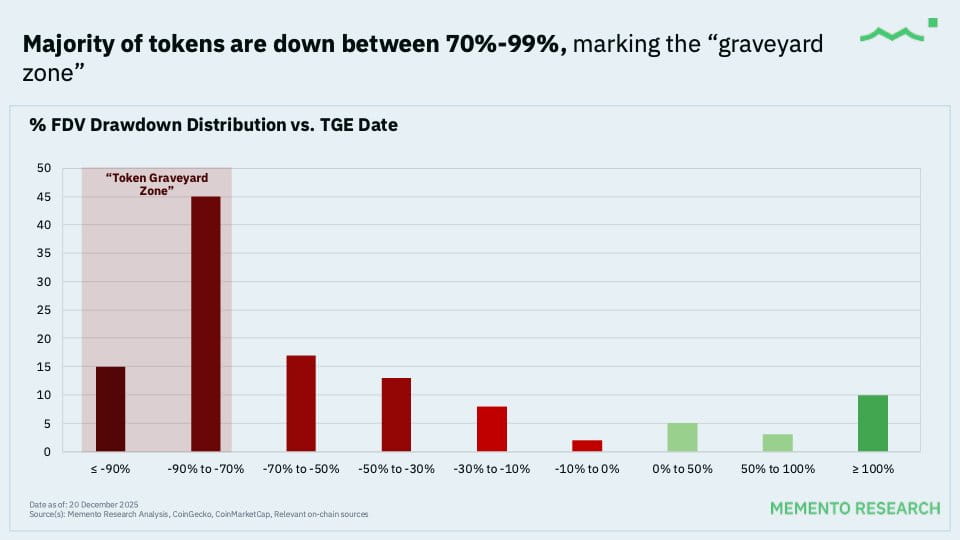
Memento recently tracked a total of 118 token issuances in 2025 and found that over 84% of them are currently trading below their valuations at the Token Generation Event (TGE), with a median drop of over 70%. Currently, only 18 tokens maintain positive returns, while the majority have experienced significant declines since their listings.
Memento wrote in the report: "Larger, highly sought-after token issuances perform worse." Research shows that when calculated on an equally weighted basis, a basket of tokens has an overall decline of about 33%. However, when weighted by FDV, the decline expands to over 61%, indicating that projects with larger issuance scales generally perform worse.
Taking the stablecoin public chain Plasma as an example, its FDV surged to approximately 17 billion dollars shortly after the TGE, followed by a significant retreat. According to CoinGecko data, as of the deadline, Plasma's FDV is approximately 1.2 billion dollars.
Memento's report states:
"The valuation set at the time of the token's launch was too high and significantly above its fair value, ultimately leading to poorer long-term performance, accompanied by larger pullbacks."
Research suggests that the clearest signal in the data comes from the initial valuation of the tokens. Tokens listed with an FDV between 25 million and 200 million dollars perform the best overall, with about 40% currently maintaining positive returns.
As the initial FDV increases, the performance of the tokens deteriorates rapidly. The report indicates that among the 28 token issuances with an initial FDV exceeding 1 billion dollars, none currently show positive returns, with a median decline of approximately 81%.
The strong performance of perpetual contract DEXs is driven by Hyperliquid
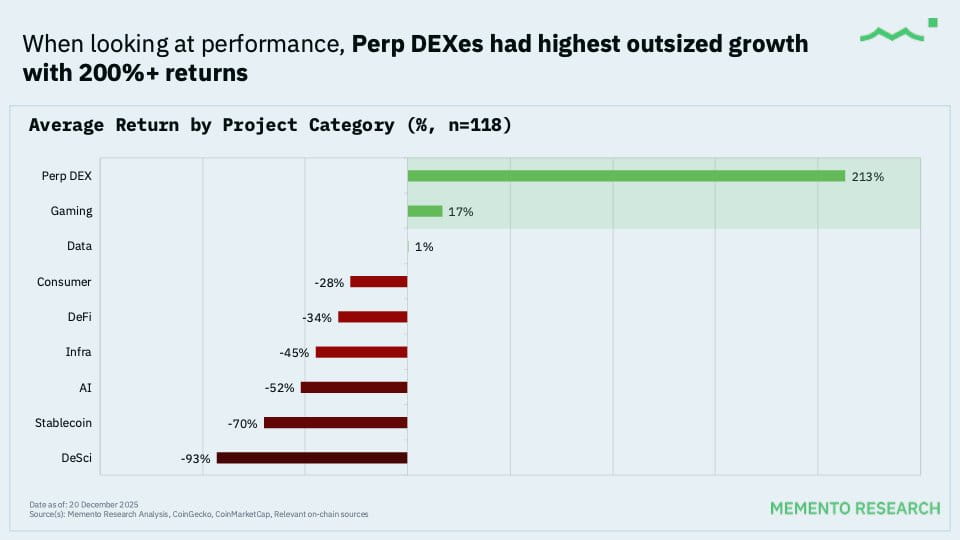
By category, the performance of decentralized perpetual contract exchanges (Perp DEX) is the most outstanding, with an average increase of over 200%. However, the report also admits that this achievement is mainly "driven by Hyperliquid and further boosted during the fourth quarter Aster launch."
 Source: Memento Research
Surprisingly, the average returns of gaming and data-related tokens are also positive, approximately 17% and about 1% respectively, but the report does not specify which projects drove these gains. In contrast, decentralized science (DeSci) and stablecoin-related projects are among the worst-performing categories, with average declines of 93% and 70% respectively.
Memento Research concluded:
"If there is only one lesson to be learned from this data, it is that the TGE in 2025 can be seen as a period of valuation reset: most tokens continue to weaken, with only a few outliers contributing almost all the upward movement, and the larger the initial FDV, the deeper the subsequent pullback tends to be."
Reference source
Source