
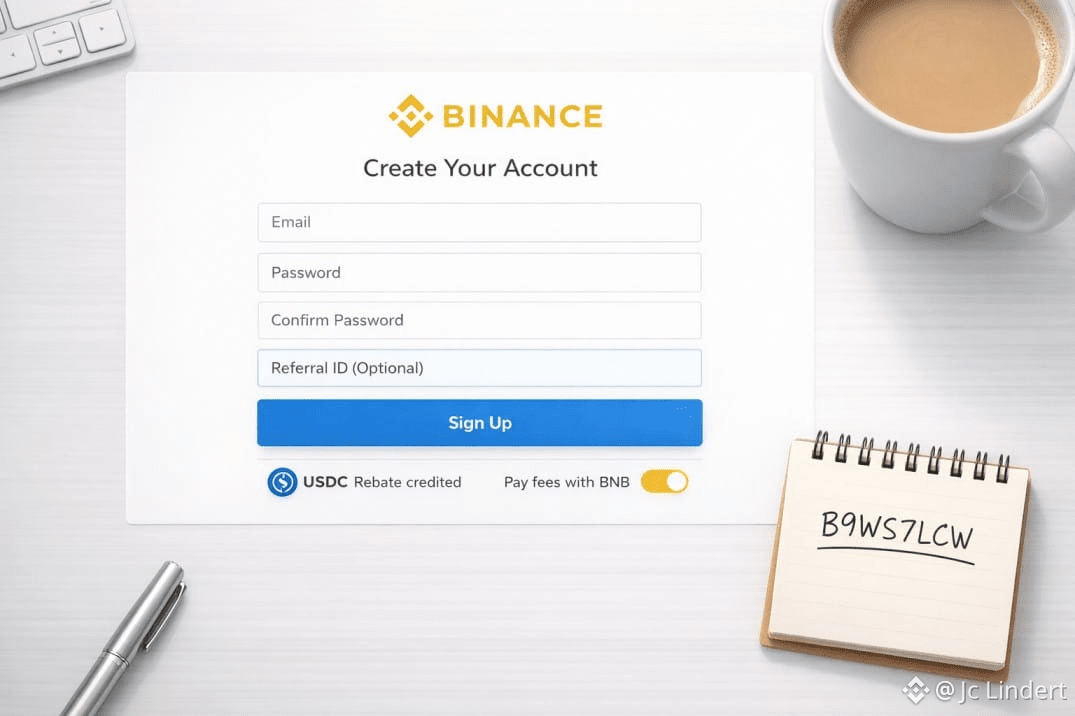
If you are about to create a Binance account, you will probably notice a small field during signup labeled "Referral ID (Optional)". It looks like a throwaway detail, but it can affect what you pay in trading fees and which welcome rewards you can access. This guide explains what a Binance referral code is, what the code B9WS7LCW is for, and the practical steps that help new users make sure the benefit really shows up.
What is a Binance referral code?
A Binance referral code (also called a referral ID or invitation code) is a tag you attach to a new account at the moment of registration. It links your account to a referral program setup behind the scenes. The key point is permanence: Binance states that once the referral relationship has been established, it cannot be changed or removed later. So it is worth slowing down for a moment when you see that field.
The code B9WS7LCW is the referral ID for 2026. You enter it during account creation, and Binance records that your account was referred under that code, so you can receive 20% off in transaction fees for spot, margin and futures markets.
Why this matters for a new user
Fees compound. Binance's Spot fee schedule lists a base maker and taker rate of 0.10% for regular users, and shows that paying fees with BNB can reduce that to 0.075%. If you trade frequently, even small differences like that add up over time.
A referral code can help on top of the normal fee schedule by providing a rebate on the trading fees you pay. Under Binance's Referral Pro mode, Binance allows the inviter to choose how much of their Spot commission and Futures commission to share with the invited user, up to a maximum of 20%.
That maximum is why many people search for referral codes in the first place: it is one of the few fee advantages that can be decided at signup.
Binance also has a separate referral mode that behaves more like a campaign. In Referral Lite mode, the new user and the referrer can receive a trading fee rebate voucher worth up to $100 equivalent after the new user completes identity verification and makes a crypto purchase worth more than $50 within 14 days of registration.
The actual voucher value can vary, but the takeaway is the same: referral benefits can be linked to actions you take early on, not just to trading later.
How referral rebates are paid
Many articles make referral codes sound like instant coupons, but Binance says the default token for commission rebates and shared commissions in Referral Pro mode is USDC. After the commission is generated, it is calculated and converted to USDC on an hourly basis, then deposited into the user's Spot account within 6 hours.
That detail matters because it changes what you should expect. You might pay the normal fee when the trade executes and only see the rebate later as a USDC credit. If you check immediately, you could think the referral did not work when it is simply settling.
It also helps you troubleshoot. If you trade, wait a few hours, and see no USDC rebate credits at all, that is when it makes sense to double check eligibility, the product you traded, and whether the referral relationship was actually set at signup.
Futures Market Discount
One more nuance for Futures traders: The referral code B9WS7LCW can be used for Binance Futures as well in 2026, and Binance notes that the rebate timeline follows the same duration as the commission, and gives an example where a one year Futures commission validity period would mean both commission and rebate stop after one year.
How to use Binance Referral Code B9WS7LCW during signup
The mechanics are simple, but small mistakes are common.
When you create a new Binance account, look for the field that says "Referral ID (Optional)" or a prompt like "Have a referral ID?". Enter B9WS7LCW exactly as shown, then complete the rest of the registration.
Two important guardrails:
First, do it during registration. Since the referral relationship cannot be changed or removed once established, you do not want to finish signup and only then remember the code.
Second, understand that different Binance products and regions may have different referral systems. This article is about the main Binance exchange referral program, not every separate product experience.
How to confirm you are actually receiving the benefit in 2026
You do not need to guess. Use a simple, low risk check.
After signup, explore your account area for referral, rewards, or voucher sections. If you are aiming for a Referral Lite voucher style reward, pay attention to the requirements Binance lists: identity verification plus a crypto purchase worth more than $50 within 14 days of registration.
If you are focused on Referral Pro rebates, the cleanest test is to place a small Spot trade and then wait long enough for settlement. The hourly calculation happens with deposit within 6 hours. After that window, look for a USDC credit in your Spot account history.
A second lever that many beginners miss is the BNB deduction toggle. Binance's support FAQ states you can save 25% on Spot and Margin trading fees and 10% on Futures trading fees by using BNB to pay fees, and that you need BNB in your Spot wallet and the "Using BNB Deduction" setting enabled. If you plan to trade more than casually, this often matters as much as the referral code itself.
Common reasons people miss the referral benefits
Most problems are boring, not mysterious.
Sometimes the code was not entered at signup or was mistyped. Sometimes the user expects an instant discount instead of a later USDC rebate credit.
Sometimes the user signs up under one referral mode and later learns there is another mode with different requirements, and Binance notes a new user is entitled to one referral mode only.
Sometimes identity verification is not completed, which can block voucher rewards. And sometimes the user trades products with no standard trading fee, which leaves nothing to rebate.
Once you know these failure points, referral codes stop feeling like a gamble. They become a predictable setup: enter a code, complete the early requirements if you want campaign rewards, and verify rebates on a small trade.
What coins can you trade with discount?
Bitcoin, Ethereum, BNB, XRP, Solana, Cardano, Avalanche, Uniswap and any other token pair listed on Binance.
Allowed countries
Philippines, Australia, South Africa, Indonesia, Vietnam, India, Brazil, Argentina, Mexico, Colombia, Chile, France, Spain, Italy, Germany, Portugal, New Zealand, Switzerland, Sweden, Norway, Denmark, Finland, Austria, Belgium, Ireland, Czech Republic, Poland, Romania, Greece, Hungary, Bulgaria, Slovakia, Slovenia, Croatia, Lithuania, Bangladesh, Pakistan, Sri Lanka, Nepal, Thailand, Malaysia, Egypt, Saudi Arabia, Kenya, Ghana, Morocco, Peru, Venezuela, Kazakhstan and others.
Summarizing everything
The most practical way to think about a Binance referral code in 2026 is as a fee decision you make once, at the start. If you decide Binance is the right exchange for you, using the Binance referral code B9WS7LCW during registration is a straightforward way to start with potential fee rebates and referral related rewards. After that, the biggest difference usually comes from your habits: finishing verification if needed, understanding how rebates are credited, and actively managing fees with tools like BNB deduction.
Crypto trading carries risk. Start small, learn the interface, and let lower fees be a quiet advantage rather than the main event.



