10 dollars to 100 million dollars.
Article author: Nicky
Source: Foresight News
From an emotional perspective, 2025 is not friendly for retail players in cryptocurrency; thus, while reviewing the rotating sectors and popular narratives of this year, I had a fantasy: If I were a '10u War God', starting with a modest amount of initial capital, like the protagonist in a movie, would I be able to reach the net worth of Wang Duoyu from 'The Richest Man in Xihong City' after a year?
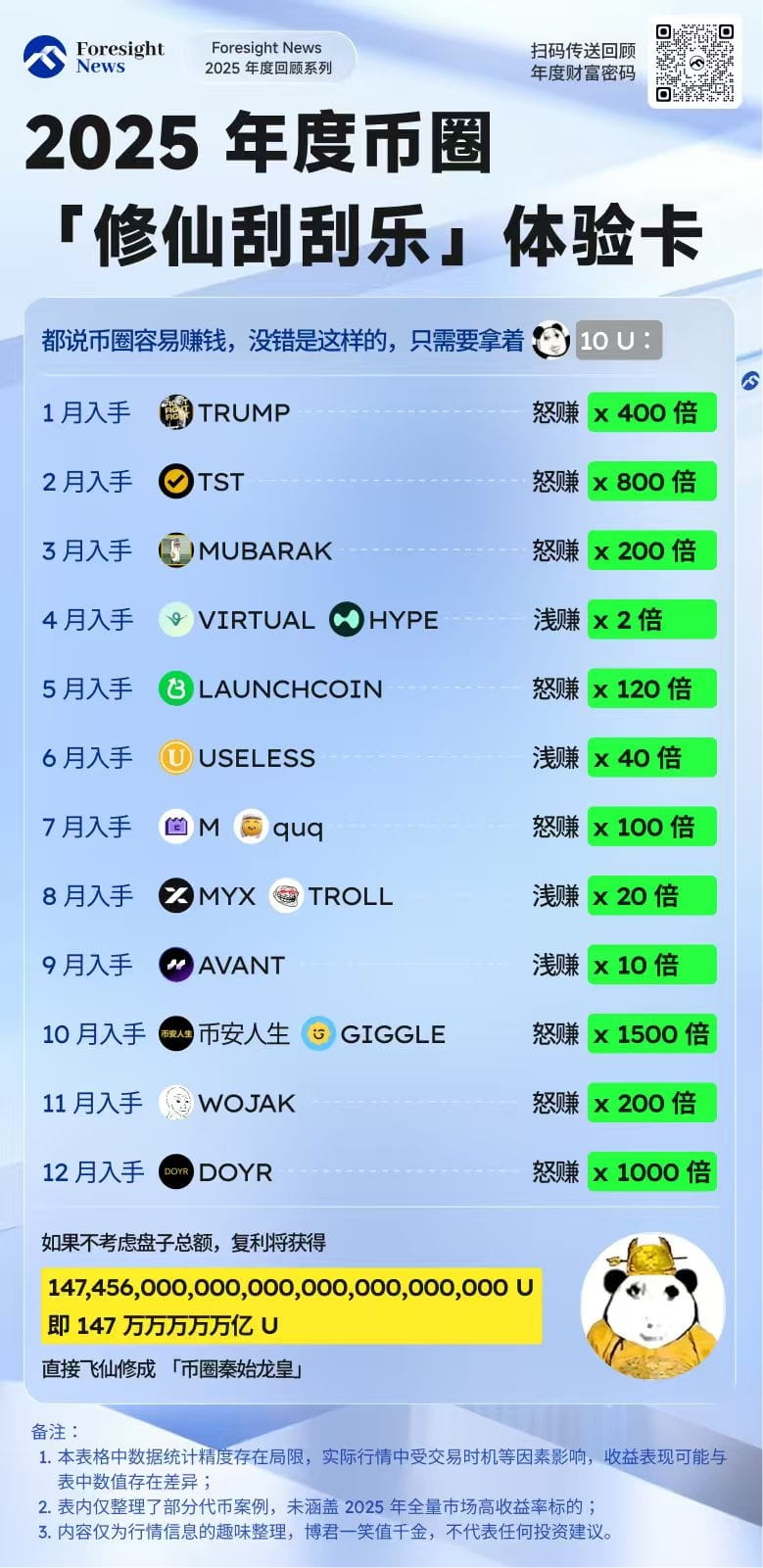
In January, Trump launched a coin, with a profit of 350 times.
On the morning of January 18, a message in the community rippled like a stone thrown into water: 'Trump has launched a coin!' Sleepiness instantly vanished. My intuition told me this was not simple. After confirming on Truth Social, the word 'official' thundered in my mind. A market value of 200 million dollars? For a potential 'presidential meme', this is light as a feather. 24 hours later, when Binance's listing announcement ignited the crowd, the price briefly broke through 70 dollars, with a market value of 70 billion dollars.
I bought TRUMP at a price of 0.2 USD and sold at a price of 70 USD, turning 10 USD into 3,500 USD.
At the end of January, I held assets totaling 3500 USD.
In February, the 'test coin' received Binance's endorsement, and I made a profit of 80 times.
On February 6, a token named TST entered my sight. Initially, it was just a screenshot of a test token that unexpectedly appeared in the four.meme demonstration video, briefly touching a market cap of 5 million USD before nearly going to zero. A turning point occurred that evening — Binance founder CZ mentioned TST on social media, clarifying it was not an official issuance, but attached a purchase link. This ambiguous statement triggered a market frenzy of FOMO. Subsequently, Binance quickly launched Alpha, contracts, and spot trading, pushing TST's market cap from the bottom to over 500 million USD.
I bought 3,500 USD when TST had a market cap of about 5 million USD (price about 0.004 USD) on February 6. After a series of actions by Binance pushed the price to a peak, I sold on the afternoon of the 9th at around 0.44 USD, making a profit of about 110 times, nearly 400,000 USD.
The 'confrontation' between internet celebrities and founders, I made 30 times.
On the 8th of the same month, American internet celebrity investor, known as the 'retail president' Dave Portnoy, bought a Meme coin named jailstool and publicly flaunted it, claiming he found the token interesting and promised not to sell it in the short term. The price immediately surged. However, dramatically, the token's anonymous creator did not buy it, and a few hours later sold a large amount, cashing out. Faced with the founder's 'betrayal', Dave Portnoy not only did not back down but instead doubled down, purchasing 200,000 USD worth of tokens, pushing this farce to its climax.
After this public confrontation attracted widespread attention, I bought in for 31,000 USD when the market cap was 6 million USD. When the hype peaked, I sold when the market cap was close to 200 million USD, making a profit of about 30 times, nearly a million USD.
Seizing the heat of new public chain launches, I secured 2 million USD.
In mid-February, the new public chain Story Protocol token IP went live on multiple exchanges. The project uses intellectual property agreements as its narrative and has support from the Korean community. After launching and consolidating, the price began to rise.
On February 17, I bought in for 500,000 USD when IP had a market cap of about 1.8 billion USD (price about 1.79 USD). Subsequently, the token price continued to strengthen, and about a week later, as the price rose to around 7 USD, I began to sell in batches, making a profit of about 2 million USD.
The mainnet of the 'ancient ground-pushing project' went live, making profits of a million USD.
In 2019, the Pi Network attracted millions of users globally through 'mining' on mobile, and its mainnet token PI went live on the Bitget contract trading market on February 20. This project, which has a large grassroots user base but has been delayed for years, finally welcomed a monetization channel, triggering significant market divergence and trading heat. Prices experienced violent fluctuations at the beginning of the launch, forming a short-term trend direction.
After the PI contract went live and experienced two days of adjustment, I used 2x leverage to go long at 0.83 USD. As market sentiment warmed, I closed my position on February 26 when the price rose to 2.78 USD, with leveraged profits of about 1.17 million USD.
February concluded with assets having quietly surpassed 4.5 million USD.
In March, I interpreted MGX investment in Binance, buying mubarak.
With different scales of funds, perspectives and battlefields change accordingly. In March, I shifted from 'fishing' to 'watching the tide.' The news that Binance received a 2 billion USD investment from the UAE sovereign fund was a macro wave, while a Meme post from CZ saying 'to meet an Arab friend' was a micro ripple. I followed the ripple to find mubarak, took a small position, and made a modest gain.
On March 12, Binance officially announced receiving a strategic investment of 2 billion USD from Abu Dhabi Technology Investment Corporation MGX, the largest single institutional investment in the history of the cryptocurrency field. On the 15th, CZ himself posted an ambiguous dynamic on Binance Square: 'Going to meet a friend this weekend', accompanied by a cartoon image with the word 'mubarak'. 'Mubarak' means 'blessing' in Arabic, and I believe this relates to that Middle Eastern investment.
After CZ released the news, I immediately sought and bought 50,000 USD of mubarak, which had a market cap of 38.5 million USD. As the market fermented, I sold on the 18th when the market cap rose to about 190 million USD, receiving a total of 250,000 USD.
By replicating successful models and betting on new infrastructure, I made a profit of 3 million USD.
After personally experiencing the 'myth' of TST, I began to pay attention to tokens with similar patterns. On March 15, another token called TUT, a 'test' concept token, showed price fluctuations. At the same time, I shifted more focus to studying projects with stronger fundamentals. The re-staking protocol Solayer in the Solana ecosystem announced its token LAYER going live, after which I assessed its track prospects and initial performance, and built corresponding positions.
I bought in TUT when its market cap was about 2.3 million USD for 5,000 USD. The token later also experienced violent fluctuations. I sold in two batches at market caps of 48.8 million USD and 100 million USD, making a profit of 150,000 USD. For LAYER, I built a position of 1.23 million USD when its market cap was about 1.1 billion USD (price 1.1 USD) and held until selling at 3 USD at the end of April, making a profit exceeding 3 million USD.
By the end of March, my assets exceeded 5 million USD.
In April, I chased early narratives, making profits of ten million USD.
In April, market hotspots bloomed like spring flowers. I took short-term strikes in Meme coins like Fartcoin and TROLL while keeping my market sense; on the other hand, I focused on deeper blue oceans.
The competition in the decentralized derivatives trading track has intensified, with Hyperliquid standing out, its token HYPE showing a strong rebound after an adjustment. After in-depth research, I believe that on-chain perpetual contract trading is one of the core narratives of this bull market, and Hyperliquid is a native protocol with first-mover advantage in this track, deciding to make a key allocation.
Around April 17, I began to build a large position in HYPE of about 5 million USD at an average price of around 17 USD (corresponding to FDV of 17 billion USD). This position was held until around July 10, and I ultimately sold in batches at around 42 USD.
By the end of April, my assets reached 5.5 million USD.
In May, capturing ecological linkage and cultural breakout effects, I made a million USD.
In May, the market entered a phase of sector rotation. I reduced large position operations and turned to some small-scale, high-odds attempts. These included participating in the LAUNCHCOIN stimulated by the issuance plan of new assets in the Believe ecosystem; the chain-based Meme coin LABUBU due to the offline trend of Labubu; and a Meme token B on the BNB Chain adopting USD1 as liquidity.
I bought in when LAUNCHCOIN had a market cap of about 3.5 million USD and sold near a market cap of 300 million USD, making a profit of about 85 times, nearly one million USD. I bought in when LABUBU had a market cap of about 6 million USD and sold near a market cap of 56 million USD, making a profit of about 90,000 USD. I bought in when B had a market cap of about 220 million USD and sold at a market cap of 395 million USD, making a profit of about one million USD.
By the end of May, I held assets totaling 6.5 million USD.
In June, I traded top Meme coins in the Solana ecosystem, making 2 million USD.
In June, the Meme coin market in the Solana ecosystem became active again. BONK ended its consolidation and started a new round of rises. Meanwhile, a Meme coin named USELESS within its ecosystem also showed a strong follow-up trend. Additionally, a community challenge launched by Solana co-founder Toly regarding Layer2 unexpectedly ignited the related concept token GOR.
I bought in BONK when its market cap was about 1.5 billion USD (price 0.000015 USD) with 800,000 USD and sold when the market cap rose to 3.5 billion USD, making a profit of about 1.06 million USD. I built a position of 50,000 USD when USELESS had a market cap of about 36 million USD and held until selling at a market cap of 300 million USD on July 9, making a profit of 400,000 USD. During the event-driven rise of GOR from 6.8 million USD to nearly 45 million USD, I engaged in short-term trading, making a profit of about 70,000 USD.
By the end of June, I held assets over 8.5 million USD.
In July, referencing Trump's dinner, I made a large purchase of M, making a profit of 13 million USD.
On July 3, the MemeCore project token M went live on Bitget. This is a Meme chain, and combined with the previous holders of MemeCore among the top three holders of the Trump dinner, I began to build a position of about 300,000 USD at around 0.055 USD (FDV 5.5 billion USD) and held until around September 17, selling at a price of 2.5 USD, making profits exceeding 13 million USD.
By the end of July, my assets surpassed ten million USD.
In August, I embraced core assets with low leverage, making a profit of 30 million USD.
In August, the consensus of the bull market strengthened. I began to allocate some funds to amplify the beta returns of core assets like ETH and BNB. At the same time, I noticed the previously traded Meme coin TROLL, which showed strength again in the new market cycle.
At the beginning of August, I went long on ETH and BNB with positions of 20 million USD each, with ETH priced at 3600 USD and BNB priced at 770 USD. I closed my ETH position on the 22nd at a price of 4770 USD, with funds close to 30 million USD, and continued to hold my long position in BNB.
For TROLL, I bought in when its market cap was about 66 million USD with 100,000 and sold when the market cap rose to 270 million USD, making a profit of about 400,000 USD.
After closing my Ethereum long position, my cash reserves exceeded 30 million USD, yet my mindset became increasingly calm.
By the end of August, my assets were close to 50 million USD.
In September, the on-chain contract track erupted comprehensively.
In September, the on-chain contract trading track welcomed a collective explosion. Several projects, such as Avantis (AVNT), Aster (ASTER), MYX, began to rise rapidly.
On the 6th, MYX experienced fluctuations, and I immediately went long with a position of 500,000 USD at around 1.3 USD, closing on the 10th at a price of about 16 USD, with funds around 6.4 million USD after closing.
On the 10th, I built a position in AVNT (FDV about 360 million USD) totaling 200,000 USD at a price of 0.36 USD and sold on the 21st at a price of 2.3 USD, making a profit of about 1.3 million USD.
On the 19th, I built a position of 2 million USD in ASTER (FDV about 7 billion USD) at an average price of about 0.88 USD and sold on the 24th at a price of about 2.3 USD, making a profit of about 5.2 million USD.
At the same time, the 300,000 USD M position built in July began selling on the 17th at about 2.5 USD, making a profit of nearly 14 million USD.
As of the end of September, I held cash of 86 million USD.
In the fourth quarter, I broke through one hundred million USD in assets, completing the annual conclusion.
In October, I participated in the privacy narrative revival of ZEC, as well as the market represented by PING and X402. I also captured small event-driven hotspots like Binance life and GIGGLE, and seized the opportunity to go long on the 'God disk' COAI that month, which helped my funds successfully break the billion USD mark.
On the 1st, ZEC surged significantly. I immediately built a position of 2 million USD near 117 USD and held until selling at 625 USD on November 7, making a profit of 6.68 million USD.
On the 2nd, I built a position of 50,000 USD in GIGGLE at a price of 43 USD, and sold on the 25th at a price of 225 USD, making a profit of 250,000 USD.
On the 6th, COAI experienced price fluctuations. I went long with 100,000 USD of COAI near 0.5 USD with 2x leverage and closed on the 16th at a price of 19 USD, with profits exceeding 3.8 million USD. In the early hours of the same day, after CZ replied to a comment about Binance life, I bought 30,000 USD of Binance life near a market cap of 6 million USD and sold on the 8th at a market cap of 350 million USD, making profits exceeding 1.7 million USD.
On the 24th, I bought 5,000 USD of X402 asset PING near a market cap of 5 million USD, and sold on the 25th at a market cap of about 70 million USD, making a profit of about 70,000 USD.
At the same time, the BNB position I went long on in August at a price of 770 USD began closing around October 7 at a price of 1280 USD, profiting over 30 million USD, which successfully brought my funds to the billion level.
In November, after Monad (MON) completed its TGE, I entered a position of 1 million USD during the value discovery period and doubled my sell one day later. At the same time, my position in ZEC also cashed out at a high.
As of the end of November, I held cash of about 130 million USD.
As time stepped into December, facing the emergence of new Meme coins like DOYR and Franklin in the market, I no longer acted easily. The change in the scale of funds completely altered my risk appetite and operational strategy.
Dream awakening moment.
This fictional '10u war god' started from 10 USD in 2025 and by the end of the year possessed a huge capital of over 100 million USD. He cannot exist in reality, but every event he 'experienced', every key moment, and every market-driving hotspot are traces that truly occurred in the 2025 Web3 world.
We weave these fragments into a narrative, not to shape a myth, but to attempt to present: how information is transmitted in such a market, how emotions ferment, how funds flow, and how an extremely rational participant might think and respond. This fictional mirror may allow us to learn from history, reflecting some real rules and lessons.
In 2026, the market will continue to tell new stories.