

 The most important infrastructure rarely markets itself to speculators it embeds itself into systems.
Crypto markets often conflate visibility with importance. Tokens trend, narratives rotate, and retail attention chases volatility. Yet the protocols that last are not those designed for quick trades. They are the ones built to be used continuously by other systems.
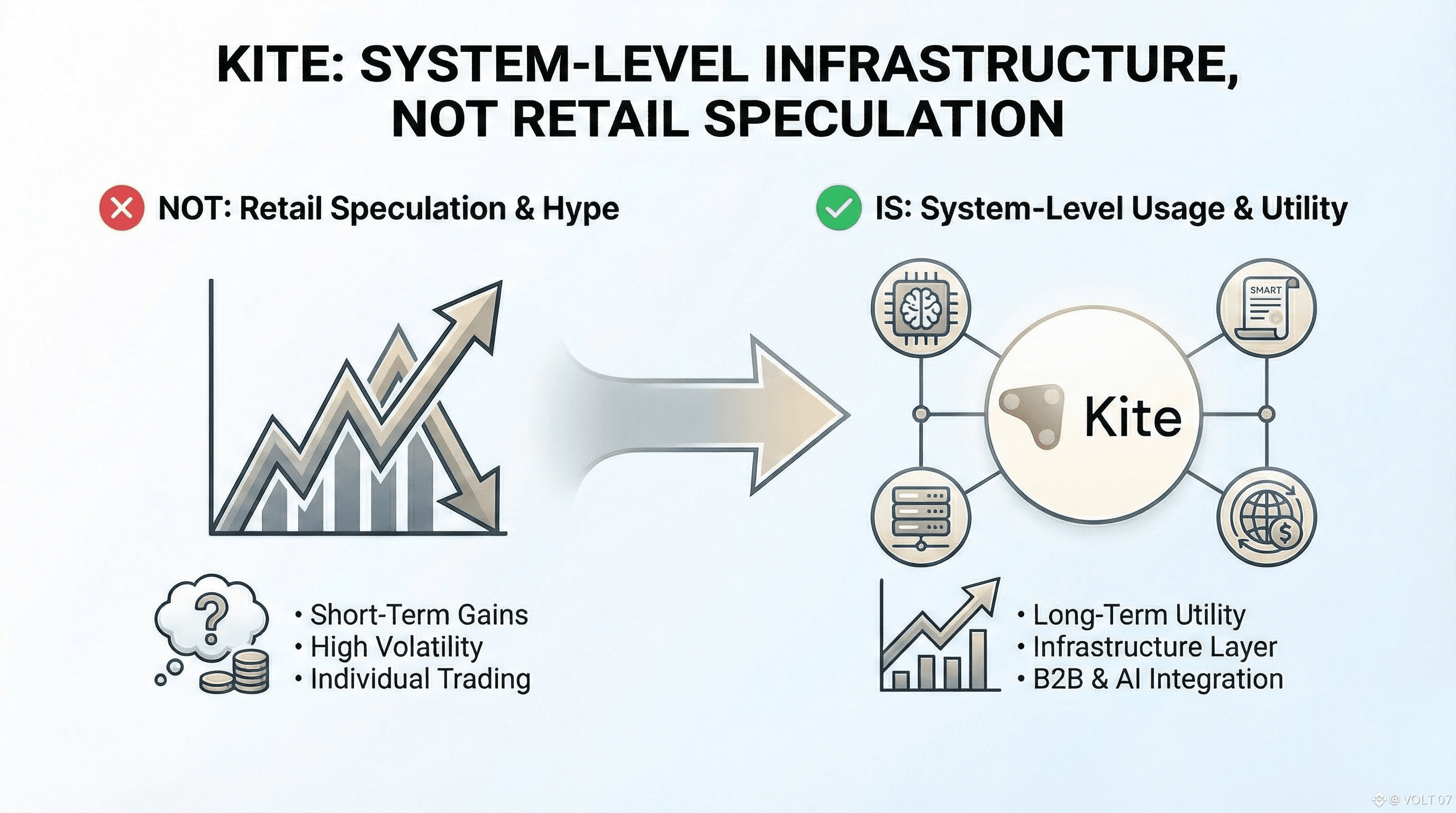
KITE’s positioning makes this distinction clear. Rather than competing for retail mindshare, KITE is architected for system-level usage where demand comes from autonomous processes, machine workflows, and persistent economic activity.
Retail speculation optimizes for excitement; system-level usage optimizes for reliability.
Retail-first protocols tend to emphasize:
token incentives
short feedback loops
narrative-driven adoption
user-triggered activity
System-level protocols prioritize something very different:
predictable execution
deterministic rules
low operational friction
continuous utilization
composability with other systems
KITE’s design choices consistently align with the second category. It is not optimized to be traded frequently; it is optimized to be relied upon constantly.
KITE treats AI agents as first-class economic actors, not applications.
Most blockchains see AI as an outside user of APIs. KITE flips this idea by putting agents right into the economic layer.
On KITE:
agents hold on-chain wallets
capital is governed by programmable constraints
spending follows policy, not human approval
earnings accrue directly to machine identities
workflows execute autonomously
This is not a retail use case. It is infrastructure for machine-native economies, where activity is generated by systems, not users clicking buttons.
System-level usage demands predictable cost structures and KITE is designed around that constraint.
Speculative environments tolerate volatile fees. Autonomous systems cannot.
AI agents operating at scale require:
stable transaction costs
minimal latency variance
deterministic finality
reliable execution guarantees
KITE’s economic model is structured to support continuous, automated activity without the unpredictability that retail-driven congestion introduces. This is a prerequisite for machine usage and a signal that speculation is not the target user.
Instruction layers replace interfaces a hallmark of system infrastructure.
Retail protocols invest heavily in user interface and onboarding processes. System-level protocols focus on instruction layers, which are machine-readable rules that define behavior. KITE enables:
task definitions that agents can interpret
conditional execution without human input
composable workflows across agents
verifiable task completion
automatic settlement upon execution
This shifts value creation away from frontends and toward coordination logic exactly where infrastructure protocols live.
Demand on KITE is expected to be endogenous, not narrative-driven.
Retail speculation relies on external attention to drive activity.
System-level usage generates its own demand:
agents pay for compute
agents pay for data
agents pay for task execution
agents pay other agents
workflows settle continuously
This creates non-reflexive demand usage that exists regardless of market sentiment. KITE’s architecture assumes this form of demand will dominate over time.
KITE’s token role is functional before it is financial.
In speculative protocols, tokens are primarily instruments of exposure.
In system-level protocols, tokens act as:
access enablement
settlement mediums
coordination incentives
economic bandwidth
KITE's positioning appears to indicate the token will interact within machine-based flows and not be kept idle in consumer wallets, waiting for price appreciation. This, of course, influences everything from token distribution to economic models.
System-level adoption compounds quietly and that is intentional.
Infrastructure rarely explodes overnight. It compounds through:
integrations
dependencies
workflow entrenchment
switching costs created by reliability
KITE’s adoption curve is therefore expected to be gradual, sticky, and opaque to casual observers. This is not a failure of marketing it is a feature of system-layer design.
Why this positioning is relevant to long-term relevance.
Retail speculation has cycles. The use of the system has longevity. Protocols for speculation need to come up with new stories all the time and stay fresh. Protocols for system use become less easily replaceable over time.
KITE’s focus on:
autonomous agents
programmable capital
instruction-driven coordination
machine-native payments
positions it where long-term economic activity is likely to accumulate beneath the surface, powering workflows that never sleep.
The real signal: KITE is building dependencies, not followers.
Followers trade.
Dependencies rely.
When other systems begin to assume KITE’s existence for settlement, coordination, or payment its relevance becomes structural rather than optional. That is the difference between a protocol that is popular and one that is necessary.
Conclusion: KITE is not trying to win attention it is trying to become invisible infrastructure.
The most valuable systems fade into the background as they scale. They stop being talked about and start being assumed.
KITE’s architecture, economic logic, and target users all point toward that outcome.
It is not designed to excite retail traders.
It is designed to support autonomous economies.
And in crypto’s next phase, systems will outlast speculation.
Speculation creates noise. Systems create gravity. The protocols that endure are the ones other systems cannot afford to ignore.

