
KITE’s planned fee activation for 2026 is drawing attention for a simple reason: it ties the token to network usage in a way that the early phase does not. Kite’s own tokenomics describe a two-phase rollout. Phase 1, around token generation, focuses on bringing builders and modules into the ecosystem and bootstrapping activity. Phase 2 is linked to mainnet, and it is where commissions on AI service transactions, staking, and governance are expected to become live. That sequencing matters because it changes what “participation” means. In the first phase, participation looks like building, testing, and qualifying for incentives. In the second, participation looks like carrying some responsibility for the network’s economic plumbing, whether you are running infrastructure, operating a module, or simply voting on how the system evolves.
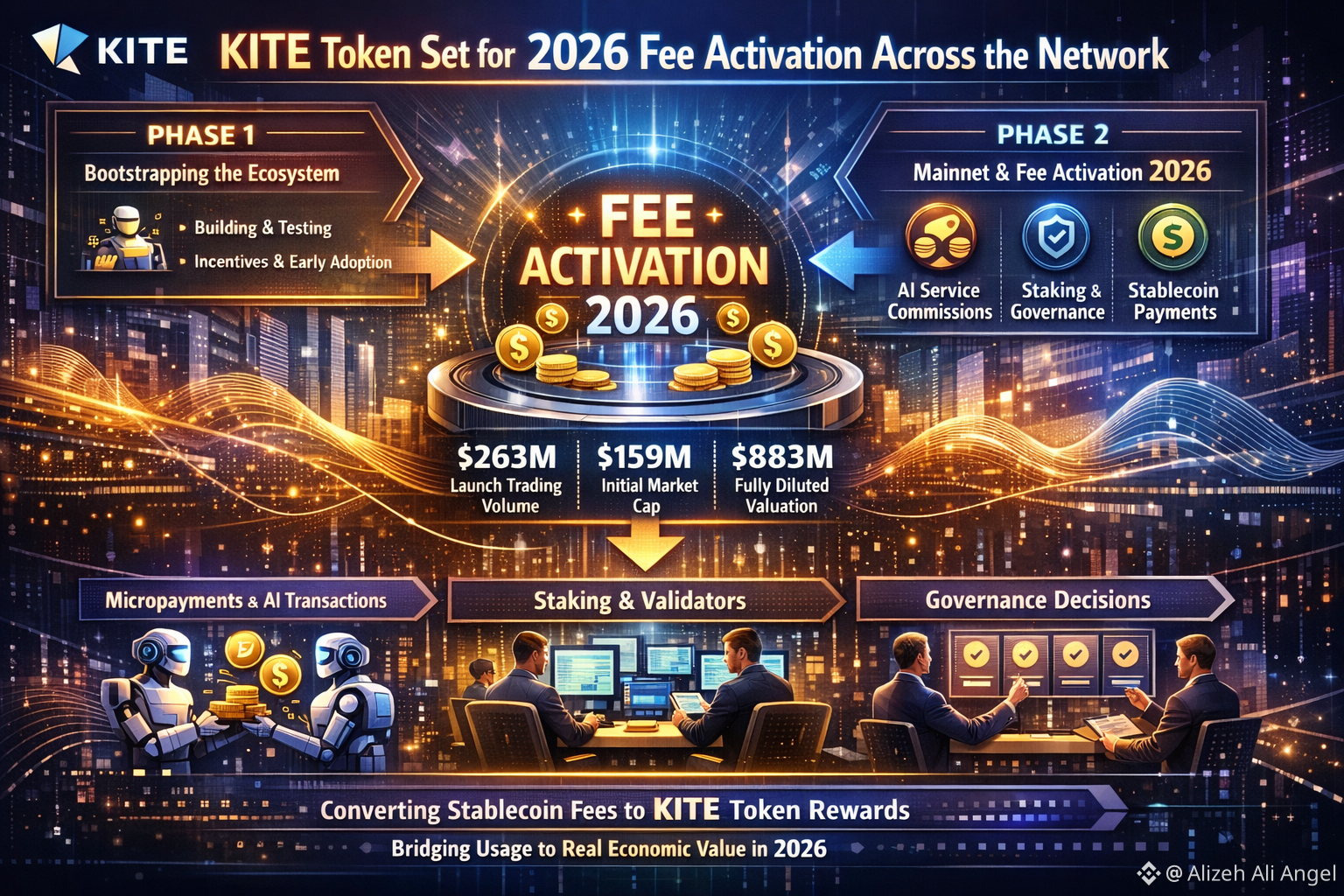
@KITE AI The topic is trending now largely because KITE’s launch in early November 2025 put the project into the kind of public spotlight where timelines and monetization suddenly matter. Reporting on the debut highlighted roughly $263 million in combined trading volume within the first two hours, with a market capitalization around $159 million and an $883 million fully diluted valuation shortly after trading began. Those numbers are not evidence that people are already paying for AI services on the network, but they do explain the mood shift. When liquidity is high, stories move faster, and the market starts demanding milestones. Fee activation became the obvious one, because it is the bridge between usage as a slogan and usage as something you can measure in dollars.
In Kite’s framing, “fee activation” is not mainly about charging ordinary gas in the native token. The documentation describes a small commission collected from each AI service transaction, with the protocol able to swap stablecoin revenue into KITE and distribute it to the relevant module and the Kite L1. The Kite Foundation’s tokenomics page echoes this, stating that a percentage of fees from AI service transactions is collected as commission for modules and the network. The practical benefit is simple: users can pay in stablecoins, which makes budgeting easier, while the protocol still routes value back into the native token behind the scenes. People tend to avoid holding volatile assets just to use an app, but they are willing to pay stablecoin-denominated fees if the service is reliable and the pricing is predictable.
@KITE AI The calendar is the part that deserves the most caution. Kite’s official materials tie Phase 2 utilities to mainnet, but they do not commit to a public date in the same way they define the mechanics. At the same time, third-party write-ups have increasingly converged on an early-2026 window, often Q1, for a public mainnet rollout, and they treat that as the moment commissions become network-wide. That may be right, but anyone who has watched launches slip knows how quickly a quarter can disappear into audits, integrations, and basic operational hardening. The safest interpretation is that 2026 is the target period for turning on the “real economy” parts of the token, and that the project wants fees to be meaningful only once the network is stable enough to make fees feel like infrastructure rather than friction.
The broader reason this resonates is that AI agents are showing up everywhere, and payments is the unglamorous bottleneck. Kite’s whitepaper argues that traditional payment rails have fixed fees and settlement delays that make micropayments irrational, especially if software agents are making many small decisions all day long. It positions the chain as stablecoin-native and leans on mechanisms like state channels to reduce cost and latency for frequent transactions. Kite’s materials also point to emerging machine-to-machine payment standards, including x402, as part of the environment it expects to live in. Whether or not you agree with the full “agentic internet” vision, it is hard to deny that small, frequent payments are becoming more common in software, and that the infrastructure designed for that pattern has to be almost boring in how consistently it works.
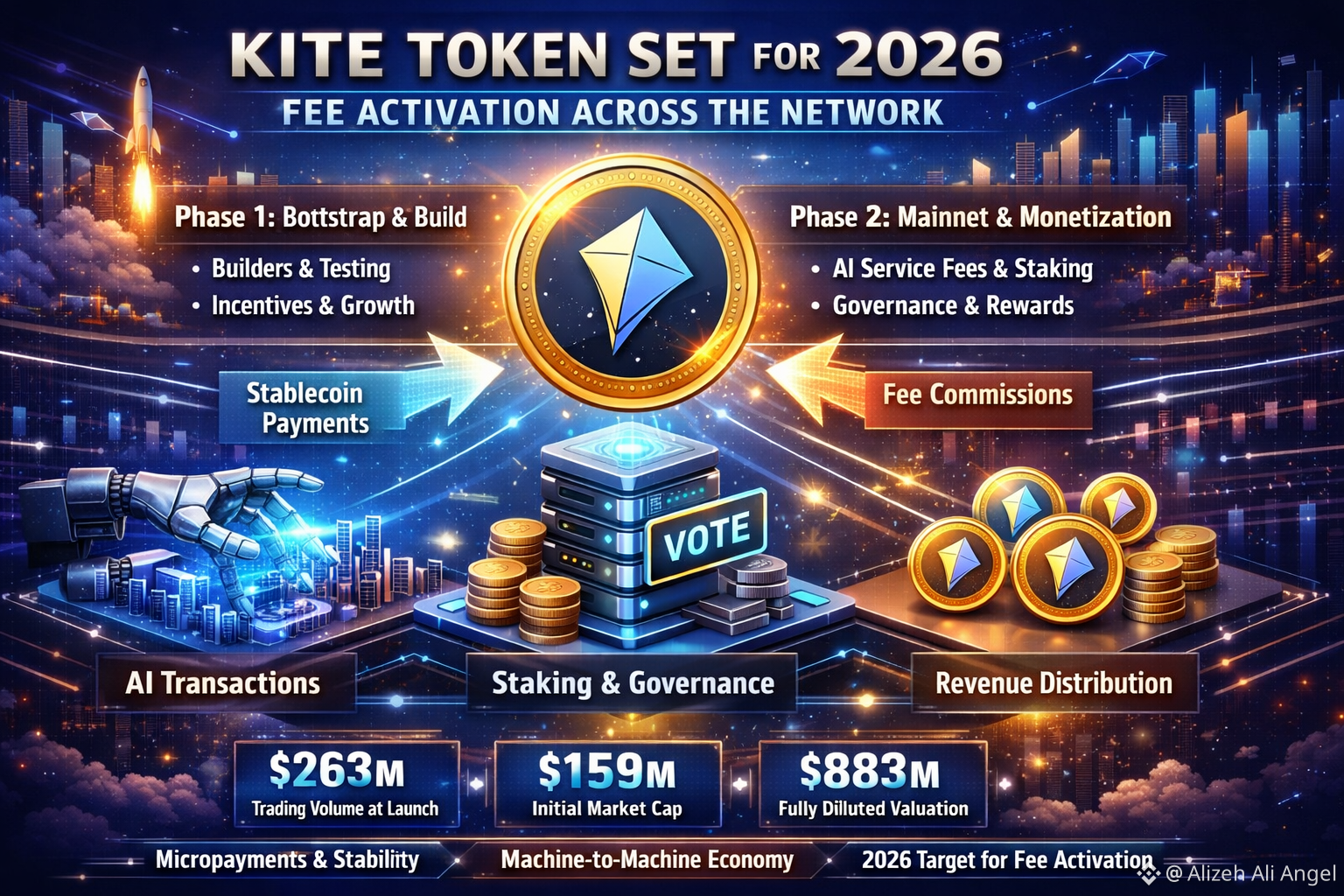
Fee activation also forces governance and incentives to matter in a more adult way. In Kite’s design, staking and governance arrive as Phase 2 utilities: validators and delegators stake KITE to secure the chain, while token holders vote on upgrades, incentives, and module requirements. The project’s MiCAR white paper describes staking as a way to activate operational roles such as validator, module owner, or delegator, with rewards and slashing tied to performance. The tokenomics are basically saying: instead of printing new tokens forever, the network wants to earn money from real usage. If that works, governance stops being “let’s tweak a few numbers” and becomes “what’s actually worth funding, and what can we delay?”
And whether people call that progress comes down to daily reality: does it feel smooth, reliable, and fair when you actually use it? People tolerate fees when fees are predictable and when the service feels dependable. Kite emphasizes programmable constraints, identity, and auditability, and it explicitly points to the wider regulatory push for accountability around AI systems as part of the backdrop. If the network delivers a smooth stablecoin flow for agent transactions, a small commission can read as maintenance: keeping the system secure and compensating the parties doing work that users never want to think about. If the product doesn’t feel solid, fees won’t feel “normal”—they’ll feel annoying. And then Kite risks becoming one of those projects with a great idea that got lost in messy rollout.
The best signs going into 2026 will be the boring ones: real transaction counts, clear fee tracking, and whether builders stay even after rewards cool down.


