

@APRO Oracle There’s a moment in every maturing technology when the plumbing finally becomes visible. For Web3, that moment isn’t flashy or dressed up it’s the growing clarity around the humble but essential problem of data delivery. We’ve all heard about blockchains and smart contracts as if they were self-sufficient engines of automation, but in truth they remain blind without reliable feeds from the outside world. This isn’t an abstract issue buried in white papers. It shows up in every price oracle glitch, every liquidation spike that wasn’t really a market move, and every application that hesitates to trust off-chain information. In other words: getting real-time feeds without the drama is not a fringe concern it’s foundational. And this is where APRO’s approach to on-demand data delivery increasingly feels relevant. 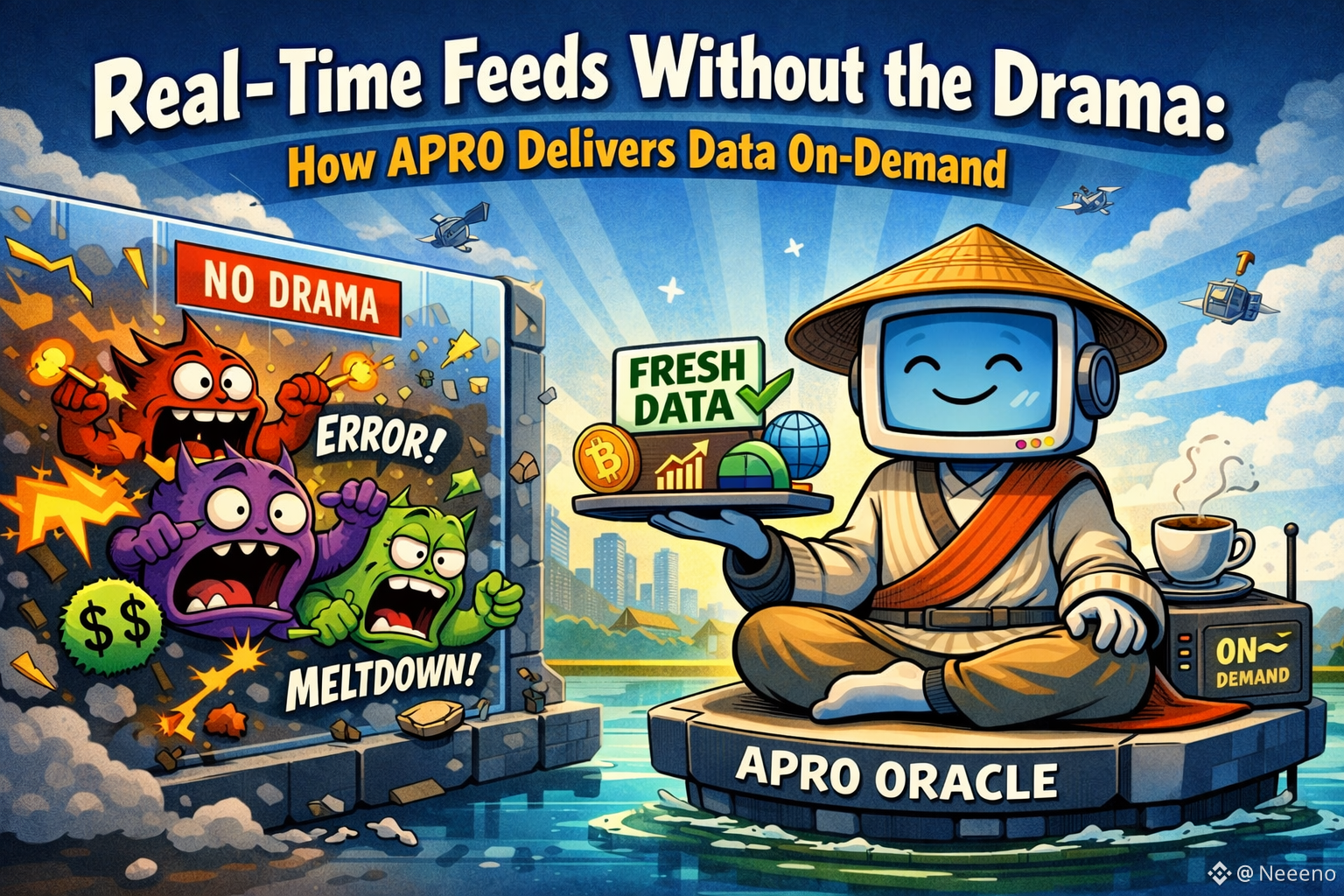
APRO started as one of many oracle projects, but it has quickly positioned itself with a specific mindset: data should be timely, accurate, and delivered in the way that makes sense for the use case, not simply blasted onto a ledger because “that’s how oracles work.” The nuance here matters. Traditional oracles tended to offer continuous broadcast updates—as if every consumer needed every piece of data at every moment. That attitude worked when the market was simpler, but as decentralized finance (DeFi), prediction markets, gaming, and even real-world asset (RWA) tokenization demand diversified inputs, the old model started showing strain—wasting resources and confusing systems that only wanted specific facts at specific times.
What APRO does with its Data Pull model is refreshingly straightforward: it gives applications on-demand access to real-time data, and only when it’s needed. Think of it as ordering information like you’d order a cab. You don’t pay for an idle car waiting at your curb; you request it when you’re ready to go. Similarly, APRO’s pull-based feeds let smart contracts fetch the latest price or event outcome exactly when they need it, minimizing unnecessary on-chain interactions and reducing costs. This isn’t just a technical quirk—it’s a practical advantage for systems where timing and cost efficiency matter.
Pull seems simple. Reality isn’t. In decentralized systems, real-time data means verifying the number, cross-checking multiple sources, and filtering out manipulated or outlier inputs. APRO’s architecture weaves together off-chain computation with on-chain verification.
Before anything goes on-chain, data is pulled from multiple sources and double-checked. The system compares the numbers, throws out weird or suspicious ones (sometimes with AI help), and settles on what looks correct. Then it signs that final data and sends it on-chain.
. It’s a bit like having a seasoned editor vet multiple drafts before publication, rather than printing the first version that arrives.
It matters because the stakes are high now. DeFi derivatives, lending, and automated hedging sit at the center of pricing and risk. A stale or manipulated oracle update can trigger instant chaos: wrong prices, domino effects, and cascading losses.. APRO’s dual delivery modes—Push for continuous, high-frequency real-time feeds and Pull for on-demand access—are designed to match the nuance of each scenario. A high-speed trading protocol might subscribe to a constant stream, while an insurance payout system might only need a data point when a specific event triggers.
This may look like a minor technical choice. But in decentralized automation, it’s a trust choice: the right timing, the right precision, and no unexpected actions from faulty input.. There’s a quiet emotional component here too. People building these systems are exhausted by “oracle drama”—unexpected outages, price spikes that aren’t real, or systems that punish applications with unnecessary costs because of how often they need to refresh feeds. APRO’s on-demand model feels like a reassurance: you get what you ask for, when you ask for it, and not more. That’s a kind of peace of mind that engineers learn to value deeply.
There’s also another trend converging with this evolution: the expansion of oracle use beyond simple asset prices. Recent developments show that APRO has begun delivering near-real-time sports data into prediction markets, with feeds covering major leagues and verified event results. This isn’t just a neat add-on—prediction markets, automated settlements tied to real-world events, and decentralized insurance systems all require timely, accurate, verified feeds that commercial APIs alone cannot reliably supply on-chain.
APRO is expanding its inputs to match new demands that barely existed a few years ago. That change is a major reason this topic is trending today. . Builders in Web3 are no longer content with simple price feeds. They want identity validation, verified randomness, outcome events, chain-agnostic APIs, and more—all in ways that don’t inflate costs or compromise security. The maturation of decentralized systems means that oracles, once a background utility, are suddenly front and center. Developers and analysts alike are asking: How do I trust what my system sees? How do I make sure timing is right? How do I avoid feeding garbage in and getting garbage out? APRO’s approach touches on all these questions by aligning data delivery with the actual rhythms of its consumers.
No system is flawless. On-demand feeds need tight settings, starting with a clear definition of what “fresh enough” really is.? Who pays for verification costs? How do you manage node incentives so that data providers act honestly? APRO’s native mechanisms, including economic structures that reward accurate delivery and penalize bad behavior, represent practical responses to these ongoing questions. But the core idea—that data should be delivered with intention, not noise—is one that resonates with anyone who has ever tried to build beyond the simplest smart contract.
In the end, real-time feeds without the drama do more than make systems run smoother. They reduce cognitive load for builders, lower operational friction, and create a clearer baseline for trust in decentralized environments. APRO’s on-demand data model may not feel revolutionary on the surface, but in an ecosystem where trust, timing, and precision are everything, it’s a significant step forward. In a landscape crowded with buzzwords, solutions that quietly work tend to matter the most.

