

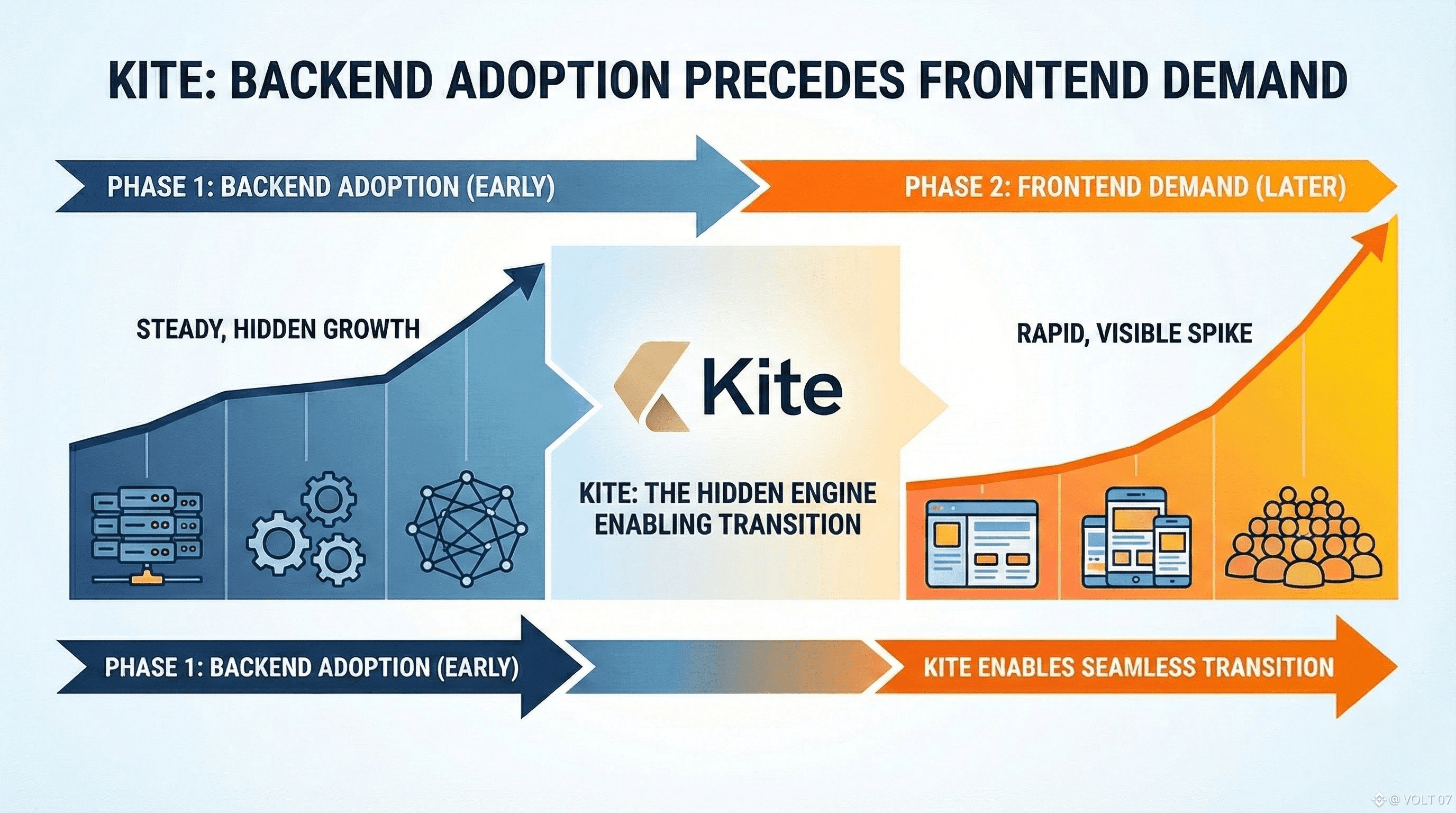
 There’s a certain pattern you start to recognize when a project is being adopted for what it does, not for how it looks. The noise is lower. The speculation is thinner. The excitement feels muted, almost restrained. That’s the pattern slowly forming around KITE. Instead of seeing a rush of retail-driven activity or frontend-heavy usage, what’s emerging feels more like backend positioning the kind that happens quietly, long before most people realize something is being built on top of it.
Market activity around KITE doesn’t carry the usual signals of user-facing hype. There aren’t sudden bursts tied to UI launches or consumer announcements. Volume doesn’t spike because a new app went viral. Instead, activity feels steady, purposeful, and oddly patient. That kind of behavior usually suggests that the people paying attention aren’t end users clicking buttons, but builders wiring systems together behind the scenes.
This makes sense when you consider where KITE actually fits. Its value isn’t obvious at the interface level. Most users won’t “feel” KITE directly the way they feel a wallet or a dApp. It lives underneath workflows handling permissions, constraints, identity, and payments for autonomous systems that don’t need dashboards or tutorials. When something operates at that layer, adoption doesn’t announce itself. It accumulates.
Backend adoption has a very different rhythm from frontend demand. It starts with experimentation. Small integrations. Quiet testing. Then it moves into dependency. Systems begin to rely on it, not because it’s exciting, but because removing it would break something important. KITE’s market behavior looks closer to that second phase than the first. Capital isn’t chasing attention; it’s positioning around usage that may not be visible yet but is expected to grow.
Another telling sign is the absence of impatience. Frontend-driven demand tends to be emotional. Users arrive quickly and leave just as fast if the experience doesn’t meet expectations. Backend adoption doesn’t behave that way. Builders don’t integrate core infrastructure lightly. They take time. They test. And once they commit, they tend to stay unless something fundamentally fails. The market activity surrounding KITE shows that mindset. There is cautious entry, low churning, and a noticeable absence of whip-saw action.
There is often a difference between the element of visibility and the aspect of importance at this stage, too. From the outside, it may seem like nothing is happening. But inside the ecosystem, connections are forming. Agent systems need predictable payment rails. Autonomous workflows need constraints they can trust. Coordination systems need settlement that doesn’t require human approval every step of the way. These needs don’t create headlines, but they create demand that compounds.
This is why frontend demand may lag and why that lag isn’t necessarily a weakness. Frontends appear once the backend is stable enough to support them. No one builds consumer-facing tools on infrastructure they aren’t confident in. If KITE is being adopted first at the backend layer, that suggests builders are still in the phase of making sure it holds up under real conditions. That’s usually a prerequisite, not an afterthought.
Markets often misread this phase. They look for obvious traction and assume absence of noise means absence of progress. But infrastructure adoption has never worked that way. Payment rails didn’t become valuable because users loved their interfaces. They became valuable because everything else quietly started depending on them.
KITE’s current market behavior feels aligned with that path. Less attention. More positioning. Less demand for explanation. More assumption of future relevance. If frontend demand eventually arrives, it will likely feel sudden not because it appeared overnight, but because the groundwork was already laid.
In that sense, what the market is signaling isn’t hesitation. It’s sequencing. Backend first. Visibility later. And for a system designed to support autonomous agents rather than human clicks, that sequence may be exactly how adoption is supposed to unfold.

