

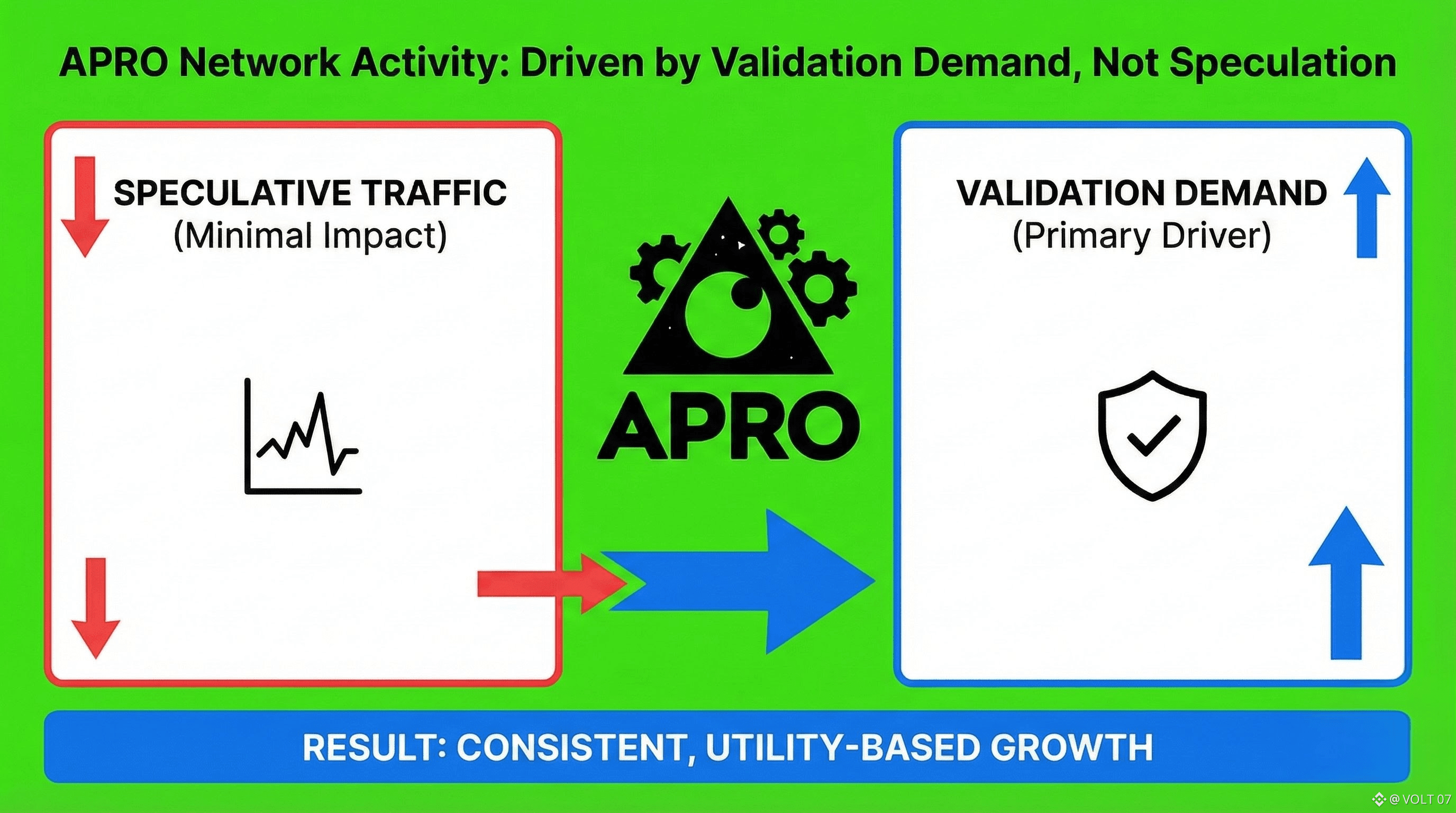
 Speculative traffic has a certain energy to it. It arrives quickly, leaves just as fast, and tends to cluster around moments of excitement rather than moments of necessity. Validation demand feels very different. It’s quieter. More repetitive. Less emotional. When you look closely at the recent network activity around APRO, what stands out isn’t the intensity of movement, but the consistency of purpose. This doesn’t look like a system being poked by traders. It looks like a system being used.
Speculation usually leaves obvious fingerprints. Spikes tied to announcements. A rhythm that mirrors price action more than function. APRO’s activity doesn’t follow that pattern. Interactions appear steady, evenly distributed, and largely indifferent to short-term sentiment. That kind of behavior is rarely driven by people trying to front-run narratives. It’s driven by systems that need something validated, confirmed, or coordinated and need it repeatedly.
What makes this distinction important is the role APRO is increasingly playing. It isn’t a destination for users in the traditional sense. There’s no reason for someone to “check” APRO the way they would check a trading interface. Its value emerges only when other systems depend on it. Oracles, coordination layers, and trust primitives don’t attract speculative traffic because they don’t offer spectacle. They attract validation demand because other protocols can’t function properly without them.
You can see this in how activity clusters around verification rather than experimentation. Instead of a wide range of one-off interactions, the network shows signs of recurring use patterns. That suggests integrations are settling in. Once a protocol relies on APRO for validation, it doesn’t come and go. It stays connected. Validation isn’t optional it’s continuous.
Another tell is the absence of congestion-driven noise. Speculative traffic pushes systems to their limits, especially during exciting times. APRO’s network load doesn’t exhibit that stress profile. It looks measured, almost deliberately paced. That’s what you expect from infrastructure that’s called upon when correctness matters more than speed. Validation demand doesn’t spike because people are excited. It persists because systems can’t afford to operate without it.
There’s also a trust signal embedded here. Protocols don’t outsource validation lightly. When they do, it’s because the alternative is worse fragmented data, inconsistent resolution, or manual intervention. The fact that APRO is seeing this kind of activity implies that some builders have already crossed that threshold. They’re no longer testing whether APRO works. They’re assuming it does and designing around it.
This is why it’s easy to misread what’s happening. From the outside, it may look uneventful. No obvious hype cycle. No dramatic usage curve. But infrastructure rarely announces itself. It reveals its importance through repetition. Through being quietly present whenever something needs to be verified, resolved, or aligned.
Speculative traffic fades the moment attention shifts. Validation demand grows slowly and then plateaus not because interest disappears, but because dependency stabilizes. APRO’s current activity looks much closer to that second phase. It suggests a network moving out of the “prove it” stage and into the “assume it” stage.
And that’s often the most important transition a protocol can make. When usage is driven by necessity rather than curiosity, the conversation changes. It stops being about why something might matter and starts being about what would break if it disappeared.
APRO’s network activity hints that this question is already being answered quietly, in the background, by systems that are less interested in speculation and more interested in being right.

