

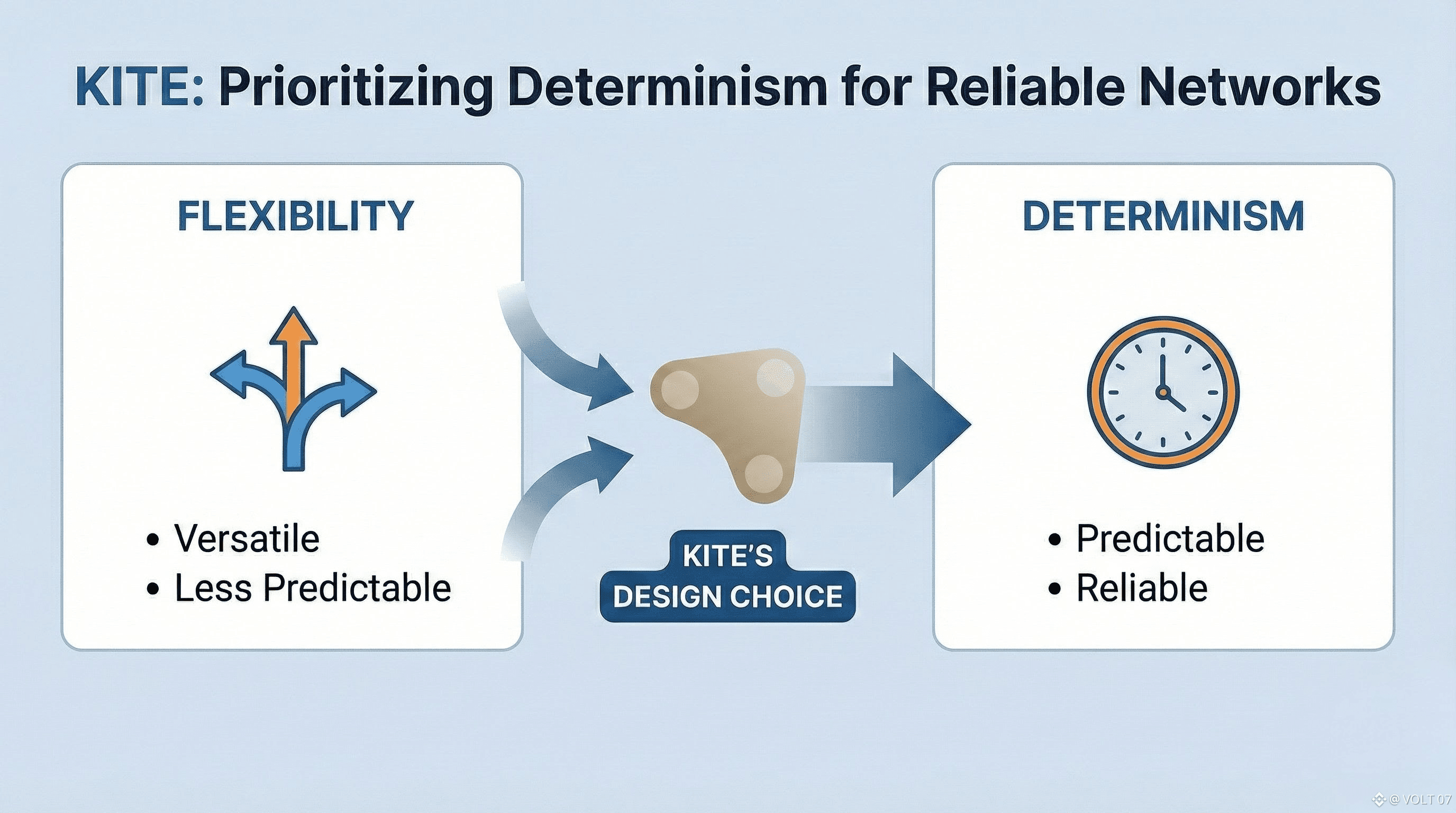
 Flexibility is usually celebrated in blockchain design. The more a system can adapt, improvise, and support endless edge cases, the more “powerful” it’s assumed to be. But when you look closely at what KITE is trying to enable, that assumption starts to break down. KITE doesn’t optimize for open-ended flexibility. It optimizes for something quieter and far less glamorous: determinism. And that choice is deliberate.
Autonomous systems don’t thrive in environments where outcomes are ambiguous. Humans can tolerate uncertainty. We can pause, interpret context, and adjust on the fly. Machines can’t at least not safely. An AI agent executing financial actions needs to know, in advance, how the system will behave. Not approximately. Not “most of the time.” Exactly. Determinism gives agents that certainty. Flexibility, when pushed too far, introduces branches, exceptions, and undefined behavior that machines are notoriously bad at navigating.
A look at the design of the KITE network illustrates this point. Rather than engaging in endless adaptations to ever-changing conditions, it invites them to do so under well-delimited rules. Rules are strictly uniform in every transaction. Permissions become exactly that. Rules turn to task enforcement. It has nothing to do with hampering ability. It has everything to do with preventing abilities from becoming threats. When agents handle finances, coordinate, or pay services without human monitoring, unpredictability does not become an asset. It automatically proves to be a liability.
What’s interesting is how this contrasts with many general-purpose chains. Those systems often prize flexibility because they serve humans first. Developers want freedom. Users want optionality. Governance wants room to maneuver. KITE flips the priority. It assumes that autonomy will increasingly belong to machines, and machines don’t need freedom they need reliability. They need an environment where the same input always produces the same outcome.
Determinism also simplifies accountability. When something goes wrong in a deterministic system, the cause is easier to trace. There are fewer hidden branches, fewer implicit assumptions. That matters deeply for agent-based economies, where actions may be executed at scale and at speed. If an agent misbehaves, the question isn’t just “what happened?” but “why was this allowed to happen at all?” Deterministic design makes that question answerable.
There’s a tradeoff here, and KITE accepts it openly. Prioritizing determinism means losing some flexibility. Some dynamic behaviors must be clearly defined or left out completely. But that tradeoff aligns with KITE’s role. It isn’t trying to be a playground. It’s trying to be a foundation. And foundations are judged not by how expressive they are, but by how little they surprise you.
This choice also hints at KITE’s long-term intent. Systems built on determinism tend to age better. They scale more predictably. They integrate more safely. And they attract builders who care less about experimentation for its own sake and more about systems that keep working under pressure. For agent-driven infrastructure, that kind of stability is non-negotiable.
In a way, KITE’s design philosophy feels almost old-fashioned. It values rules over improvisation. Predictability over novelty. Structure over freedom. But as automation takes on more responsibility, those values start to look less conservative and more necessary.
Flexibility makes sense when humans are in the loop. Determinism makes sense when they aren’t. And since KITE is building for a future where machines increasingly act on our behalf, its design choices reflect a clear understanding of who its real users are not people clicking buttons, but systems that need to know, with certainty, what will happen next.
That’s why KITE prioritizes determinism. Not because flexibility is bad. In a world of autonomous action, certainty is what makes everything else possible.

