

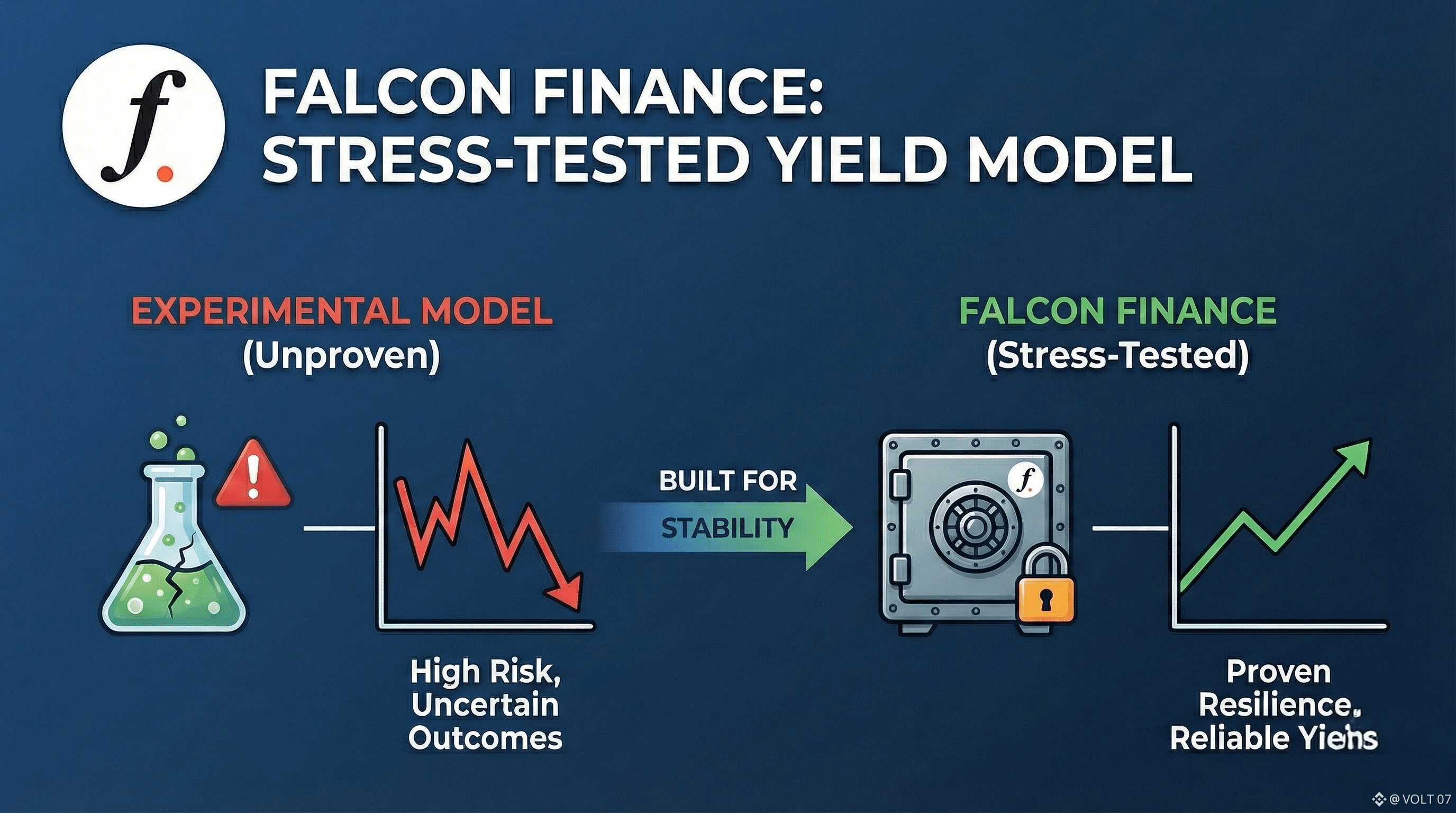
 In DeFi, the difference between a model and an experiment is what happens when conditions turn hostile.
Many yield platforms perform well when liquidity is abundant and volatility is forgiving. Few demonstrate discipline when markets fracture, correlations spike, and exits become crowded. Falcon Finance positions itself on the opposite side of that divide. Rather than presenting yield as an open-ended experiment, Falcon approaches strategy design as a stress-tested financial model, built to endure adverse regimes rather than optimize for perfect ones.
Experimental yield optimizes for upside; stress-tested yield optimizes for survival.
Experimental models are defined by assumptions: stable liquidity, cooperative governance, responsive oracles, and rational market behavior. Stress-tested models assume the inverse. Falcon’s design philosophy begins by asking how a strategy behaves when:
liquidity evaporates
volatility exceeds historical norms
incentives decay abruptly
correlated protocols fail simultaneously
governance changes mid-cycle
Yield that survives these conditions is not accidental it is engineered.
Falcon treats stress as a baseline scenario, not a tail event.
Most DeFi strategies treat stress testing as a post-launch exercise. Falcon integrates stress assumptions into pre-deployment design. Each strategy is evaluated under conditions that include:
widened spreads and slippage shocks
delayed oracle updates and price dislocations
leverage compression and forced deleveraging
withdrawal clustering and liquidity mismatches
parameter changes from external protocols
If a strategy cannot degrade gracefully, it does not qualify for deployment.
The architecture favors bounded failure over fragile optimization.
Experimental yield often maximizes efficiency at the expense of robustness. Falcon optimizes for bounded outcomes. This means:
downside is explicitly capped
leverage is conditional and reversible
liquidity assumptions are conservative
exposure is diversified across non-identical primitives
dependencies are treated as replaceable modules
Losses, if they occur, are intended to be contained rather than cascading.
Stress-tested models reveal themselves in how they handle leverage.
Leverage is the fastest way to inflate returns and the fastest way to invalidate a strategy under stress. Falcon does not reject leverage outright; it subjects it to continuous scrutiny. Where leverage is used, it is:
sized relative to volatility, not optimism
paired with automatic de-risking triggers
justified by structural carry, not reflexive loops
unwindable without catastrophic slippage
This ensures leverage amplifies efficiency without amplifying fragility.
Liquidity modeling distinguishes theory from reality.
In calm markets, liquidity looks infinite. In stress, it disappears. Falcon’s strategies are designed with liquidity realism:
exit paths are tested under thin depth
slippage tolerance is modeled, not assumed
time-to-unwind is treated as a risk variable
correlated exits across venues are anticipated
A yield model that cannot exit under pressure is not a model it is a bet.
External integrations are stress-mapped, not blindly trusted.
Falcon acknowledges that composability multiplies both opportunity and risk. Each external protocol introduces governance, oracle, and execution risk. Rather than ignoring this, Falcon:
limits dependency concentration
monitors upstream parameter changes
prepares alternative execution routes
designs for rapid reallocation or shutdown
Stress-tested systems assume integrations will eventually misbehave and plan accordingly.
Duration and withdrawal design prevent reflexive collapse.
Experimental platforms often tout immediate liquidity at any moment in time. Falcon recognizes that this could destabilize strategies in moments of stress. Its design balances user flexibility with systemic resilience by doing the following:
avoiding structures that disproportionately reward first movers
Smooth the pressure of forced selling when volatility spikes.
Alignment of Withdrawal Mechanics With Underlying Liquidity Reality
It protects both individual capital and integrity of collective strategy.
Performance across regimes matters more than peak returns.
Yield models that have gone through stress tests are gauged by their consistency, not headlines. Falcon's framework places the greatest emphasis on:
smaller drawdowns in adverse markets
faster recovery after stress events
lower volatility of returns across cycles
predictable behavior under regime shifts
This is the difference between a yield engine and a yield experiment.
Transparency is part of stress testing, not a marketing afterthought.
Experimental models obscure risk until it manifests. Stress-tested models surface risk early. Falcon emphasizes:
clarity around yield composition
explicit articulation of failure modes
realistic expectations during downturns
avoidance of performance smoothing narratives
When users understand risk, panic diminishes and strategies survive longer.
Institutional alignment is a byproduct of stress-tested design.
Institutions do not deploy capital into experiments. They deploy into systems with:
known constraints
defined downside
auditable logic
adaptive governance
demonstrated resilience
Falcon’s stress-tested orientation aligns naturally with this mindset, making it structurally more compatible with durable capital than yield-maximizing platforms.
The real innovation is not higher yield it is fewer surprises.
Falcon Finance reframes success in DeFi yield generation. The goal is not to outperform in ideal conditions, but to remain functional when conditions deteriorate. That is what makes a financial model different from an experiment.
In markets defined by reflexivity and volatility, survival is the rarest edge.
A system proves its intelligence not by how well it performs when everything goes right, but by how little breaks when everything goes wrong.

