
Some years quietly pass. Others leave a clear paper trail. Looking back at the last 12 months for Hedera, the second category fits far better. A steady stream of institutional, regulatory, and enterprise-level developments kept showing up across the calendar, shaping a year that looked very different from the average crypto roadmap.
The timeline shared by Tokenicer helps frame that story. Month by month, Hedera kept appearing in places where enterprise infrastructure usually lives, not speculative cycles.
January Set The Tone With Financial Infrastructure And Banking Links
The year opened with Hedera stepping deeper into regulated financial territory. Capital was allocated into a Fidelity money market fund through Archax, signaling comfort with traditional financial structures. Around the same period, Dropp expanded its footprint by partnering with Truist Bank, tying Hedera to everyday payment rails rather than experimental pilots.
Tokenicer pointed to January as an early signal that the year ahead would focus on institutions first, not narratives.
February And March Expanded Aviation And Public Sector Use
Momentum continued into February with Neuron securing a UK Civil Aviation Authority contract. That development placed Hedera inside regulated aviation systems, an environment where performance and compliance matter more than hype. HederaCon also returned during this stretch, keeping developer and enterprise conversations active.
March added a broader regulatory layer. Archax received a license to operate in the EU, strengthening the bridge between tokenized assets and European markets. Hedera Guardian also appeared in the UNDP registry, aligning the network with sustainability and public sector tracking initiatives. Tokenicer highlighted these moves as quiet but foundational.
Let's take a look back at the year for $HBARJan• Hedera invests in Fidelity MMF on Archax• Dropp partners w Truist BankFeb• Neuron UK CAA contract• Return of HederaConMar• Archax license to operate in EU• Hedera Guardian for UNDP registryApr• Hedera launches… pic.twitter.com/O3m7g5G68Y
— Tokenicer✲⥃⬢ (@Tokenicer) December 23, 2025
April And May Focused On Sovereign And Stablecoin Experiments
April introduced HashSphere, Hedera’s enterprise-focused environment built for permissioned use cases. Around the same time, the Bank of Ghana tested a CBDC pilot with EMTECH on Hedera, bringing sovereign experimentation into the picture.
May extended that theme. Hedera was shortlisted for Australia’s Project Acacia, while the AUDD stablecoin launched directly on the network. Tokenicer noted how these developments tied Hedera into national and regional financial experiments rather than isolated pilots.
Mid-Year Activity Pulled In Consultancies And Financial Institutions
June added new council members as Arrow Tech and B4E joined governance. Accenture also entered the Verifiable Compute initiative, reinforcing Hedera’s appeal to large scale enterprise service providers.
July delivered one of the more concrete financial use cases of the year. Lloyds and ABRDN executed tokenized collateral activity, and Hedera was officially selected for Project Acacia. According to Tokenicer, these were the kinds of deployments institutions tend to build on quietly and expand later.
Late Summer And Early Fall Deepened Global And Regulatory Reach
August brought a partnership with Saudi government backed Byzanlink focused on real world assets, alongside inclusion in the OMFIF Public DLT Working Group. Both moves positioned Hedera closer to policy and institutional coordination circles.
September extended this presence. DIFC Courts and Qatar Financial Centre expanded collaborations, while Hedera appeared as a Discover member and speaker at SWIFT SIBOS. Tokenicer described this phase as Hedera showing up where financial infrastructure conversations actually happen.
Final Months Added ETFs Energy Firms And Defense Programs
October introduced a notable milestone with Canary launching an HBAR ETF on the NYSE. During the same month, BEEAH rolled out a digital identity solution built on Hedera, reinforcing real world deployment narratives.
November continued the institutional thread. PwC partnered with the Hashgraph Association, and Hedera was used as the layer 1 in EU and UK money market fund trials. December closed the year with Repsol and GBBC joining the Hedera council, while Neuron was selected for NATO’s DIANA program.
Tokenicer framed the final quarter as confirmation rather than surprise.
Read Also: Solana (SOL) Is Checking Every Box Except One The Market Cares About
What Hedera’s 2025 Activity Could Mean Going Into 2026
Despite the steady stream of institutional developments, HBAR price did not escape the broader market pressure that defined much of 2025. Like most altcoins, price action remained uneven throughout the year. HBAR is currently trading more than 50% above its January opening price, yet that performance still reflects a challenging market rather than a breakout phase.
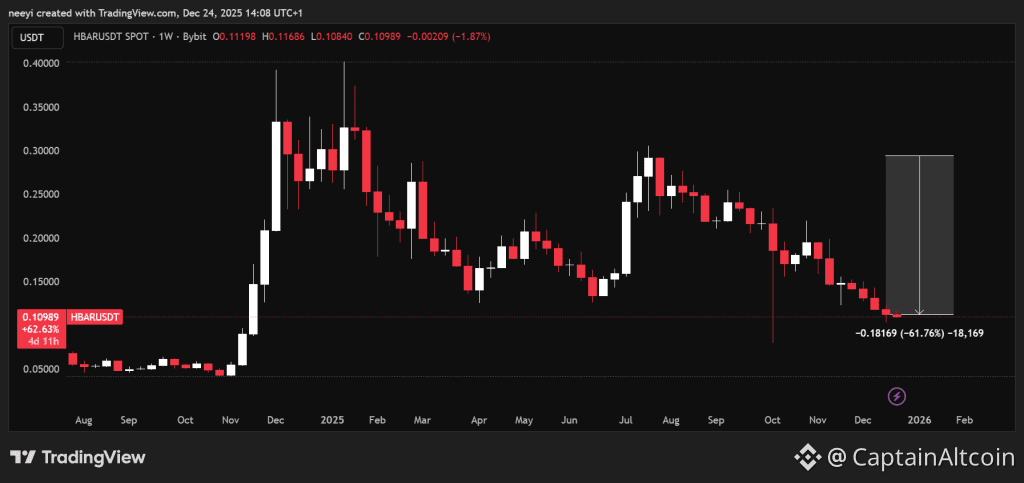 HBAR Price Chart
The contrast between price behavior and network activity stands out. Partnerships, regulatory aligned trials, and enterprise integrations continued to accumulate even as sentiment stayed cautious.
If broader market conditions begin to recover, the groundwork laid throughout 2025 could allow growth to materialize more quickly than it otherwise would. That dynamic is why the past year now feels less like an endpoint and more like a setup heading into 2026.
Subscribe to our YouTube channel for daily crypto updates, market insights, and expert analysis.
The post Hedera (HBAR) Institutional Year Was Not Normal: Why This Could Matter in 2026 appeared first on CaptainAltcoin.

