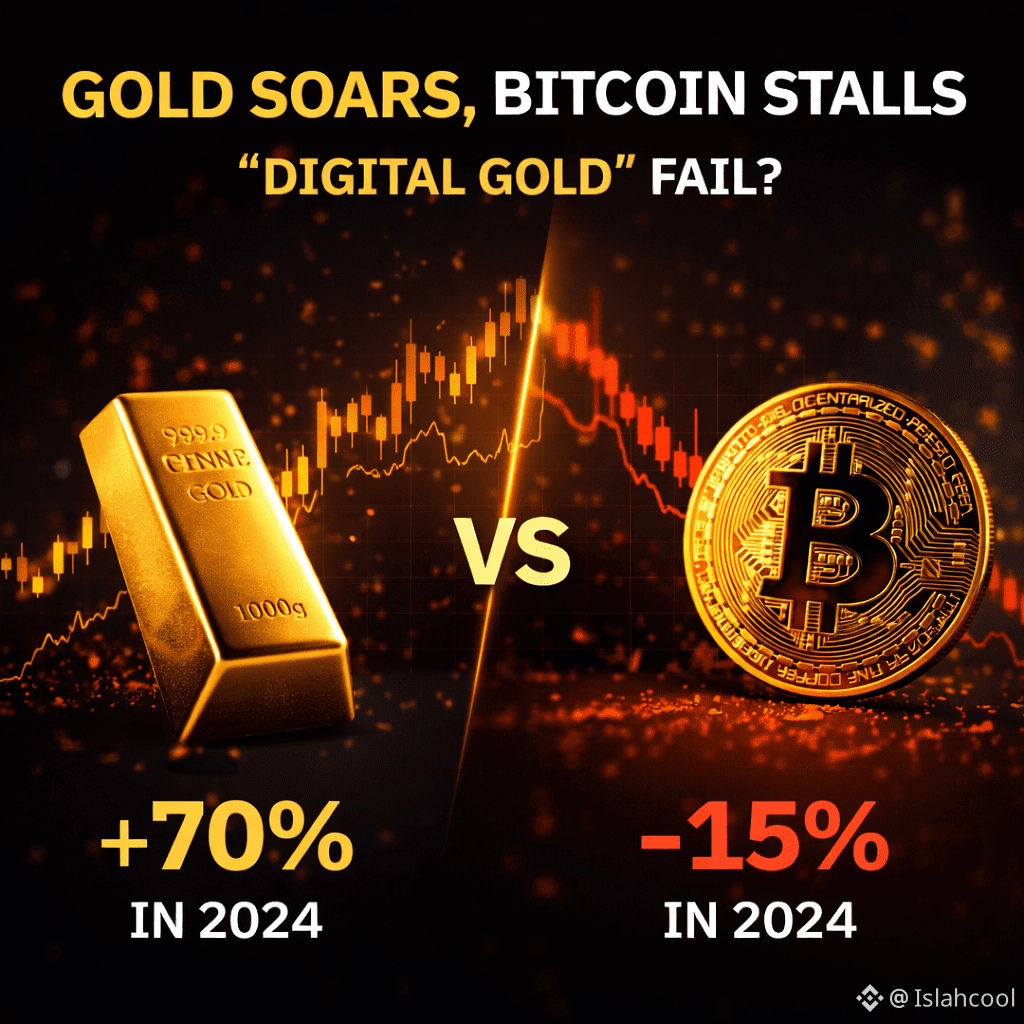
The narrative is facing its toughest challenge in years. As gold rockets to record highs, Bitcoin is struggling to hold key psychological levels. This divergence is forcing the crypto community to re-examine a core premise: if Bitcoin is truly "digital gold," why isn't it winning in the environment tailor-made for it?
The Great Divergence: A Tale of Two Assets
· Gold's Record Run: The traditional safe haven is having a historic year, up over 70%. It's being fueled by a perfect storm of rate cut expectations and soaring geopolitical risk. Investors are flooding into precious metals as a hedge against volatility and long-term currency devaluation.
· Bitcoin's Struggle: In contrast, Bitcoin has failed to break and hold decisively above crucial levels. Each rebound has been met with swift profit-taking. While it reacts to some of the same macro forces as gold, its price action remains more aligned with risk assets like equities, often stumbling in "preserve capital" market moods.
Why the Split? Positioning, Macro, and Institutional Reality
1. Market Positioning: The crypto market is still working through a phase of high leverage. This has led to increased volatility and selling pressure on any upward move, as traders quickly lock in gains.
2. Macro Nuances: Bitcoin doesn't just need the expectation of easier monetary policy; it often needs a clear, risk-on environment to thrive. Recent volatile bond yields and a whipsawing dollar have created uncertainty, sending institutional capital first to the proven haven: gold.
3. The "Reserve Asset" Divide: This is the critical distinction. As noted by David Miller of Catalyst Funds, "What gold does that bitcoin definitely can’t is serve as an actual alternative reserve asset to a currency." Central banks globally hold gold as a reserve. Bitcoin's adoption at that level remains nascent. Gold is deeply institutional; Bitcoin, while growing, still has a significant retail-driven component.
The Institutional Data oesn't Lie
The flow of money confirms the story. According to the World Gold Council, holdings in gold-backed ETFs have grown almost every month this year. The largest fund, SPDR Gold Trust (GLD), has seen holdings surge over 20% in 2025. This points to sustained, strategic accumulation, not speculative trading.
Wall Street banks are also bullish on gold's trajectory, with forecasts like Goldman Sachs' projecting a rise toward $4,900/oz by 2026.
What Does This Mean for Crypto Investors?
This isn't necessarily a death knell for Bitcoin's "digital gold" thesis, but it is a vital reality check.
· Long-Term Hedge vs. Short-Term Correlation: Bitcoin may still serve as a powerful long-term hedge against fiscal expansion and currency debasement. However, its short-to-medium-term correlation with risk assets can decouple it from gold during specific market stresses.
· Portfolio Role Clarification: The divergence highlights that gold and Bitcoin, for now, can play different roles. Gold acts as a volatility dampener and geopolitical hedge. Bitcoin functions as a high-growth, tech-forward bet on monetary system change and digital scarcity.
· A Maturing Narrative: For Bitcoin to fully inherit the "digital gold" mantle, it must demonstrate more consistent non-correlation with risk-off periods. This will likely require deeper, more stable institutional adoption.
The Bottom Line
The current market is performing a stark stress test on one of crypto's most beloved narratives. Gold is proving its mettle as the ultimate safe haven. Bitcoin, while a revolutionary asset, is showing that its path is unique—influenced by, but not yet identical to, its ancient counterpart.
The debate is far from settled, but the tape is clear: for now, in the eye of the storm, the world still reaches for the original metal.
What's your take? Is the "digital gold" narrative being challenged, or is this just a temporary divergence in Bitcoin's long-term story? Share your thoughts below.
Disclaimer: This content is for informational purposes only and is not investment advice. Always conduct your own research before making any financial decisions.